
 Worksheets
Geologic Processes/Earth's History Review
Total questions: 55
Worksheet time: 39mins
Name
Class
Date
1.
Which layer of the earth is in the very center?
a)
Crust
b)
Mantle
c)
Outer Core
d)
Inner Core
2.
Which layer of the earth is much thinner than the others?
a)
Crust
b)
Mantle
c)
Outer Core
d)
Inner Core
3.
What is the thickets layer of the Earth
a)
crust
b)
mantle
c)
outer core
d)
inner core
4.
This layer of Earth is the thickest part
a)
crust
b)
outer core
c)
mantle
d)
inner core
5.
Rock sediment that have already been compacted are now glues tightly together with mineral and water mixture
a)
Compaction
b)
Uplift
c)
Deformation
d)
Cementation
6.
Rock sediment are placed or deposited on top of one another from wind or sand pushing it downwards.
a)
Melting
b)
Uplift
c)
Weathering and Erosion
d)
Deposition
7.
a rock formed from the consolidation of sediment that has accumulated in layers or within water
a)
igneous rock
b)
sedimentary rock
c)
metamorphic rock
d)
mineral
8.
Rocks are broken down by wind, water, and chemicals into smaller pieces, many times as small as a speck of sand
a)
Cementation
b)
Weathering and Erosion
c)
Deposition
d)
Deformation
9.
a rock that forms when an existing rock is altered through heat and/or pressure
a)
igneous rock
b)
sedimentary rock
c)
metamorphic rock
d)
mineral
10.
The three groups of rocks are classified by
a)
How they form
b)
Color
c)
Grain size
d)
Chemical Composition
11.

This rock started as lava that cooled and then was heated and put under pressure over time. What type of rock is this?
a)
Sedimentar
b)
Igneous
c)
Metamorphic
12.

This rock formed when bits of other rocks became pressed into a solid. What type of rock is it?
a)
Sedimentary Rock
b)
Metamorphic Rock
c)
Igneous Rock
13.

This rock was formed when magma cooled very slowly inside the Earth. What specific type of rock is it?
a)
Intrusive Igneous Rock
b)
Extrusive Igneous Rock
c)
Foliated Metamorphic Rock
d)
Clastic Sedimentary Rock
14.
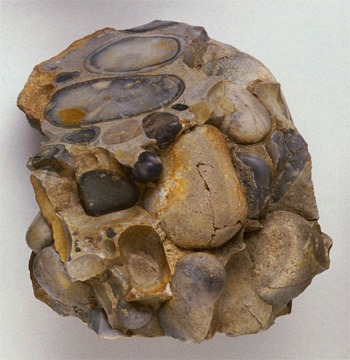
This rock was formed by smaller pieces of rock that settled at the bottom of a lake millions of years ago. What type of rock is this?
a)
Sedimentary
b)
Igneous
c)
Metamorphic
15.
The process by which water, ice, wind or gravity moves weathered rock and soil from one place to another.
a)
weathering
b)
erosion
c)
deposition
d)
dumptruck
16.
How might a weathered mountain appear different than an unweathered mountain?
a)
Weathered mountain would be taller.
b)
Weathered mountain would be rounder and less jagged.
c)
Weathered mountain would be more jagged and less rounded.
d)
Weathered mountain would have no trees.
17.
Water getting into cracks, freezing, and breaking the rocks or pavement apart
a)
Weathering
b)
Erosion
c)
Deposition
18.
As you were climbing a mountain, you noticed that rocks were crumbling below your feet and moving down the mountain. What 2 processes did you observe?
a)
Weathering and erosion
b)
Erosion and deposition
c)
Abrasion and chemical weathering
d)
Abrasion and ice wedging
19.
What natural force formed the Grand Canyon millions of years ago?
a)
a landslide
b)
an earthquake
c)
a river
20.
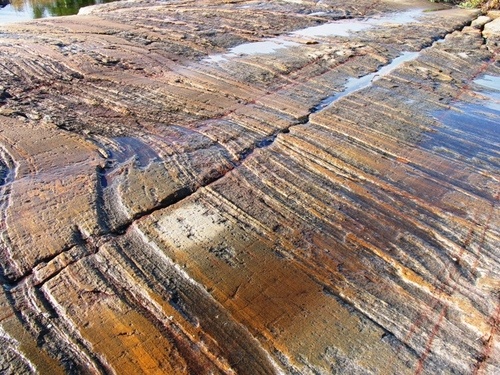
This is a picture of glacier scars found in Africa. What are these evidence for?
a)
Africa has always been near the equator
b)
Africa was once in an area of the Earth that had a very cold climate
c)
The continents have not moved
d)
sea floor spreading
21.
What does the theory of continental drift state?
a)
The continents were once joined in a super-continent and have moved over time
b)
Continents are stationary and do not move
c)
The Earth is broken into lithospheric plates that move due to convection currents
d)
none of the above
22.
Of the following statements, which best supports the continental drift theory?
a)
All oceans are salty
b)
Igneous rocks are found on all continents
c)
Fossils of the same species of extinct land plants have been found in both South America and Africa
d)
Early humans migrated to North America over a land bridge from eastern Asia
23.
What causes the movement of tectonic plates?
a)
Gravitational pull between Earth and the moon
b)
Convection occurring beneath the Earth's crust
c)
Energy produced by earthquakes within the Earth
d)
Rotation of liquid rock found within the core
24.
Which of the following is the best evidence that Earth's continents were once in vastly different positions than they are today?
a)
Penguins only found in southern hemisphere
b)
Fossils of tropical plants found in Antartica
c)
Volcanoes encircling Pacific Ocean
d)
Major rivers from deltas from continental erosion
25.
In Seafloor Spreading, molten material rises from the mantle and erupts or flows out
a)
along the edges of all the continents
b)
along mid-ocean ridges
c)
in the deep ocean trenches
d)
in the north and south poles
26.
What discovery caused scientists to rethink Wegener's continental drift theory?
a)
discovery of earthquake activity in California
b)
discovery of the ring of fire in the Pacific Ocean
c)
discovery of seafloor spreading in the Atlantic Ocean
d)
discovery of deep trenches off the coast of South America
27.
The age of a rock compared to the ages of other rocks.
a)
relative age
b)
half-life
c)
absolute age
d)
radioactive decay
28.
Change over time for organisms.
a)
geologic time scale
b)
evolution
c)
era
d)
period
29.
A record of the geologic events and life forms in Earth's history.
a)
index fossil
b)
half-life
c)
radioactive dating
d)
geologic time scale
30.
The Law of Superposition helps scientists to determine what?
a)
The absolute age of rock layers
b)
The age of fossils
c)
The relative age of rock layers
d)
the super powers of rocks
31.

According to the law of superposition, which layer is the youngest?
a)
A
b)
B
c)
C
32.
This provides information about the history of life on earth and how organisms lived and evolved over time.
a)
fossil data
b)
fossil evidence
c)
fossil record
d)
remains of fossil
33.

Which of the following correctly lists the layers of rock in order from youngest to oldest?
a)
A, B, C, D, E
b)
B, C, D, E, A
c)
E, D, A, B, C
d)
C, B, A, D, E
34.

Which period are we currently in?
a)
Quaternary
b)
Holocene
c)
Jurassic
d)
Tertiary
35.

Which layer is the oldest and youngest?
a)
C and B
b)
C and E
c)
D and E
d)
A and B
36.

Which era is the longest?
a)
Cenozoic
b)
Cambrian
c)
Precambrian
d)
Phanerozoic
37.
Based on the law of superposition, where would the oldest rocks be found.
a)
at the bottom
b)
at the top
c)
second from the bottom
d)
second from the top
38.

Which letter matches with the OLDEST layer of rock?
a)
W
b)
X
c)
Y
d)
Z
39.
Index fossils are used by geologists to
a)
match rocks of the same age in different regions
b)
determine the relative age of rocks in one place
c)
identify organisms that did not leave fossil evidence behind
d)
determine why some organisms became extinct
40.
Which of the following means of transportation uses a renewable resource for its energy source?
a)
solar powered car
b)
coal powered steam train
c)
natural gas car
d)
gasoline truck
41.
A farmer decides that he is going to produce his own energy on the farm by using a type of renewable energy. The renewable energy could come from--
a)
setting up wind turbines
b)
having a coal furnace
c)
using natural gas
d)
burning oil
42.
Which of the following is a way a person could conserve natural resources?
a)
recycling waste materials like plastic, glass, paper, and aluminum
b)
limiting water use when showering, brushing teeth, and shaving
c)
using rechargeable batteries
d)
all of the above are good conservation practices
43.
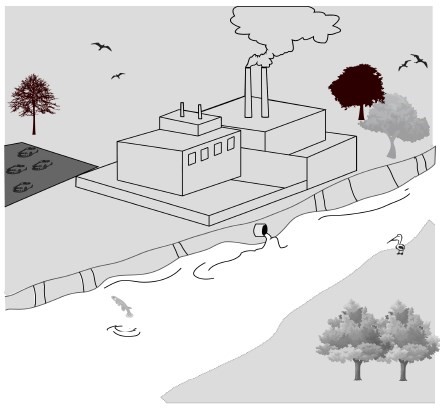
If the factory in this diagram was NOT practicing good environmental conservation, what effect would be produced?
a)
air and water pollution
b)
good fishing for recreation
c)
plentiful animals in the river
d)
purified drinking water
44.
Fossil fuels are nonrenewable because...
a)
they are used to produce heat
b)
they take a long time to form
c)
they can be found underground
45.
What does conserving resources mean?
a)
Use as much of the resources as you can
b)
Only use the resources at school
c)
Protecting the resource so it does not run out
46.
Which group includes ALL renewable resources?
a)
Coal, trees, water, oil
b)
Water, wind, sun, plants
c)
Minerals, sun, natural gas, water
47.
The main human activity that releases greenhouse gases is
a)
using bottled water
b)
burning fossil fuels
c)
texting on cellphones
d)
eating meat
48.
What is the Greenhouse Effect?
a)
The rising of sea level over time
b)
The Earth's atmosphere losing heat
c)
The trapping of the Sun's warmth in the Earth'satmosphere
d)
The way we get energy to our holmes
49.
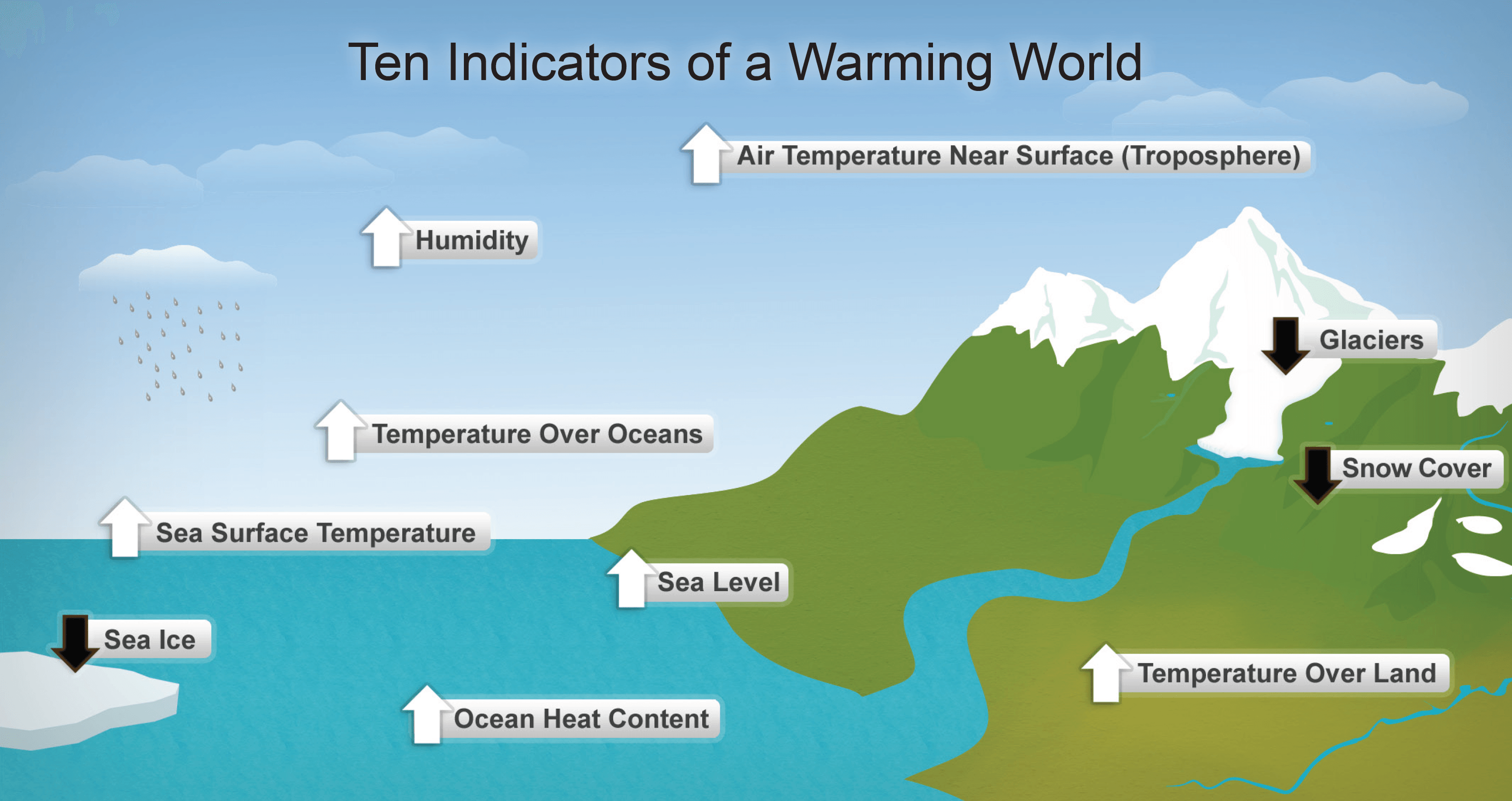
The greenhouse gas having the greatest role in human-caused global warming is
a)
methane
b)
carbon dioxide
c)
CFCs (chlorofluorocarbons)
d)
ozone
50.
Human activity is adding additional greenhouse gases to the amount that are in the atmosphere naturally
a)
True
b)
False
51.
Global average warming is the result of
a)
The Ozone Hole
b)
Natural Earth Climate Cycles
c)
A Human-Caused Increase in Greenhouse Gases
d)
Aliens
52.
Which one of the choices below is NOT a cause for global warming?
a)
Having too many cows
b)
Burning Fossil Fuels
c)
Planting new trees
53.
How can global warming cause sea levels to rise? Choose the best answer.
a)
by causing it to rain more often
b)
by melting glaciers and ice caps
c)
by increasing the number of undersea volcanic eruptions
d)
by creating bigger and more powerful hurricanes
54.

By what amount did carbon dioxide in Earth's atmosphere increase between 1960 and 2000?
a)
40 -50 ppm
b)
60 -70 ppm
c)
110 -120 ppm
d)
360 -370 ppm
55.
Which of the following is NOT an effect of Global Warming?
a)
Polar ice caps will melt.
b)
Coastal regions will be covered with rising sea levels.
c)
Some areas will experience serious droughts
d)
The Earth's rotation will slow down and eventually stop
100 %

