
Font size
S
M
L
XL
 Worksheets
2nd Semester
Total questions: 105
Worksheet time: 2hrs 45mins
Name
Class
Date
1.
Which precedent was established by Marbury v. Madison?
a)
regulate trade among states
b)
judicial review
c)
regulate state bureaus
d)
take away authority for states to challenge a law
2.
The first political parties in the US were established in the 1790s largely because of political differences between:
a)
Adams & Franklin
b)
Hamilton & Paine
c)
Washington & Madison
d)
Jefferson & Hamilton
3.
In his Farewell Address, Washington warned that political parties would:
a)
divide the nation
b)
create a lively debate
c)
help the nation
d)
destroy states's rights
4.
Why was the year 1803 significant to US History?
a)
Washington became 1st president
b)
Washington delivered farewell address
c)
The US doubled in size
d)
England began a war with the US
5.
The US purchased 530,000 acres of territory in North America from
a)
Spain
b)
England
c)
France
d)
Louisiana
6.
All of the following are defining events during the era of the Early Republic EXCEPT:
a)
The War of 1812
b)
The closing of the National Bank
c)
The purchase of the Louisiana Territory
d)
The XYZ Affair
7.
How did Washington's Farewell Address influence American foreign policy?
a)
US formed international organizations
b)
US remained neutral with foreign powers
c)
US gained territory in South America
d)
US sought trading relationships with Asia
8.
This controversial legislation of John Adams' administration restricted citizens from criticizing the government.
a)
The Embargo Act
b)
The Monroe Doctrine
c)
The Alien & Sedition Acts
d)
The Judiciary Act
9.
A group of advisors to the President is called a
a)
cabinet
b)
immigrant
c)
embargo
d)
nullifier
10.
Who was the 2nd president?
a)
Adams
b)
Monroe
c)
Washington
d)
Jefferson
11.
Who was the 3rd President?
a)
Jefferson
b)
Madison
c)
Adams
d)
Hamilton
12.
Who was the 4th president?
a)
Monroe
b)
Madison
c)
Adams
d)
Hamilton
13.
What did John Marshall do?
a)
wrote the Supreme court decision that established judicial review
b)
upheld the doctrine of states' rights
c)
supported the popular election of judges
d)
allowed slavery to extend into the West
14.
According to Alexander Hamilton, which action was necessary to ensure the stability of the nation's economy?
a)
establish a national bank
b)
pass a trade embargo
c)
end consumption taxes
d)
create an alliance with France
15.
After the War of 1812, the supply of British goods decreased. How did that affect the US economy?
a)
US manufacturing increased.
b)
Congress reduces tariffs
c)
agricultural imports increased
d)
exports to Great Britain increased
16.
What ended the War of 1812?
a)
Treaty of Ghent
b)
Proclamation of 1763
c)
Compromise of 1850
d)
Three-Fifths Compromise
17.
What was a cause of the War of 1812?
a)
British impressment of US sailors
b)
slavery
c)
Native Americans marching to Oklahoma
d)
The Boston Tea Party
18.
Who was the president who helped design the deal to acquire the Louisiana Territory?
a)
Washington
b)
Adams
c)
Hamilton
d)
Jefferson
19.
A government's plan to deal with issues with other countries is it's ____________ policy
a)
domestic
b)
foreign
c)
soup
d)
conflictive
20.
A government's plan to deal with internal issues of it's own country is it's ______________ policy.
a)
domestic
b)
foreign
c)
soup
d)
conflictive
21.
This early political party was pro-British, believed in a loose interpretation of the Constitution & was supported by wealthy, Northern businessmen
a)
Federalists
b)
Democratic-Republicans
c)
Libertarians
d)
Henchmen
22.
This early political party was pro-French, believed in a strong interpretation of the Constitution & was supported by farmers & the working class
a)
Federalists
b)
Democratic-Republicans
c)
Libertarians
d)
Henchmen
23.
Which Political party did Andrew Jackson belong to?
a)
Republican
b)
Whig
c)
Democratic
d)
Federalist
24.
Did Andrew Jackson listen to the supreme court decision to give the land to the Native Americans?
a)
Listened
b)
Ignored it
c)
Vetoed the decision
25.
Which of the following did not take place during the time of Andrew Jackson?
a)
The Nullification Crisis
b)
The Trail of Tears
c)
Removal of Native Americans
d)
The Civil War
26.
What was the main state invovled in the Nullification Crisis?
a)
New York
b)
Massachussets
c)
Kentucky
d)
South Carolina
27.
Why did Andrew Jackson dislike the National Bank?
a)
The bank did not allow Jackson to raise tariffs
b)
He feared the bank favored the wealthy
c)
The bank was lead by corrupt leaders
d)
The bank did not allow for gold or silver used as currency
28.
Southern states believed the issue of slavery was what?
a)
A states rights issue
b)
the right of each individual person
c)
a national issue
d)
a global issue
29.
The trail of tears moved the cherokee tribe where?
a)
West of the Mississippi
b)
North of Kentucky
c)
Into Florida
d)
to North Dakota
30.
Suffrage deals with?
a)
cancelling laws
b)
ending slavery
c)
Voting Rights
31.
Nullification is the right of
a)
people to vote
b)
States to cancel a law
c)
the government to control states
32.
Sectionalism is a sense of pride in what?
a)
Country
b)
Planet
c)
Area or region
33.
Nationalism is a a sense of pride in?
a)
Nation
b)
state
c)
area
d)
region
34.
Why did the election of 1828 include many first-time voters?
a)
Southern states gave voting rights to women.
b)
African Americans were voting for the first time.
c)
New states gave voting rights to all white men.
d)
A new federal law required all men and women to vote.
35.
What is Jacksonian Democracy?
a)
the idea that the common people should control their government
b)
the political party that supported Jackson in the election of 1828
c)
the notion that the rich and upper class should have the most power
d)
the nickname Andrew Jackson earned in the War of 1812
36.
How was President Jackson different from other Presidents?
a)
He served more than two terms
b)
He owned slaves
c)
He came from a poor family
d)
He was a military general
37.
The spoils system gave jobs to who?
a)
The most qualified people
b)
Jackson's Friends
c)
Republicans
d)
Native Americans
38.
What was the harsh journey of the Cherokee from their homeland to Indian Territory called?
a)
spoils system
b)
Trail of Tears
c)
Indian Removal Act
d)
Whig Party
39.

What is a tariff a tax on?
a)
Income
b)
Slaves
c)
Imported Goods
d)
Crops
40.
The Nullification Crisis was triggered by strong opposition to the -
a)
Force Bill.
b)
Indian Removal Act.
c)
Tariff of Abominations.
d)
Bank of the United States.
41.
What river did United States believe was the correct border between Texas and Mexico?
a)
•Mississippi River
b)
•Rio Grande
c)
•Nueces River
d)
•Missouri River
42.
What started the massive number of settlers moving to California in 1849?
a)
•the discovery of gold in mountain streams
b)
•the idea of establishing another slave state
c)
•battles fought between Mexicans and Americans
d)
•California's introduction as a state in the Union
43.
Which important territory did the United States gain control of as a result of the Mexican-American War?
a)
Nebraska
b)
Oregon
c)
Arkansas
d)
California
44.
What treaty ended the Mexican-American War?
a)
A. the Treaty of Mortefontaine
b)
A. the Treaty of Guadalupe Hidalgo
c)
A. the Treaty of Madrid
d)
A. the Treaty of Paris
45.

The map below shows territories acquired by the United States.
Which region was acquired as a result of the Mexican Cession in 1848?
Which region was acquired as a result of the Mexican Cession in 1848?
a)
Region 1
b)
Region 2
c)
Region 3
d)
Region 4
46.
What caused the Mexican War?
a)
Polk provoked Mexico into attacking
b)
a fight over gold in Texas
c)
the U.S. broke a treaty with Mexico
d)
Santa Anna attacked the Alamo
47.
Which of these is a belief belief associated with “Manifest Destiny?”
a)
a belief that being wealthy is a natural right
b)
a belief that it was America's mission to spread West to the Pacific
c)
a belief in every person's right to religious freedom
d)
a belief that people of all races should have equal rights
48.

What religious movement led to the reform movements?
a)
The Reformation
b)
The Second Great Awakening
c)
The Renaissance
d)
The First Great Awakening
49.
What movement was started because of alcohol abuse in America?
a)
Women's Rights
b)
Abolition
c)
Temperance
d)
Second Great Awakening
50.
What event was the event held to promote women’s rights in 1848?
a)
The March on Washington
b)
The Sarah Childress Polk Meeting
c)
The Rally in Hyde Park
d)
The Seneca Falls Convention
51.
Which two women led the Women’s Rights Movement?
a)
Angelina and Sarah Grimke
b)
Susan B Anthony and Elizabeth Cady Stanton
c)
Sojourner Truth and Dorothea Dix
d)
Betsy Ross and Sacajawea
52.
Define Reform
a)
to change something in order to improve it
b)
first co-ed college
c)
the time period directly after a major war
d)
the right to vote
53.
Which of the following was associated with women's suffrage?
a)
Charles Finney
b)
Horace Mann
c)
Frederick Douglass
d)
Susan B. Anthony
54.
What is an abolitionist?
a)
Someone who wants to abolish or end slavery.
b)
Someone who wants to end voting for slaves.
c)
Someone who doesn't want to work with slaves.
d)
Someone who wants to never wear jeans.
55.
Frederick Douglass was a former slave who:
a)
Complained about his new life in the North.
b)
Went into hiding in New York.
c)
Created a platform about returning to Africa.
d)
Spoke up about his experiences as a slave while living in the North.
56.

How did "Uncle Tom's Cabin" help the abolitionist movement?
a)
It showed Northerners that slavery was a problem
b)
It created new laws
c)
It taught many slaves how to read
d)
It only hurt the reform movement
57.

What literary work did Harriet Beecher Stowe write that brought attention to the brutal conditions of slavery?
a)
Uncle Tom's Cabin
b)
Gone With the Wind
c)
Up From Slavery
d)
North and South
58.
Why did Elizabeth Cady Stanton oppose the 15th Amendment to the U.S. Constitution?
a)
Public education was not addressed.
b)
Women were still excluded from voting.
c)
Slavery was still allowed in the territories.
d)
Native Americans gained citizenship.
59.
Urbanization means
a)
move to the city
b)
move to the country
c)
kicking people off their land
60.

Who invented the telegraph in 1840?
a)
James Hargreaves
b)
John Deer
c)
Samuel Morse
d)
John Montressor
61.
The Bessemer process, invented by Henry Bessemer, was created to produce...
a)
cotton
b)
peanuts
c)
steel
d)
electricity
62.

This artificial waterway was built to connect New York City with the Great Lakes Region.
a)
Slave States
b)
Mississippi River
c)
Toll Road
d)
Erie Canal
63.

Who Invented the cotton gin and interchangeable parts
a)
Eli Whitney
b)
Robert Fulton
c)
Samuel Slater
d)
William Lowell
64.
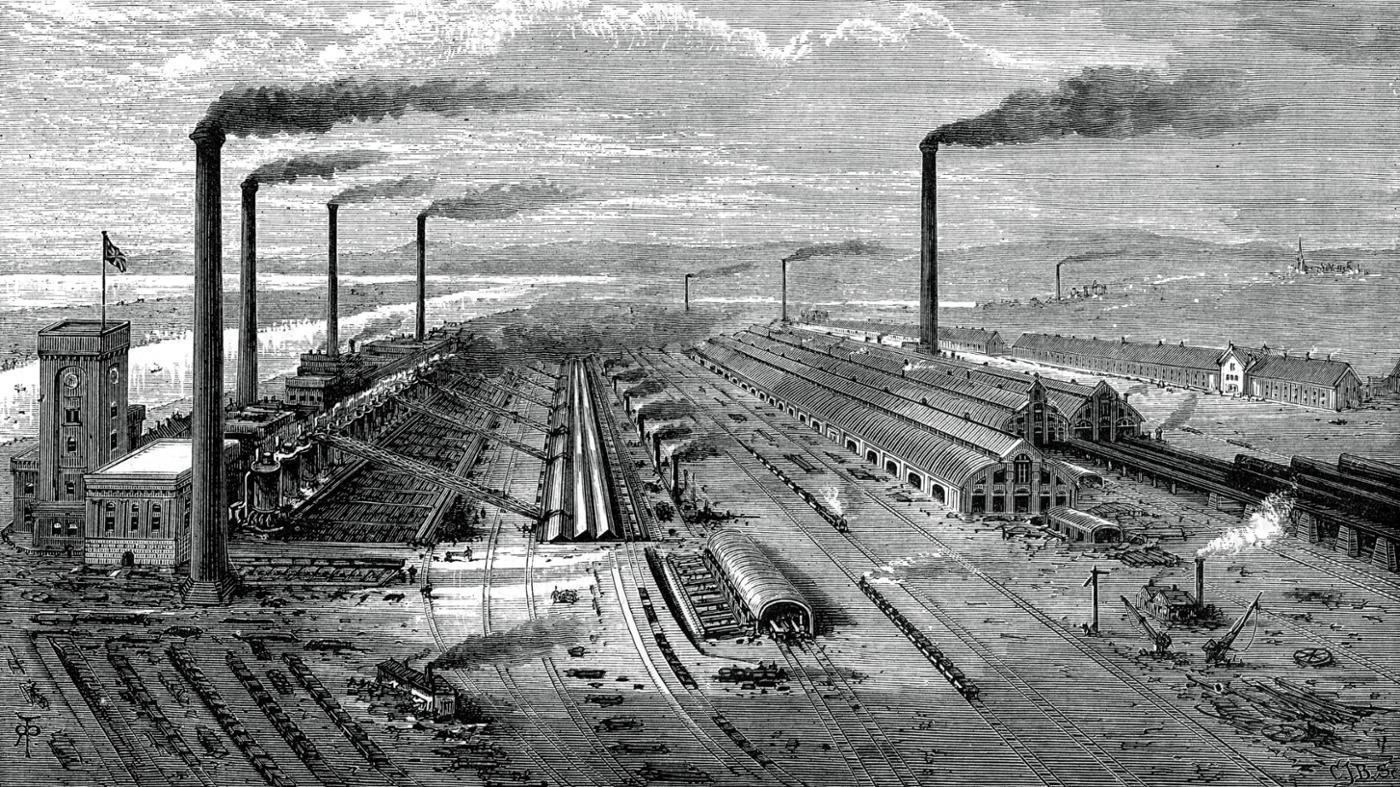
What is the area of the United States where the Industrial Revolution began
a)
South
b)
Midwest
c)
New England
d)
South
65.

The invention of the cotton gin increased the efficiency of cotton production and actually increased the demand for this
a)
Water Power
b)
Coal
c)
Fire
d)
Slaves
66.
Who invented the mechanical reaper?
a)
Eli Whitney
b)
Cyrus McCormick
c)
Samuel Morse
d)
Henry Bessemer
67.
Which region of the United States had the highest population density during the Industrial Revolution?
a)
North
b)
South
c)
West
68.
What is TEXTILE?
a)
Goods made of wool, cotton, or linen
b)
Goods made of steel/iron
c)
Goods made of plants
d)
All exports from the U.S
69.
Which immigrant group worked on the Transcontinental Railroad?
a)
Germans
b)
Irish
c)
Chinese
d)
Mexicans
70.
Which immigrant group came to the U.S. to escape a famine in their home country?
a)
Germans
b)
Irish
c)
Chinese
d)
Mexican
71.
The Compromise of 1850 admitted what state as a free state?
a)
Nevada
b)
Kansas
c)
Missouri
d)
California
72.
What law allowed special government officials to arrest any person accused of being a runaway slave?
a)
Fugitive Slave Act 1850
b)
Emancipation Proclomation
c)
Underground Railroad
d)
Kansas Nebraska Act
73.
This law left it to the white citizens of the territory to decide whether that territory would be a free or slave territory.
a)
Missouri Compromise
b)
Wilmot Proviso
c)
Kansas-Nebraska Act
d)
Emancipation Proclomation
74.

Who is known as the Great Compromiser?
a)
Abraham Lincoln
b)
Stephen Douglas
c)
Dred Scott
d)
Henry Clay
75.
What was the Underground Railroad?
a)
A place where slaves were sold
b)
It was a railroad that was underground and carried slaves to freedom.
c)
A network slaves used to get to freedom.
d)
A smooth form of transportation.
76.
Who was Harriet Tubman?
a)
She led many slaves to freedom using the Underground Railroad.
b)
She started the Underground Railroad.
c)
She died being a slave in 1913.
d)
A woman born free in Delaware.
77.

In the Missouri Compromise, what state was allowed to enter as a free state?
a)
Missouri
b)
Maine
c)
Kentucky
d)
Alabama
78.
What was the result of the Kansas/Nebraska Act?
a)
Southern states seceded.
b)
South Carolina began a nullification campaign.
c)
Violence at voting polls resulted in Bleeding Kansas.
79.
Which compromise stated that slavery would not be allowed north of the 36 30' parallel?
a)
Tariff of 1832
b)
Compromise of 1850
c)
Missouri Compromise
80.
Many southern states believe that the state should be the final authority over slavery. This belief is an example of
a)
abolition
b)
sectionalism
c)
states' rights
d)
popular sovereignty
81.
What was the US Supreme Court's decision when Dred Scott, a slave, attempted to sue for his freedom? The US Supreme Court determined that he
a)
would be granted his freedom
b)
was lying about living in a free state
c)
was property, not a citizen, and had no legal right to sue
82.

Confederates attacked the fort, the Union surrendered. First shots of the war
a)
Bull Run/ Manassas 1
b)
Antietam
c)
Appomattox Courhouse
d)
Ft. Sumter
83.
Who led the Union troops to victory in the Civil War?
a)
Stonewall Jackson
b)
Robert E. Lee
c)
Abraham Lincoln
d)
Ulysses S. Grant
84.

Where did the war end with the surrender of Robert E. Lee?
a)
Yorktown, VA
b)
Fredricksburg
c)
Appomattox Court House
d)
At the corner store over ice cream
85.
What was the official name of the south during the Civil War?
a)
Confederate States of America
b)
Communist States of America
c)
Southern States of America
d)
Lincoln's Land
86.
What was Lincoln's main reason for fighting in the war?
a)
to get rid of slavery
b)
to bring the British and French to America
c)
to show his strength as a president
d)
to preserve the Union
87.
Jefferson Davis was
a)
President of the Union
b)
Vice President of the Confederacy
c)
Union General at Chickamauga
d)
President of the Confederacy
88.
The idea of attacking the Confederacy by squeezing them like a snake from the East and West is known as the...
a)
Snake Plan
b)
Anaconda Plan
c)
Hugging Plan
d)
No idea plan
89.
General Thomas Jackson received which nickname after the Battle of Bull Run?
a)
Stonehenge
b)
Rockwall
c)
Stonewall
d)
Rockhenge
90.
Big cities. Large population in a small area. Manufacturing is usually shown here.
a)
Urban
b)
Rural
91.
Bloodiest battle of the Civil War. Turned the tide of the war in favor of the Union. Northern most battle in the civil war.
a)
Antientam
b)
Gettysburg
c)
Bullrun
d)
Vicksburg
92.
What amendment abolished (ended) slavery?
a)
12th Amendment
b)
13th Amendment
c)
14th Amendment
d)
15th Amendment
93.
Who took the office of President after President Lincoln was assassinated?
a)
Andrew Jackson
b)
Andrew Johnson
c)
Andrew Livingston
d)
Andrew Young
94.
The amendment that prohibits federal and state governments from denying a citizen the right to vote based on his or her race.
a)
12th Amendment
b)
13th Amendment
c)
14th Amendment
d)
15th Amendment
95.
The 14th amendment to the Constitution was the second of the "Reconstruction Amendments." What was the purpose of this amendment?
a)
to give African Americans the right to vote
b)
to give all Americans citizenship regardless of race
c)
to abolish slavery
d)
to officially terminate the government of the Confederate States of America
to officially terminate the government of the Confederate States of America
96.
Which of the following men assassinated President Abraham Lincoln only two weeks after the Civil War ended?
a)
John Wilkes Booth
b)
Ulysses S. Grant
c)
Jim Crow
d)
Robert E. Lee
97.
When racial groups are separated from one another, this is called _____________.
a)
segregation
b)
impeachment
c)
sharecropping
98.
When farmers rented land in exchange for crops, this was known as ___________________.
a)
carpetbagging
b)
segregation
c)
sharecropping
d)
crop sharing
99.
The Freedmen's Bureau was made to
a)
send runaway slaves back to the South
b)
Help former slaves and provided food, clothing, medical care, and legal advice
c)
Give voting rights to African American men
d)
none of these answers are correct
100.
Black Codes are
a)
a coded language African Americans used
b)
laws that told people what they could wear
c)
Laws that restricted African American rights
d)
Curfew laws for African Americans
101.
The period of time immediately after the Civil War where the Confederate States rejoined the Union.
a)
Reconstruction
b)
Industrial Era
c)
Golden Age
d)
Great Depression
102.
A Northerner who moved to the South to take advantage of the poverty is called a...
a)
Carpetlegger
b)
Carpetmatcher
c)
Carpetflyer
d)
Carpetbagger
103.
What name was given to a terrorist group that used violence to keep African-Americans from having equal rights in the South?
a)
Freedman's Bureau
b)
Black Codes
c)
Jim Crow Laws
d)
Ku Klux Klan
104.
This act forced Native American tribes to give up their ancestral land holdings and move to reservation lands elsewhere.
a)
Homestead Act
b)
Morrill Act
c)
Dawes Act
d)
Fort Laramie Treaty, 1868
105.
What gave settlers 160 acres of land in exchange for the settlers "improving" their new land?
a)
Homestead Act
b)
Dawes Act
c)
Morril Act
d)
Reconstruction Act
Reset

