
 Worksheets
Atmosphere and Weather Review
Total questions: 30
Worksheet time: 25mins
Name
Class
Date
1.
Which gas in our atmosphere is most abundant?
a)
Argon
b)
Oxygen
c)
Nitrogen
d)
Carbon Dioxide
2.
The air in the troposphere has a greater density than the air in any other layer of the atmosphere,
a)
True
b)
False
3.
Temperature in the stratosphere warms as altitude increases.
a)
True
b)
False
4.
Temperature decreases as altitude increases in the Thermosphere.
a)
True
b)
False
5.
What is the percentage of oxygen in Earth's atmosphere?
a)
1%
b)
21%
c)
78%
d)
90%
6.
What is the percentage of nitrogen in Earth's atmosphere?
a)
1%
b)
21%
c)
78%
d)
90%
7.
Which layer of the atmosphere contains the greatest amount of water vapor?
a)
Thermosphere
b)
Troposphere
c)
Mesosphere
d)
Stratosphere
8.

Where is the temperature the highest?
a)
1
b)
2
c)
3
d)
4
9.

Where is the air pressure the greatest?
a)
1
b)
2
c)
3
d)
4
10.
Atmospheric pressure _________________ with ________________altitude.
a)
Decreases with increased
b)
Increases with decreased
c)
Decreases with decreased
d)
Increases with increased
11.
The density of our atmosphere _____________ with an increase in altitude.
a)
Increases
b)
Gets greater
c)
Decreases
d)
Gets heavier
12.
The greenhouse effect causes the Earth's air to
a)
heat up
b)
cool down
c)
blow up
d)
turn brown
13.

What part of the water cycle does this picture show?
a)
condensation
b)
precipitation
c)
evaporation
14.
What is the main cause of greenhouse gases?
a)
Pollution (cars, factories, etc)
b)
Humans breathing (carbon dioxide)
c)
Radiation
d)
Plants
15.
What causes the Coriolis effect, which causes winds to curve?
a)
Gravitational pull of the moon
b)
Continental deflections
c)
the rotation of the Earth
d)
density differences
16.

What does this symbol on a weather map indicate?
a)
High pressure system
b)
Low pressure system
c)
Cold front
d)
Warm front
17.

What does this symbol indicate on a weather map?
a)
High pressure system
b)
Low pressure system
c)
Cold front
d)
Warm front
18.
What kind of weather is usually associated with a high pressure system?
a)
Sunny weather
b)
Precipitation (rain, snow, etc.)
19.
Which weather tool measures air pressure?
a)
thermometer
b)
barometer
c)
anemometer
d)
psychrometer
20.
The boundary between two air masses is known as:
a)
front
b)
storm
c)
climate
d)
flood
21.
Which condition usually means cloudy, stormy weather?
a)
high pressure
b)
low pressure
22.

The amount of water vapor present in the air is called ________________.
a)
weather
b)
humidity
c)
air mass
d)
dew point
23.

Identify the type of front that is shown in the image.
a)
Occluded Front
b)
Cold Front
c)
Stationary Front
d)
Warm Front
24.

Identify the type of front that is shown in the image.
a)
Occluded Front
b)
Cold Front
c)
Stationary Front
d)
Warm Front
25.
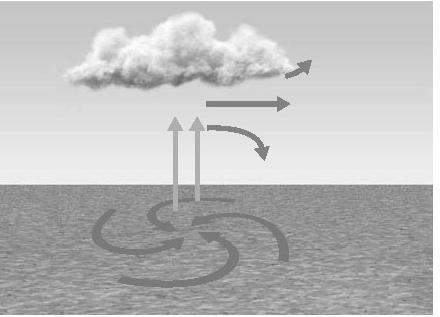
Which type of pressure system is pictured?
a)
high
b)
low
c)
medium
d)
none
26.
The warmer the air the __________ water vapor it can hold.
a)
less
b)
more
27.

Dew Point is the
a)
temperature air cools down to reach condensation (or turn into a liquid)
b)
temperature where ice melts to liquid water
c)
temperature where ice turns directly into water vapor
d)
time of day when dew on the ground disappears
28.
What causes warm air to rise?
a)
the fact that it's less dense than cold air
b)
The fact that it weighs more than cold air
c)
The fact that it has higher pressure than cold
d)
the fact that its more dense than cold air
29.
What causes wind to blow?
a)
Differences in longitude
b)
Shock waves from clouds
c)
Differences in air temperature and pressure
d)
The rotation of the earth
30.
Which term best describes how the earth's atmosphere is heated?
a)
Spirally
b)
Unevenly
c)
Circularly
d)
Kinetically
100 %

