

wayground logo

Free Printable Worksheets

NEW

Font size

S
M
L
XL
Worksheets

Final Exam Review: Part 3

Total questions: 76

Worksheet time: 46mins

Name
Class
Date
1.
Which group of people revolted against the Russian revolutionary provisional government in 1917?
a)
A.  the Bolsheviks 
b)
B. the Czarists 
c)
C. the nobility 
d)
D. the clergy
2.
Which statement describes the ideology of V.I. Lenin during the Bolshevik Revolution?
a)
A.  He preserved the monarchy as a national symbol. 
b)
B. He called for authoritarian rule to implement communism. 
c)
C. He promoted the use of nonviolent protest for social change. 
d)
D. He held parliamentary elections to legitimize the new government.
3.
Which leader was most influenced by Marxist ideology?
a)
A.  Adolf Hitler 
b)
B. David Lloyd George 
c)
C. V.I. Lenin 
d)
D. Woodrow Wilson
4.
Acting as a religious figure, which person gained significant influence over the Russian royal family during the early 20th century?
a)
A.  Alexander Kerensky 
b)
B. Vladimir Lenin 
c)
C. Gregory Rasputin
d)
 D. Leon Trotsky
5.
Which one of the events listed below identifies the campaign of terror that Josef Stalin implemented against other Communist Party leaders during the mid-1930s?
a)
A.  New Economic Policy 
b)
B. Bloody Sunday 
c)
C. collectivization 
d)
 D. the Great Purge
6.
During Josef Stalin’s rule, Russians only had access to select information. This is an example of
a)
A.  suffrage. 
b)
B. democracy. 
c)
C. fascism. 
d)
D. censorship.
7.
A Soviet citizen living under Stalin’s rule had all aspects of life monitored and controlled by a centralized authority.
This is an example of
a)
A.  totalitarianism. 
b)
B. anarchism.
c)
C. theocracy. 
d)
D. democracy.
8.
Which opinion on economic production would Karl Marx most likely express?
a)
A.  A free market best supports the needs of workers. 
b)
B. The role of the government is to regulate the means of production. 
c)
C. Ownership of the means of production should be shared equally by all workers. 
d)
D. Businesses should own the means of production to effectively increase economic output.
9.
Karl Marx’s slogan “. . . WORKERS OF ALL LANDS UNITE!” is associated with which economic theory?
a)
A.  capitalism 
b)
B. communism
c)
C. utopianism 
d)
D. mercantilism
10.
Who were the "oppressed poor" as Marx called them?
a)
Proletariat
b)
Bourgeoisie
c)
Soviets
d)
Slaves
11.
What was the name of the civil government groups that sprouted up to rise against the Romanov Dynasty
a)
Chekas
b)
Soviets
c)
Gulags
d)
Townships
12.
The strong and vibrant leader of the Bolshevik Revolution
a)
V. I. Lenin
b)
Josef Stalin
c)
Leon Trotsky
d)
Alexander Kerensky
13.
Who was the "Mad Monk" that was an aid to Tsarina Alexandria before the Russian Revolution
a)
Rumi
b)
Roma
c)
Rasputin
d)
Romanov
14.
General Secretary of the Communist Party and successor to Lenin in 1924
a)
Leon Trotsky
b)
Tsar Nicholas II
c)
Alexander Kerensky
d)
Josef Stalin
15.
Commander of the Red Army, lost succession of Lenin to Stalin in 1924
a)
Josef Stalin
b)
Leon Trotsky
c)
Alexander Kerensky
d)
Tsar Nicholas II
16.
Who supported the "Red Army"?
a)
Imperialists
b)
Communists
c)
Monarchists
d)
Anarchists
17.
The collection of markets and exchange where the issuing and trading of equities, bonds and other sorts of securities takes place.
a)
Margin
b)
New Deal
c)
Deficit Spending 
d)
Stock Market 
18.
The name given to the programs enforced by FDR to ensure relief, recovery and reform. 
a)
Stock Market 
b)
Great Depression
c)
Margin 
d)
New Deal 
19.

Following World War One, why were many Germans disappointed with the Weimar Republic?

a)

The Weimar Republic abandoned the Gold Standard making most of the German money too valuable.

b)

The newly formed government agreed to the strict payment of war reparations in the Treaty of Versailles.

c)

Fascist and communist republics began a series of rebellions against the Ottoman Empire.

d)

The government was believed to have fixed the free elections so Hitler would not be elected.

20.

How did the cost of war reparations for World War One affect the German economy?

a)

Following the war, soldiers were the only citizens receiving medical benefits from socialist medicine.

b)

The high cost of war reparations forced Germany to allow American engineers to rebuild the nation.

c)

The war reparations forced Germany to spend their entire national reserve on building a newer, more modernized military.

d)

High unemployment and uncontrolled inflation crippled the national economy.

21.

How did the Nazi Party gain political influence in Germany during the 1930s?

a)

The depression and civil unrest caused many middle-class Germans to support the nationalist ideas of the Nazi Party.

b)

The failure of World War One forced many military leaders to support the Weimar Republic by voting for Nazi candidates.

c)

The Nazi Party provided tax incentives to promote modern industry and communist expansion of industry.

d)

The housing market boom and bull market encouraged free enterprise and the election of Nazi legislators.
22.
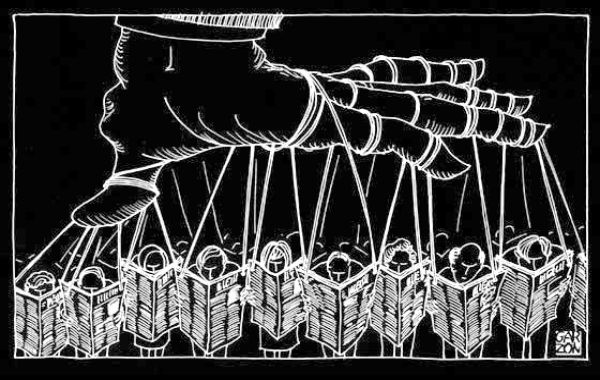
A system of government that exerts complete control over its citizens; individuals have no rights and all opposition to the government is suppressed
a)
Monarchy
b)
Totalitarianism
c)
Democracy
d)
Communism
23.
A political movement that promotes an extreme form of nationalism, a denial of individual rights, and a dictatorial one-party rule
a)
Fascism
b)
Communism
c)
Socialism
d)
Democracy
24.
Which of these did the Fascists NOT promise to do?
a)
Restore national pride
b)
Revive the economy
c)
Punish those responsible for embarrassing them
d)
Keep the peace with other countries
25.
The German brand of Fascism
a)
Communism
b)
Nazism
c)
Totalitarianism
d)
Marxism
26.
What is the swastika?
a)
This was a hooked cross that the Nazi's adopted for their symbol.
b)
This was Hitler's private militia of storm troopers or "thugs".
c)
This was Hitler's nickname which means "the leader".
d)
This was Mussolini's nickname which means "the leader".
27.
What was the Nazi Party?
a)
This was the German brand of Fascism also known as the Nationalist Socialist German Worker's Party and is known for its Anti-Semitism.
b)
A meeting of France, Germany, and Britain that allowed Germany to occupy the Rhineland and Hitler promised to respect Czechoslovakia's new borders.
c)
Local councils consisting workers, peasants, and soldiers, whom had more influence than the provisional government.
d)
information that is designed to influence an audience and give only one point of view
28.
What is propaganda?
a)
information that is designed to influence an audience and give only one point of view
b)
System of forced labor camps/prisons in the Soviet Union
c)
In Marxist theory, the group of workers who would overthrow the czar and come to rule Russia
d)
A militant and nationalistic movement that emphasized loyalty to the state and obedience to its leader.
29.
What is anti-Semitism?
a)
Hatred of Jews and Jewish culture
b)
System of forced labor camps/prisons in the Soviet Union
c)
information that is designed to influence an audience and give only one point of view
d)
A long business slump resulting from the weaknesses of the US economy and stock market collapse.
30.
Who was Adolf Hitler?
a)
This Fascist dictator rejected the Treaty of Versailles, began to rearm Germany. He blamed Jews and communists for World War I.
b)
Benito MussoliniThis Fascist leader of Italy was known for his powerful speeches. 
c)
He was a militaristic Japanese general and Prime Minister of Japan during World War II.
d)
major leader of the Bolsheviks; founded the Communist Party in Russia;
31.

why did hitler single out the jews

a)

because he thought they caused political problems and ruined Germans

b)

they wanted to kill Germans

c)

they thought that they were superior to the Germans

32.
What was the party that Hitler ran?
a)
Slumber Party
b)
Birthday Party
c)
Nazi Party
d)
Dance Party
33.
Who Did Hitler Blame the most for Germany's problems?
a)
Jews
b)
Cathlics
c)
The Allies
d)
Gypsies
34.
Which 3 countries made up the Axis Powers?
a)
American, England, and Russia
b)
Sweden, Germany, and Denmark
c)
Italy, Russia, and Austria
d)
Italy, Germany, and Japan
35.
The Allies consisted of......
a)
Japan, Germany, and America
b)
America, France, and Australia
c)
America, U.S.S.R, and Britain
d)
Germany, China, Japan, and Hawaii
36.
Who ruled as a dictator and leader of the Nazi party and wanted to build a powerful military and make his country a strong nation?
a)
Hitler
b)
Mussolini
c)
Stalin
37.
Why did the United States enter WW2?
a)
Zimmer Telegraph
b)
Unrestricted Warfare
c)
Bombing on Pearl Harbor
38.
What happened to Japanese Americans after Pearl Harbor?
a)
The joined the war effort in large numbers
b)
Nothing, they lived their lives normally
c)
Were sent to internment camps
d)
Japanese Americans strongly suppported Japan during the war
39.
The Holocaust occurred during which war?
a)
World War I
b)
Civil War
c)
World War II
d)
Cold War
40.
Two superpowers that emerged after World War II
a)
Soviet Union and Germany
b)
United States and Germany
c)
Soviet Union and China
d)
United States and Soviet Union 
41.
Two superpowers that emerged after World War II
a)
Soviet Union and Germany
b)
United States and Germany
c)
Soviet Union and China
d)
United States and Soviet Union 
42.
Attacked Pearl Harbor
a)
Germany
b)
Italy
c)
France
d)
Japan
43.
What is a dictator?
a)
A leader of a democracy.
b)
A leader that has complete control of their government.
c)
A form of government that denies freedom.
d)
A parliament.
44.
All of the following were members of the Allied Powers EXCEPT
a)
Germany
b)
United States
c)
France
d)
Soviet Union
45.
Where did the miracle of moving 300,000 soldiers across the English Channel with an improvised armada occur?
a)
Vichy
b)
Dunkirk
c)
Normandy
d)
Ardennes
46.
Who did Hitler sign a 10-year non-aggression pact with?
a)
France
b)
Soviet Union
c)
Britain
d)
Poland
47.
A new form of warfare tactic that involves using fast-moving airplanes followed by tanks and massive infantry forces to take the enemy by surprise. Means “lightning war”.
a)
Lebensraum
b)
Mein Kampf
c)
Blitzkrieg
d)
Anschluss
48.
Which country made a secret deal with Hitler and occupied the eastern half of Poland?
a)
Finland
b)
Italy
c)
Austria
d)
Soviet Union
49.
A system of fortifications along France’s border with Germany. French soldiers stationed themselves along this area during the "Phony War".
a)
Rhineland
b)
Maginot Line
c)
Ardennes Forest
d)
The Long Trench
50.
Britain sends a fleet of 850 civilian ships across the English Channel to save the soldiers at ________?
a)
Calais
b)
Belgium
c)
Paris
d)
Dunkirk
51.
A political movement that promotes an extreme form of nationalism, a denial of individual rights, and a dictatorial one-party rule
a)
Fascism
b)
Communism
52.
The German brand of Fascism
a)
Communism
b)
Nazism
c)
Marxism
d)
Totalitarianism
53.
Giving in to an aggressor to keep peace.
a)
Appeasement
b)
Fascism
c)
Isolationism
d)
Pacification
54.
 What was the League of Nation's (specifically Britain and France) stance towards Hitler's actions leading up to WWII?
a)
Aggressive action
b)
Isolationism
c)
Appeasement
d)
Containment
55.

What day was the attack on Pearl Harbor?

a)

December 14, 1942

b)

December 14, 1941

c)

December 7, 1942

d)

December 7, 1941

56.

Which best describes the Bataan Death March?

a)

Japanese treated American civilians brutally

b)

Japanese treated American POW's brutally

c)

American treated Japanese civilians brutally

d)

Americans treated Japanese POW's brutally

57.

This battle used allied code talkers and turned the tide of the war in the Pacific.

a)

Battle of Midway

b)

Battle of Coral Sea

c)

Battle of Guadalcanal

d)

Battle of Okinawa

e)

Battle of Iwo Jima

58.

This battle marked the beginning of the island hopping campaign and was led by U.S. General Douglas MacArthur.

a)

Battle of Midway

b)

Battle of Coral Sea

c)

Battle of Guadalcanal

d)

Battle of Okinawa

e)

Battle of Iwo Jima

59.

Japanese suicide pilots that would crash-dive their bomb-filled planes into Allied ships.

a)

Okinawas

b)

Samurais

c)

Kamikazes

d)

Kalimazos

60.

Why did President Truman decide to drop the atomic bombs on Japan?

a)

He was a terrible person

b)

He wanted to kill as many Japanese civilians as possible

c)

He believed invading Japan would cost too many Allied lives

d)

He did not care about what other people thought

61.

What was the top secret Atomic Bomb project called?

a)

The Anaheim Project

b)

The New Mexico Project

c)

The Manhattan Project

d)

The Atomic Bomb Project

62.

Which two locations (in the CORRECT ORDER) were the atomic bombs dropped?

a)

Hiroshima, Nagasaki

b)

Nagasaki, Hiroshima

c)

Okinawa, Hiroshima

d)

Hiroshima, Okinawa

63.

Why did America declare war on Japan?

a)

German Unrestricted Submarine Warfare

b)

The Bataan Death March

c)

The Battle of Iwo Jima

d)

Attack on Pearl Harbor

64.
What race did the Nazi's proclaim as the "master race"?
a)
Americans
b)
Japanese
c)
Aryan
d)
Japanese
65.
Which term means prejudice against or hatred of Jews?
a)
Semitism
b)
Anti-semitism
c)
ghetto 
d)
Holocaust
66.
On the evening of November 9, 1938, 250 Jewish synagogues were burned, Jewish businesses destroyed, and many Jewish people killed.  This event was known as _____.
a)
Holocaust
b)
Kristallnacht
c)
Anti-semitism
d)
Ghetto
67.
Which statement about ghettos is not correct?
a)
Many families lived together in one small apartment.
b)
People were always hungry.
c)
The residents of the ghetto were free to come and go as they pleased.
d)
Living conditions were unsanitary.
68.
What is this?
a)
Star of David
b)
Symbol representing helpful people.
c)
Tattoo all Jewish people
were given
d)
good luck charm
69.
Hitler's plan to systematically kill are Jews was called ____ .
a)
Night of Broken Glass
b)
Kristallnacht
c)
The Final Solution
d)
Holocaust
70.
How many Jews were killed during the Holocaust?
a)
6 hundred thousand
b)
6 million
c)
6 hundred million
d)
it is not known how many people were killed.
71.
What was the name of the largest death camp located in Poland?
a)
Auschwitz
b)
Bergen-Belsen
c)
Belzec
d)
Treblinka
72.
Nazis believed Germans were racially superior and Jews were ______ .
a)
prejudiced
b)
unkind
c)
inferior
d)
respected
73.
Which statement about life in a Nazi camp is not correct?
a)
Prisoners were forced to do hard physical labor.
b)
Only men were contained in the Nazi camps.
c)
Meals consisted of watery soup, few vegetables, and stale bread.
d)
Many people slept together on wooden bunks.
74.
The turning point in the war on the Eastern Front was at ______.
a)
Moscow
b)
Stalingrad
c)
Leningrad
d)
St. Petersburg
75.
The D-Day invasion was the Allied invasion of _____.
a)
Normandy, France
b)
Sicily, Italy
c)
Madrid, Spain
d)
Berlin, Germany
76.
Hitler's last attempt to win the war on the Western Front was stopped at _____.
a)
the Battle of Britain
b)
the Battle of Kursk
c)
Operation Torch
d)
the Battle of the Bulge
