wayground logo

Free Printable Worksheets

Font size

S
M
L
XL
Worksheets

2nd Semester Exam Review

Total questions: 114

Worksheet time: 1hrs 14mins

Name
Class
Date
1.
The process of slowly breaking rocks into smaller pieces is called
a)
weathering
b)
erosion
c)
deposition
d)
Breaking
2.
Weathering involves the movement of rocks and minerals by agents such as water, wind and gravity.
a)
True
b)
False
3.
Which of these substances plays the most important part in chemical weathering?
a)
Wind
b)
Water
c)
Ice
d)
Frost
4.
If a hammer were left out in the rain for several days, it would begin to rust. Is this a form of physical or chemical weathering?
a)
Physical
b)
Chemical
5.
Wind blows sand onto rocks and slowly breaks down the rock
a)
Mechanical Weathering
b)
Chemical Weathering
c)
Erosion
d)
Deposition
6.
Acid rain melts the features of a statue
a)
Mechanical Weathering
b)
Chemical Weathering
c)
Erosion
d)
Deposition
7.
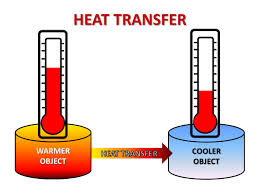
The decayed organic matter in soil is _____.
a)
humus
b)
parent material
c)
silt
d)
loam
8.

Solid rock at the bottom of the soil profile is ______.

a)

organic layer

b)

parent material

c)

subsoil

d)

bedrock

9.
A depression or hole formed when the roof of a cave collapses
a)
Cavern
b)
Cave
c)
Sinkhole
d)
Bedrock
10.
What are the two factors that affect the rate at which weathering occurs?
a)
climate and mass of rock
b)
climate and size of rock
c)
type of rock and size of rock
d)
type of rock and climate
11.
Wind, water, and ice breaking down rock is called
a)
Erosion
b)
Deposition
c)
Compaction
d)
Weathering
12.
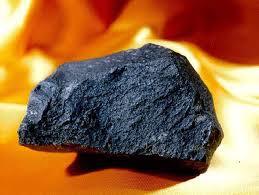
This rock was found near the mouth of a volcano. What type of rock is this?
a)
Sedimentary
b)
Igneous
c)
Metamorphic
13.
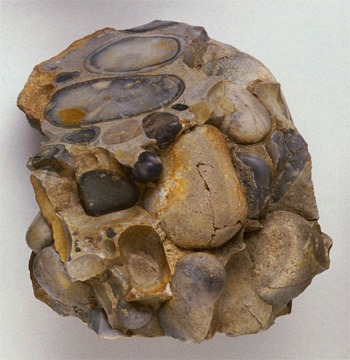
This rock was formed by smaller pieces of rock that settled at the bottom of a lake millions of years ago. What type of rock is this?
a)
Sedimentary
b)
Igneous
c)
Metamorphic
14.
This rock started as lava that cooled and then was heated and put under pressure over time. What type of rock is this?
a)
Sedimentar
b)
Igneous
c)
Metamorphic
15.
Each rock type can follow only one pathway of the rock cycle.
a)
True
b)
False
16.

Fossils are often found in ____________ rocks.

a)

metamorphic

b)

magma

c)

igneous

d)

sedimentary

17.
Which gas in our atmosphere is most abundant?
a)
Argon
b)
Oxygen
c)
Nitrogen
d)
Carbon Dioxide
18.
In which layer of the atmosphere does weather occur?
a)
Mesosphere
b)
Thermosphere
c)
Stratosphere
d)
Troposphere
19.
What is the outer most main layer of Earth's atmosphere?
a)
Thermosphere
b)
Troposphere
c)
Stratosphere
d)
Mesosphere
20.
The layers of the atmosphere are classified according to changes in _________.
a)
altitude
b)
density
c)
composition
d)
temperature
21.
Which of the following is NOT a reason why the atmosphere is important?
a)
It is made of many layers.
b)
It provides gases living things need.
c)
It provides warm temperatures.
d)
It protects us from UV rays and meteors.
22.
Which of the following is the correct order of the atmosphere layers from Earth to space?
a)
troposphere, stratosphere, mesosphere, thermosphere, exosphere
b)
troposphere, mesosphere, thermosphere, exosphere, stratosphere
c)
thermosphere, stratosphere, mesosphere, troposphere, exosphere
d)
troposphere, stratosphere, mesosphere, exosphere, thermosphere
23.
Which layer protects the earth from meteors?
a)
Troposphere
b)
Stratosphere
c)
Mesosphere
d)
Thermosphere
24.
Describe how the ozone layer protects the earth.
a)
Absorbs solar radiation, Protects Earth from UV Rays,  and emits heat
b)
Ozone in the lower atmosphere is a pollutant
25.
Which layer of the atmosphere do most satellites orbit the Earth?
a)
Stratosphere
b)
Mesosphere
c)
Exosphere
d)
Ionosphere
26.
Which layer of the atmosphere contains the ozone layer? 
a)
Mesosphere
b)
Stratosphere
c)
Ionosphere
d)
Exosphere
27.
The space shuttle orbits in this layer.
a)
Troposphere
b)
Stratosphere
c)
Mesosphere
d)
Thermosphere
28.
What is the weather conditions in an area over a long period of time?
a)
climate
b)
temperature
c)
elevation
d)
precipitation
29.
Changes from minute-to-minute, hour-to-hour, day-to-day
a)
Climate
b)
Weather
30.
A tornado warning was issued for Kansas City this morning.
a)
Climate
b)
Weather
31.
Texas has long, hot summers.
a)
Climate
b)
Weather
32.
Meteorologists forecast this.
a)
Climate
b)
Weather
33.
It snowed for three days last week.
a)
Climate
b)
Weather
34.
What is climate?
a)
 What's going on with the atmosphere at any particular time
b)
The type of weather that occurs during a particular season
c)
An area's pattern of weather over a long period of time
d)
How much sunshine an area gets 
35.
A front is
a)
where warm air is cooling at earth's surface
b)
a line where hot and cold air are separating
c)
a line where two different air masses meet
d)
where cold air is rising and forming rain clouds
36.
What symbol is this?
a)
warm front
b)
cold front
c)
stationary front
d)
occluded front
37.
What does this symbol indicate on a weather map? 
a)
High pressure system
b)
Low pressure system
c)
Cold front
d)
Warm front
38.
Which weather tool measures temperature?
a)
thermometer
b)
barometer
c)
psychrometer
d)
anememeter
39.
This weather tool measures wind speed and direction
a)
thermometer
b)
barometer
c)
anemometer
d)
psychrometer
40.
The amount of moisture (water vapor) in the air
a)
Barometer
b)
Humidity
c)
Rain gauge
d)
Evaporation
41.
_____________ has the same temperature and moisture content throughout. 
a)
convection current
b)
front
c)
air mass
42.
Which statement best describes the difference between weather and climate?
a)
Weather is the conditions when you look outside while climate is the conditions you can expect for the next 6 months.
b)
Climate is the current condition outside while weather is what you can expect for the next 6 months.
43.
Rain, sleet, hail, and freezing rain are all...
a)
precipitation
b)
condensation
c)
evaporation
d)
perspiration
44.
Which of the following will heat the fastest? 
a)
water
b)
land
c)
both heat at equal rates
45.
____________ air sinks/falls because it is ____________dense.
a)
Cold, More
b)
Warm, Less
c)
Cold, Less
d)
Warm, More
46.
____________ air rises because it is ____________dense.
a)
Cool, Less
b)
Warm, Less
c)
Cold, More
d)
Warm, More
47.
The place where two air masses meet.
a)
air mass
b)
air pressure
c)
water cycle
d)
front
48.
An instrument used to measure the amount of rainfall
a)
barometer
b)
thermometer
c)
rain guage
d)
wind sock
49.
The conditions of the atmosphere at a certain time and place. 
a)
weather
b)
climate
c)
precipitation
d)
atmosphere
50.
An instrument that measures air pressure
a)
thermometer
b)
barometer
c)
rain guage
d)
wind sock
51.

What is the definition of "Greenhouse Effect?"

a)

Gases that increase Earth's temperature

b)

when the gases in Earth’s atmosphere trap heat from the Sun and keep the planet warm

c)

the pattern of weather that occurs over time

d)

When our climate changes

52.

When did climate change (CO2 in the atmosphere) increase significantly?

a)

Industrial Revolution

b)

Crusades

c)

French & Indian War

d)

French Revolution

53.

What is the definition of climate?

a)

The condition of the air around the Earth

b)

The rainforest

c)

The pattern of weather over time

d)

How hot it is in a certain place

54.

What are some possible solutions to climate change

a)

Use less energy

b)

Choose renewable energy sources

c)

Plant trees and other plants

d)

Recycle and reuse items

55.

What are some potential consequences of climate change?

a)

The sea levels will rise putting seaside towns and cities at risk of drowning

b)

The sea levels will drop putting seaside towns and cities at risk of drowning

c)

More extreme weather

d)

Animals will be able to adapt to the changes

56.
The two largest fuel sources are?
a)
wood and coal
b)
wood and natural gas
c)
oil and nuclear power
d)
coal and oil
57.
Scientists predict that the hurricanes coming off the warming waters of the Gulf of Mexico will be less severe and less frequent.
a)
True
b)
False
58.
What does this symbol on a weather map indicate? 
a)
High pressure system
b)
Low pressure system
c)
Cold front
d)
Warm front
59.
What does this symbol on a weather map indicate? 
a)
High pressure system
b)
Low pressure system
c)
Cold Front
d)
Warm Front
60.
Identify the type of front that is shown in the image.
a)
Occluded Front
b)
Cold Front
c)
Stationary Front
d)
Warm Front
61.
Identify the type of front that is shown in the image.
a)
Occluded Front
b)
Cold Front
c)
Stationary Front
d)
Warm Front
62.
Identify the type of front that is shown in the image.
a)
Occluded Front 
b)
Cold Front
c)
Stationary Front
d)
Warm Front
63.
Identify the type of front that is shown in the image.
a)
Occluded Front
b)
Cold Front
c)
Stationary Front
d)
Warm Front
64.
What is the definition of CONDUCTION?
a)
When heat is transferred from objects like rays of light or electromagnetically.
b)
a  hot liquid or air that  expands, becomes less dense, and rises or becomes more dense, and sinks.
c)
When heat transfers from objects that are touching.
d)
When heat transfers through the heater or AC in your house.
65.
What is the definition of CONVECTION
a)
When heat transfers through waves.
b)
When heat transfers from objects that are touching.
c)
a  hot liquid or air that  expands, becomes less dense, and rises or becomes more dense, and sinks.
d)
Heat traveling from the sun
66.
What kind of heat transfer happens when the sun is heating your body?
a)
Conduction
b)
Radiation
c)
Convection
d)
Density
67.
Heat transfers from an area of ____temperature to an area of ___ temperature.
a)
high to low
b)
low to high
c)
high to high
d)
It can travel high to low and low to high. 
68.
Heat from warm sand at the beach moves through the atmosphere by what method of heat transfer?
a)
Convection
b)
Conduction
c)
Radiation
d)
insulation.
69.
What percent of Earth's water is fresh?
a)
99%
b)
1%
c)
3%
d)
75%
70.
Where is most of Earth's fresh water?
a)
lakes
b)
rivers
c)
ocean
d)
ice caps and glaciers
71.
What powers the water cycle?
a)
water
b)
ocean currents
c)
ground water
d)
sun
72.
Specific sources of pollution that can be identified are called
a)
point sources
b)
nonpoint sources
c)
runoff
d)
sewage
73.
What causes deep ocean currents?
a)
Changes in the wind
b)
Changes in temperature and salinity
c)
Decrease in density
74.
What is an ocean tide? 
a)
Larger waves that crash on the shore line
b)
When the water pulls sand back into the ocean
c)
Periodic rise and fall of ocean waters due to gravitational pull
75.
How is the salt in the ocean water measured in? 
a)
Salty
b)
Salts
c)
Salt
d)
Salinity
76.
What effects salinity? 
a)
Evaporation rates
b)
runoff
c)
Both evaporation rates and runoff
77.
What is a neutral pH level?
a)
5
b)
6
c)
7
d)
8
78.
Why is filtration an important part of water treatment?
a)
Filtration guarantees a clear coloring in water.
b)
Filtration removes small particles from the water.
c)
Filtration adds chlorine to water to kill microorganisms.
d)
Filtration adds vitamins and minerals to drinking water.
79.
This process kills germs and bacteria and makes water safe to drink
a)
Sedimentation
b)
Chlorination
c)
Carbonation
d)
Filtration
80.
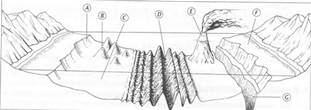
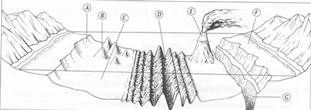
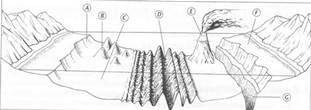
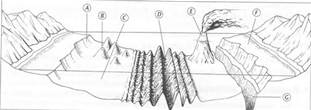
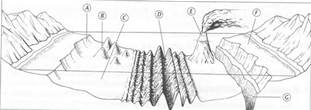
What is letter D?
a)
Cont. Shelf
b)
Mid-Ocean Ridge
c)
Volcanic Island
d)
Seamount
81.
What is letter C?
a)
Mid-Ocean Ridge
b)
Cont. Shelf
c)
Cont. Slope
d)
Abyssal Plain
82.
What is letter E?
a)
Volcanic Island
b)
Seamount
c)
Mid-Ocean Ridge
d)
Abyssal Plain
83.
What is letter G?
a)
Mid-Ocean Ridge
b)
Rift
c)
Trench
d)
Cont. Shelf
84.
What is letter A?
a)
Cont. Shelf
b)
Cont. Slope
c)
Seamount
d)
Abyssal Plain
85.
What letter is B?
a)
Cont. Shelf
b)
Cont. Slope
c)
Mid-Ocean Ridge
d)
Seamount
86.
The gradually sloping part of a continent that extends under the ocean is the...
a)
continental slope
b)
continental shelf
c)
abyssal plain
d)
trench
87.
What is the difference between a volcanic island & a seamount?
a)
A volcanic island rises above the water & a seamount does not
b)
A seamount rises above the water & a volcanic island does not
c)
Both the seamount & volcanic island are underwater
d)
Both the seamount & the volcanic island rise above the water
88.
Which best represents the order of seafloor features as you move from the shoreline to the deep ocean?
a)
 Continental slope – continental shelf- continental rise – mid-ocean ridge
b)
 Continental rise – continental shelf – mid-ocean ridge -  continental slope
c)
 Continental shelf – continental slope – continental rise – mid-ocean ridge
d)
   Mid-ocean ridge – continental rise – continental shelf- continental slope
89.
How do the conditions for a tornado differ from the conditions for a hurricane?
a)
Tornadoes never form when there is rain, while hurricanes always form with rain.
b)
Tornadoes form under low pressure, while hurricanes form under high pressure
c)
Tornadoes form in a stable atmosphere, while hurricanes form in an unstable atmosphere 
d)
Tornadoes form over land, while hurricanes form over bodies of water
90.
What are thunderstorms?
a)
a storm with thunder and lighting and typically also heavy rain or hail
b)
a storm that can be the same as thunderstorms, but even more dangerous
c)
a mobile, destructive vortex of violently rotating winds having the appearance of a funnel shaped cloud and advancing beneath a large storm system.
d)
a huge storm with strong winds and storm surges
91.
What are tornadoes?
a)
a storm with thunder and lighting and typically also heavy rain or hail
b)
a storm that can be the same as thunderstorms, but can be even more dangerous
c)
a mobile, destructive vortex of violently rotating winds having the appearance of a funnel shaped cloud and beneath a large storm system.
d)
a huge storm with strong winds and storm surges
92.
A severe storm that involves high winds and forms over water is:
a)
tornado
b)
thunderstorm
c)
hurricane
d)
blizzard
93.
These can be produced by thunderstorms
a)
stationary fronts
b)
tornadoes
c)
volcanoes
d)
tsunamis
94.
What do hurricanes feed on?
a)
warm tropical water
b)
hot water
c)
cold artic water
d)
rain
95.
Where is Tornado Alley located?
a)
Near the equator of the Earth
b)
Near the North Pole
c)
South Central Los Angeles
d)
Middle states of United States
96.
What happens if a hurricane moves over land or cold ocean water?
a)
it will get stronger
b)
it will get weaker
c)
it will upgrade its category
d)
it will morph into a typhoon
97.
During a _________ you should lay low in a ditch if you can't seek shelter inside.
a)
tornado
b)
hurricane
c)
thunderstorm
98.
During _____________ stay inside if possible, stay out of the water, and do not stand under trees.
a)
rain Storm
b)
hurricane
c)
tornado
d)
thunderstorm
99.
What is Magma when it reaches the surface of Earth?
a)
Lava
b)
Mafic Magma
c)
Felsic Magma
d)
None of these
100.

A volcano that has gentle sloping sides and is formed from low viscosity lava

a)

Shield volcano

b)

Cinder cone

c)

Composite

d)

None of these

101.

When an explosive eruption forms a mixture of hot rock, ash, and gas, this material is also called a...?

a)

Land slide

b)

Lava

c)

Eruption trail

d)

Pyroclastic flow

102.
A volcano that is made from layers of both runny lava and lava chunks is called 
a)
a shield volcano
b)
a cinder cone volcano
c)
a composite volcano
103.
Why does magma tend to rise to the surface?
a)
It has large amounts of silica.
b)
It contains very little silica.
c)
It is denser than the surrounding material.
d)
It is less dense than the surrounding material.
104.
What is the resistance of a liquid, such as lava, to flow?
a)
Elasticity
b)
Pyroclasticity
c)
Silica
d)
Viscosity
105.
What type of volcano is made of lava fragments that have been ejected from a volcanic vent?
a)
Caldera
b)
Cinder Cone
c)
Composite Volcano
d)
Shield Volcano
106.
All of the following are ways in which scientists try to predict tsunamis EXCEPT:
a)
Satellites that gather seismic data
b)
Sensors that detect sea level change
c)
sensors that record change in water pressure
d)
Sensor that detect change in air pressure
107.
Most tsunamis occur here.
a)
Atlantic Ocean
b)
Indian Ocean
c)
Arctic Ocean
d)
Pacific Ocean
108.
What are some ways that people can protect themselves from tsunamis?
a)
build protective walls
b)
use tsunami warning devices (buoys and signals)
c)
live / retreat to higher elevations
d)
all of these
109.
The most devastating tsunami that killed the most people occurred in...
a)
2004- Indian Ocean
b)
2011 - Japan
c)
1960 - Chile
d)
79 - Pompeii
110.
What percentage of our energy use comes from fossil fuels?
a)
25%
b)
45%
c)
61%
d)
86%
111.
Which of the following determines whether a resource is a renewable or nonrenewable resource?
a)
The cost for obtaining and using the resource.
b)
The effect of the resource on the environment
c)
whether the resource is used to generate energy or is made into products
d)
the rate at which the resource can be replaced
112.
Which of the following statements about all fossil fuels is true?
a)
Fossil fuels are liquids.
b)
Fossil fuels are found only on land.
c)
Fossil fuels are renewable.
d)
Fossil fuels form from the remains of ancient organisms such as plants and animals.
113.
Why are fossil fuels considered nonrenewable resources if they are still forming beneath the surface today?
a)
They are being formed as a type of methane which we cannot use.
b)
We are depleting the fossil fuels much faster than they can form.
c)
They are being formed too far beneath the surface of the ocean 
d)
The fossil fuels are being broken down by a natural process faster than they can form.
114.
What causes smog?
a)
The burning of particulates
b)
The formation of ozone
c)
Acid Rain
d)
the interaction of sunlight with pollutants produced by fossil fuels