wayground logo

Free Printable Worksheets

NEW

Font size

S
M
L
XL
Worksheets

7th Grade Final Exam Review

Total questions: 35

Worksheet time: 1hrs 8mins

Name
Class
Date
1.
________________ is done whenever a force moves an object a distance
a)
load
b)
friction
c)
force
d)
work
2.
Work done = Force x _________
a)
distance
b)
acceleration
c)
velocity
d)
speed
3.
These boys are pulling with the same amount of force so they don't move.  
a)
The boy in blue is doing more work.
b)
The boy in red is doing more work.
c)
  No work is done by either boy
d)
  Impossible to tell because I need to know the mass of each boy 30 Secs
4.
Which of the following is the best example of work being done. 
a)
doing homework
b)
lifting a box
c)
pushing a stationary box
d)
holding a box
5.
The energy of motion describes - 
a)
Kinetic Energy
b)
Potential Energy 
6.
Which of the following examples best demonstrates kinetic energy?
a)
A brick lying on the ground
b)
A kite flying across the sky 
c)
A television sitting on a table
d)
A curtain handing in the window
7.
What is the best example of an object with only potential energy?
a)
A boat moving through the water
b)
A boulder resting on top of a cliff
c)
A ball being thrown across a field
d)
Water being poured out of a pitcher
8.

Three situations in which force is applied to a box are illustrated. What conclusion can you draw?

a)

More work is done in Situation 2 than in Situation 1. The most work is done in Situation 3.

b)

More work is done in Situation 3 than in Situation 1. No work is done in Situation 2.

c)

No work is done in Situation 2. More work is done in Situation 3 than in Situation 1.

d)

No work is done in Situation 2. The same amount of work is done in Situations 1 and 3.

9.

The table provides data on the force applied to three objects and the distance over which this force was applied. What correctly ranks the objects from least to most work done on each object?

a)

Object Y, Object Z, Object

b)

Object Z, Object X, Object Y

c)

Object X, Object Y, Object Z

d)

Object Y, Object X, Object Z

10.
At which point is potential energy greatest?
a)
W
b)
X
c)
Y
d)
Z
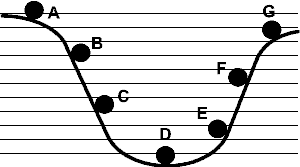
11.
Which point has the most potential energy?
a)
G
b)
f
c)
b
d)
a
12.
Burning fuel, food, and batteries are examples of __ energy.
a)
electrical
b)
thermal
c)
mechanical
d)
chemical
13.
Torn paper, sliced bread, and melting ice are examples of a __ change.
a)
chemical
b)
physical
c)
atomic
14.
What is a watershed?
a)
Water in an area
b)
Water that flows into a river or stream
c)
Land that water flows over and through
d)
Water that is salty
15.
Which of the following energy transformations occur when a lamp that is plugged into a wall socket is functioning correctly?
a)
Chemical to light
b)
Electrical to chemical
c)
Electrical to light
d)
Chemical to electrical
16.

Which of the following best describes the energy transformations that occur when a flashlight that runs on batteries is turned on?

a)

chemical to mechanical to electrical to radiant

b)

radiant to electrical to sound

c)

chemical to radiant to mechanical to electrical

d)

electric to radiant to chemical

17.
Which of the following shows an energy transformation from chemical energy to electrical to light energy?
a)
A bolt of lightning lights the night sky.
b)
A candle glows brightly in the dark.
c)
A fire in a fireplace lights up a room.
d)
A battery causes a flashlight to shine.
18.

A student’s model of an area near a city depicts many activities that affect the quality of the water in the area.


How does the agricultural activity most likely affect the surface water of the area?

a)

Excess crop fertilizer is carried by runoff into the river, causing excess growth of water plants.

b)

Excess crop material accumulates on the riverbanks, slowing the movement of the river water.

c)

Crops reduce erosion, increasing the amount of soil entering the river.

d)

Crops absorb pure water from soil, causing the remaining water to contain more salt.

19.
How are canyons formed?
a)
Wind blows sand into high piles, which form the canyon walls.
b)
Rivers erode soil and rock over time, leaving behind canyon walls.
c)
Gravity causes rocks to fall from mountain sides onto valley floors.
d)
Ice freezes and thaws in cracks of rocks, and the cracks become canyons.
20.
The formation of stalactites and stalagmites in a cave as water mixed with carbon dioxide creates carbonic acid, which dissolves away the limestone, is an example of:
a)
mechanical weathering
b)
chemical weathering
21.
The process that breaks down rocks and other materials on Earth's surface is called
a)
weathering
b)
erosion
c)
soil conservation
d)
decomposition
22.

The removal of sediment from one location to another

a)

weathering

b)

erosion

c)

deposition

d)

oxidation

23.

The process of laying down or settling of sediment

a)

weathering

b)

erosion

c)

deposition

d)

oxidation

24.
The use of pesticides and fertilizers must be carefully monitored 
because of the effect they can have on the environment. 
Which of the following is a possible negative effect of the use 
of these chemicals on the environment?
a)
Runoff carries these chemicals into lakes and streams.
b)
Theses chemicals cannot be purchased in large bulk.
c)

These chemicals are expensive to produce.
d)
Storage space for these chemicals is limited.
25.
What is a watershed?
a)
Land that collects and channels water froma small body of water to a larger body of water
b)
the shape of the land determined by elevation
c)
A natural stream of water of considerable  volume
d)
a river and all its tributaries
26.

How do astronauts counteract the effects of microgravity on their bones while they are in space?

a)

monitor sensors outside the space station

b)

consume twice as many calories as normal

c)

use exercise equipment on the space station

d)

breathe at a faster rate than normal

27.
Which of the following parts of a spacesuit is essential for the survival of astronauts taking short space walks of less than thirty minutes? 
a)
Tool belt 
b)
Oxygen supply
c)
Freeze-dried food
d)
Magnetic boots 
28.
What is an example of a pioneer species in primary succession?
a)
lichens
b)
mosses
c)
grasses
d)
both a and b
29.

Use the desert food web above to answer the following question:

How is this ecosystem MOST likely to be affected by a sudden decrease in the number of rats?

a)

The snake population will increase.

b)

There will be a decrease in the number of snakes, coyotes, and

hawks.

c)

There will be an increase in the number of coyotes and hawks.

d)

There will be a decrease in the number of cacti and sagebrush

plants.

30.

Based on the table, which of the following is most likely true?

a)

Ecosystem Q will sustain itself longer than Ecosystem T, because Ecosystem Q has the least amount of organisms to support.

b)

Ecosystem R will sustain itself longer than Ecosystem T, because Ecosystem R has a more even distribution of organisms.

c)

Ecosystem S will sustain itself longer than Ecosystem R, because Ecosystem S has more organisms in total.

d)

Ecosystem T will sustain itself longer than Ecosystem Q, because Ecosystem T has a more dominant species in its environment

31.

The food webs model relationships among the organisms in two ecosystems.

Which ecosystem would be more likely to survive if a disease killed the grasses?

a)

The forest ecosystem, because most of the animals can eat other organisms.

b)

The grassland ecosystem, because several predators compete for food.

c)

The forest ecosystem, because it has three top predators.

d)

The grassland ecosystem, because it has many herbivores.

32.
The higher the biodiversity, the more sustainable an ecosystem is.
a)
True
b)
False
33.
What is the goal of the pioneer species in Primary Succession?
a)
To kill the dead materials after a disaster
b)
To rebuild soil
c)
To feed Johnny
d)
To put fresh oxygen into the air
34.
The series of changes that occurs in an area where the ecosystem has been disturbed, but where soil and organisms still exist
a)
Primary succession
b)
Secondary succesion
c)
Tertiary succession
d)
Climax community
35.
Which type of succession occurs more rapidly?
a)
Primary succession
b)
Secondary succession