wayground logo

Free Printable Worksheets

Font size

S
M
L
XL
Worksheets

Physical Science Final Exam Review Part 2

Total questions: 83

Worksheet time: 1hrs 3mins

Name
Class
Date
1.
The highest point on a wave is:
a)
the crest
b)
the trough
c)
the top
d)
the coast 
2.
The lowest point on a wave is the:
a)
Amplitude
b)
Crest
c)
Trough
d)
Wavelength
3.

Which is true?

a)

A plane wave is a wave front that is a straight line and is perpendicular to the direction of the wave movement. A circular wave radiates outward from the center.

b)

A plane wave radiates outward from the center. A circular wave is a wave front that is a straight line and is perpendicular to the direction of the wave movement.
4.

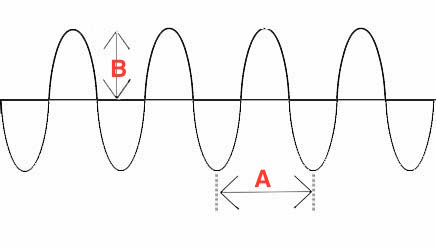
What property of this wave is represented by the letter "A"

a)

amplitude

b)

crest

c)

trough

d)

wavelength

5.
Which harmonic is shown?
a)
1st
b)
2nd
c)
3rd
d)
4th
6.

What kind of wave is pictured below?

a)

longitudinal wave

b)

transverse wave

c)

sound wave

d)

mechanical wave

7.
What kind of wave moves at right angles to the direction of the wave?
a)
compressional waves
b)
mechanical waves
c)
transverse waves
d)
ultraviolet rays
8.
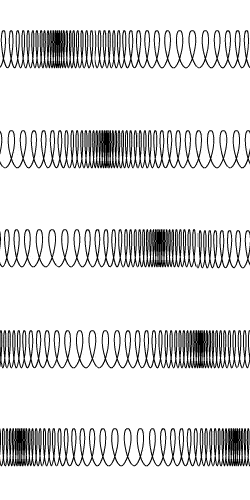
A stretched spring attached to two fixed points is compressed on one end and released, as shown in the picture. The resulting wave travels back and forth between the two fixed ends of the spring until it comes to a stop.  This mechanical wave is an example of a
a)
longitudinal wave
b)
transverse wave
c)
superpositioned wave
d)
refracted wave
9.
What kind of wave is this?
a)
Transverse
b)
Longitudinal
10.
One end of the rope is vibrated to produce a wave with a wavelength of .25 m.  The Frequency of the wave is 3.0 Hz.  What is the speed of the wave?
a)
3.00 m/s
b)
2.50 m/s
c)
.75 m/s
d)
1.25 m/s
11.
 A wave has frequency of 50 Hz and a wavelength of 10 m. What is the speed of the wave?
a)
500 m/s
b)
50 m/s
c)
5 m/s
d)
0.5 m/s
12.
The units for frequency are measured in _____________.
a)
hertz
b)
seconds
c)
m/s
d)
m
13.

The units for speed or velocity are measured in _____________.

a)

hertz

b)

seconds

c)

m/s

d)

m

14.

The units for wavelength are measured in _____________.

a)

hertz

b)

seconds

c)

m/s

d)

m

15.

When a wave strikes an object and bounces off. (example echo)

a)

medium

b)

refraction

c)

reflection

d)

interference

16.
When a wave bends as it passes through at an angle from one medium to another.(example: pencil in a glass of water-)
a)
medium
b)
refraction
c)
reflection
d)
interference
17.

The diagram shows a series of wave fronts approaching an opening in a barrier. Point P is located on the opposite side of the barrier. The wave fronts reach point P as a result of

a)

resonance

b)

refraction

c)

reflection

d)

diffraction

18.

When a wave gets absorbed into a surface and disappears

a)

diffraction

b)

absorption

c)

reflection

d)

refraction

19.
True or False: Every object has at least one natural frequency.
a)
True
b)
False
20.
What occurs when vibrations traveling through an object match the object's natural frequency?
a)
reflection
b)
diffraction
c)
resonance
d)
refraction
21.
The stationary dot is called:
a)
a node.
b)
an anti-node.
c)
the amplitude.
d)
the not moving bit.
22.
The moving black dot is called:
a)
a node
b)
an anti-node
c)
an anti-amplitude
d)
the wangy bit
23.
A wave in which the vibration is in the same direction as that in which the wave is traveling; sound waves
a)
longitudinal wave
b)
ocean wave
c)
transverse wave
d)
mechanical wave
24.
When 2 waves meet and there amplitude increases it is known as what?
a)
Constructive Interference
b)
Amplitude Addition
c)
Positive Interference
d)
Destructive Interference
25.

The path when a load, such as a string of light bulbs, is connected across a source of voltage is called a?

a)

Circuit

b)

Linear System

c)

Fuse

d)

Breaker

26.

What is the SI unit for electric charge?

a)

Coloumb

b)

Volt

c)

Ampere

d)

Ohm

27.

If an object is negatively charged, it must have an excess of ___________________________.

a)

Protons

b)

Neutrons

c)

Electrons

d)

Megatrons

28.

If an object is positively charged, it must have an excess of ___________________________.

a)

Protons

b)

Neutrons

c)

Electrons

d)

Megatrons

29.
The accumulation of excess electric charge on an object is called
a)
Static electricity 
b)
Electric discharge
c)
Resistance
d)
Circuit 
30.
True or False, Lighting is a form of static electricity.
a)
True
b)
False
31.

This is the symbol for a _____?

a)

switch

b)

light

c)

battery

d)

wires

32.
What does this symbol represent in a circuit diagram?
a)
Battery
b)
Light Bulb
c)
Resistor
d)
Switch
33.
What does this symbol represent in circuit diagrams?
a)
Battery
b)
Light Bulb
c)
Resistor
d)
Switch
34.

Electrical lights will not come on unless their electrical circuit is a --

a)

parallel circuit

b)

series circuit

c)

closed circuit

d)

open circuit

35.
A open circuit allows charges to flow. 
a)
True 
b)
False
36.
If a substance has a higher number of electrons than protons on its surface, what type of charge does it have?
a)
A positive charge.
b)
A negative charge.
c)
A neutral charge
d)
No charge at all
37.
Will the light bulb in this circuit light and why/why not?
a)
yes, because it has two batteries
b)
no, because the switch is open
c)
yes, because it is in a circuit
d)
no, because the bulb is burned out
38.
The difference between attract and repel is that to attract is to pull something closer and repel is to push something away.
a)
True
b)
False
39.
What types of charges attract?
a)
Positive and Positive
b)
Positive and Neutral
c)
Negative and Neutral
d)
Positive and Negative
40.
Electric charges that are alike _______ each other.
a)
Attract
b)
Repel
41.
Which light will be brighter and why?
a)
Bulb A because its circuit is closed
b)
Bulb B because its circuit is closed
c)
Bulb B because it has more volts
d)
Bulb A because it has less volts
42.

What kind of energy is in a battery?

a)

chemical

b)

heat

c)

mechanical

d)

light

43.
The type of electricity used in homes is called
a)
alternating current
b)
current
c)
direct current
d)
electromotive force
44.
AC stands for ___.
a)
Alternating Current
b)
Attraction Connections
45.
The type of current where charges flow in one direction
a)
Direct Current
b)
Alternating Current
c)
Electron Flow
d)
Voltage
46.
DC stands for ____ and is used in batteries.
a)
Distant Current
b)
Don't Current
c)
Direct Current
47.
The flow of electricity in a circuit-
a)
current
b)
flow
c)
circuit
48.
A conductor is?
a)
material that current can pass through easily
b)
material that current cannot pass through easily
c)
magnet
d)
electric current
49.
Insulator is?
a)
material that current can pass through easily
b)
material that current cannot pass through easily
c)
magnet
d)
static electricity
50.

What is a material that electrons flow through, but not easily?

a)

conductor

b)

semiconductor

c)

insulator

d)

absorber

51.
The difference in electrical potential energy between two places is called
a)
resistance
b)
friction
c)
induction
d)
voltage
52.
the tendency for a material to oppose the flow of electrons
a)
current
b)
circuit
c)
resistance
d)
difference
53.
Resistance is measured in ___. 
a)
watts. 
b)
amps.
c)
ohms.
54.

The charge that moves through the wires of a circuit is _____.

a)

supplied by the battery; if it weren't there would be no current.

b)

already present in the wires; it simply takes a batter to force it to move.

c)

a fictional idea that originated when scientists gave up on the possibility of determining what was really happening.

d)

used up when the bulb lights.

55.
What causes current to flow?
a)
potential difference
b)
energy
c)
electricity
d)
magnetism
56.
What does the battery / cell provide?
a)
Voltage
b)
Current
c)
Resistance
57.
brass is a _____?
a)
insulator
b)
conductor
58.
Why are metals useful for making electrical wire?
a)
Metals do not bend.
b)
Metals hold much heat.
c)
Metals are insulators.
d)
Metals are conductors.
59.

Copper wire is a

a)

Insulator

b)

Conductor

60.
In a Series circuit the more lightbulbs you add the brighter they get 
a)
False 
b)
True 
61.
Every time the number of components in a series circuit increases,
a)
... the current decreases more
b)
... the current increases more
c)
... the voltage increases more
62.

The batteries and bulbs of the two circuits shown above are identical. In which circuit will there be the greatest resistance?

a)

Circuit A

b)

Circuit B

c)

Circuit A and B have the same resistance.

63.
A voltmeter should be placed ........... in a circuit
a)
in parallel
b)
in series
c)
in order
d)
upside down
64.

How should you put in an Ampmeter?

a)

In Parallel

b)

In Series

65.

On a multimeter which wire is used for what?

a)

the red probe is used for positive, and the black probe is used for negative

b)

the red probe is used for negative, and the black probe is used for positive

66.
Where should the black test lead be connected on a multimeter when you are measuring resistance?
a)
To the COM input jack
b)
To the V•Ω or V•Ω•mA input jack
c)
To the 10A input jack
d)
To any input jack
67.
Current is measured in....
a)
Amps 
b)
Volts
c)
Ohms
d)
Coulombs
68.
Resistance is measured in ___. 
a)
watts. 
b)
amps.
c)
ohms.
69.
Voltage is measured in __.
a)
volts.
b)
watts.
c)
coulombs. 
70.

What doesn't a spectroscope do?

a)

Analyze electromagnetic radiation emitted by a star

b)

Determine distance of a star

c)

Determine size, temperature, and density of a star

d)

Determine how soon a star will die

71.

As galaxies move away from our galaxy

a shift on the electromagnetic spectrum

(EMS) is noticed. This phenomena is

called _____________.

a)

redshift

b)

blueshift

c)

unshift

d)

blackshift

72.

As galaxies move toward our galaxy

a shift on the electromagnetic spectrum

(EMS) is noticed. This phenomena is

called _____________.

a)

redshift

b)

blueshift

c)

unshift

d)

blackshift

73.

Most scientists believe the Big Bang Theory explains which of the following questions?

a)

How our planets and moons formed

b)

How our universe began

c)

How the sun turns hydrogen into helium

d)

How fast light travels through space

74.

What do the initial moments after the Big Bang have in common with the universe as it exists now?

a)

a. All the stars, galaxies, and planets that exist today were formed just a few moments after the Big Bang.


b)

b. The universe back then could not sustain life, and it cannot sustain life now.

c)

c. The universe was extremely hot then, and it is still extremely hot now.

d)

d. The universe began expanding then, and it is still expanding today.

75.

What is one major piece of evidence that the Big Bang theory is correct?

a)

a. Astronomers have detected leftover radiation from the Big Bangn called background radiation

b)

b. Everything in the universe has remained in the same location for billions of years

c)

c. Astronomers have discovered that the universe is no longer expanding

d)

d. Astronomers have discovered evidence that the universe will soon begin contracting in a "Big Crunch"

76.
Cooler stars appear to be what color? 
a)
Red
b)
Blue
c)
Yellow
d)
Green
77.
Hotter stars appear to be what color? 
a)
Red
b)
Blue
c)
Yellow
d)
Green
78.

What is the life cycle of a star in the correct order?

a)

protostar, sun-like star, red giant, white dwarf, black dwarf

b)

nebula, sun-like star, red giant, white dwarf, black dwarf

c)

black dwarf, nebula, protostar, red giant, white dwarf

d)

protostar, nebula, red giant, black dwarf, white dwarf

79.
What is the name of our Galaxy
a)
Andromeda
b)
Dwarf Galaxy
c)
Milky Way
d)
None of the above
80.
What are in galaxies?
a)
ice and rock
b)
dust, gas, and star
c)
stars and ice
d)
water and dust
81.
A constellation is a group of visible ____ that form a pattern when viewed from Earth.  
a)
planets
b)
stars
c)
patterns
d)
creatures
82.
Ursa Major is also called “Great Bear” and is one of the largest constellations.  
a)
True
b)
False
83.
The sun is a star.
a)
true
b)
false