
 Worksheets
Solar System
Total questions: 28
Worksheet time: 22mins


As the Earth travels(revolves) around the sun, this tilt causes different areas of the Earth’s surface to get different amounts of daylight at different times of the year. The angle of the Sun’s rays to the surface also causes areas to have more or less of the Sun’s energy. This causes the ________.
months
day and night
seasons
years

Which of the following causes seasons?
the Earth's tilt
the Earth's rotation
the Earth's moon
the Earth's size
Why does the lit part of the Moon appear to change shapes during the month?
because the Moon is moving
because the Sun is moving
because the stars are moving
Which is true about the objects in the sky?
The Moon orbits the Sun.
The Moon orbits the Earth.
The Moon is larger than the Sun.
The Sun is closer to Earth than the Moon.
How many full moons will usually appear in a month/every 29.5 days?
1
24
365
29.5
Starting with full moon, which is the correct order of the phases of the Moon?
full, third quarter, new, first quarter
full, new, first quarter, third quarter
full, first quarter, new, third quarter
full, new, third quarter, first quarter
In what direction does the sun rise and then set in the sky?
East to West
West to East
North to South
South to North
Why does the Sun appear to rise and set every day?
Earth is rotating.
The Sun is rotating.
Earth revolves around the Sun.
The Moon revolves around Earth.
How long does it take for Earth to complete one rotation on its axis?
one day
one month
one hour
one year (365 days)
Which is the correct order of the planets from the Sun?
Mercury, Venus, Earth, Mars, Jupiter, Saturn, Uranus, Neptune
Venus, Neptune, Mars, Earth, Mercury, Jupiter, Saturn, Uranus
Neptune, Uranus, Saturn, Jupiter, Mars, Earth, Venus, Mercury
Mercury, Venus, Mars, Earth, Jupiter, Saturn, Neptune, Uranus
About how long does it take the Moon to complete all of its phases?
one month
one week
one day
one year
How long does it take for Earth to make one complete revolution around the Sun?
one year (365 days)
one day (24 hours)
one week (7 days)
one month (30 days)
Summer days in the Northern Hemisphere are hotter than winter days, because in summer ____________.
Earth’s Northern Hemisphere is tilted towards the sun.
Earth is closest to the sun.
The number of sun spots increases.
The sun gives off more energy.
Which best describes our solar system?
It has revolving planets.
It has Earth at its center.
It has one moon.
It has many stars.
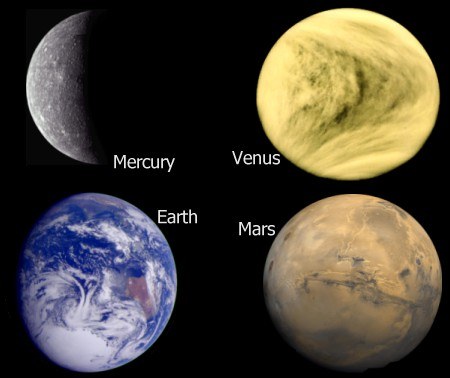
Which statement best describes the inner planets?
rocky
gas
Which statement best describes the outer planets?
Gas
Rocky

