wayground logo

Free Printable Worksheets

Font size

S
M
L
XL
Worksheets

Evolution Exam Review

Total questions: 25

Worksheet time: 17mins

Name
Class
Date
1.
Which term refers to the process by which individuals that are better suited to the environment survive and reproduce therefore passing down their genes to their offspring? 
a)
Evolution 
b)
Variation 
c)
Adaptation
d)
Natural Selection 
2.
When an organism completely dies out, it is called.....
a)
Adaption
b)
Extinction
c)
Fossilization
d)
Mutation
3.
The white feathers of a snowy owl allow it to blend in with its environment during the winter months (snow). This is an example of ________________
a)
Species
b)
Environmental Change
c)
Adaptation
d)
Variation
4.
Genetic differences between organisms of the same species
a)
Variation
b)
Adaptation
c)
Behavior
d)
Environment
5.
The struggle for existence against other members of an organisms species is
a)
Competition
b)
Natural Selection
c)
gene flow
d)
genetic drift
6.
Which of the following is NOT a factor that affects the process of natural selection?
a)
Overpopulation
b)
Fossils
c)
Competition
d)
Variations
7.
A group of similar organisms that can mate with each other and produce fertile offspring is called a species.  
a)
True  
b)
False
8.
Darwin wrote that organisms with traits that are best suited to the environment will ________________
a)
increase in number
b)
become extinct
9.
What is the study of organisms at the early stages of development?
a)
DNA studies
b)
embryology 
c)
extinction
d)
fossil record
10.
What is this an example of?
a)
diversity of species
b)
variation
c)
vestigial structures
d)
DNA studies
11.
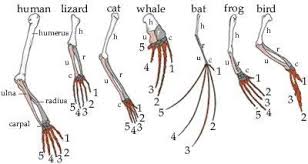
What is this an example of?
a)
vestigial structures
b)
embryology
c)
homologous structures
d)
fossil record
12.

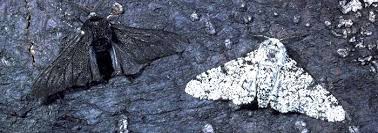
Predict which moth would increase in population (explain why)

a)

light

b)

dark

13.
When the DNA of an organism is altered it is referred to as…
a)
Mutation
b)
Gene Flow
c)
Genetic Drift
d)
Sexual Selection
14.

Which of the following is NOT an example of natural selection?

a)

A caterpillar turning into a butterfly

b)

Insect populations developing resistance to certain pesticides.

c)

Bacteria becoming resistant to antibiotics.

d)

Male birds of certain species developing colorful feathers to attract female mates.

15.
Which species’ DNA is most similar to the DNA of the toothed whale? 
a)
Hippopotamus 
b)
Baleen Whale
c)
Grazing Mammals
d)
Camels
16.
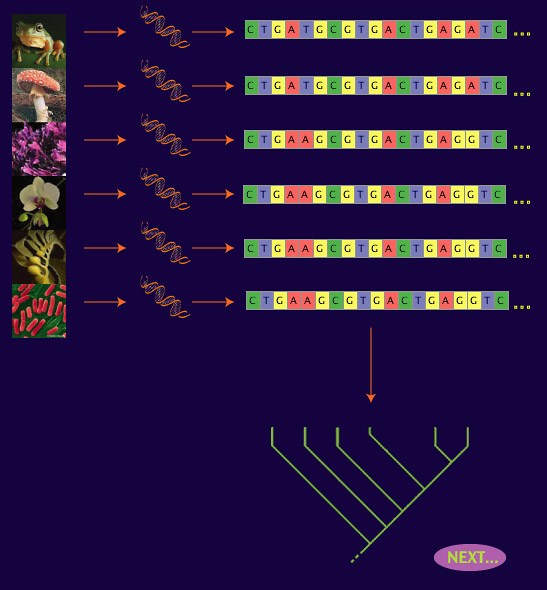
Two organisms that are closely related would have
a)
very similar DNA sequence
b)
exactly the same DNA sequences
c)
no proteins in common
d)
completely different DNA sequence
17.
The diagram shows fossils in different rock layers. Which of these statements about the age of these fossils is most likely correct?
a)
Fossil A and C are the same age
b)
Fossil B is older than fossil C
c)
Fossils A is older than fossil B
d)
Fossil D is older than fossil C
18.
Why are advantageous traits more likely to be passed onto offspring?
a)
Because they are more likely to survive and reproduce.
b)
Because they come from dominant alleles.
c)
Because they come from recessive alleles.
d)
Because the trait is an acquired phenotype.
19.

A population of weeds is treated with weed killer. Because of genetic variation in the population, what is a possible outcome?

a)

The population will grow quickly

b)

They will get better at obtaining a food source

c)

All of the weeds are resistant

d)

Some may be resistant and survive

20.

Which of the following increases genetic variation? Choose all the apply (explain how they increase genetic variation)

a)

Mutations

b)

Sexual Reproduction

c)

Natural Selection

d)

Meiosis

e)

Crossing Over

21.

Which of the following is not a principle of evolution? (explain what the principles of evolution are and why they are important)

a)

Overproduction

b)

adaptations

c)

competition

d)

behavior

22.

What type of macroevolution is being demonstrated in the picture? (be able to explain why)

a)

Divergent Evolution

b)

Convergent Evolution

c)

Adaptive Radiation

d)

Coevolution

23.

What type of macroevolution is being modeled in the image? (explain why)

a)

Divergent

b)

Convergent

c)

coevolution

d)

extinction

24.

What type of macroevolution is being modeled in the image? (explain why)

a)

Divergent

b)

convergent

c)

coevolution

d)

competition

25.

Which of the following is most closely related to Ursus maritimus (explain how you know)

a)

Ailuropoda melanoleuca (Giant Panda)

b)

Phascolarctos cinereus (Koala)

c)

Ursus arctos (grizzly bear)

d)

Balaenoptera musculus (blue whale)