
 Worksheets
NC Final Exam Review 2
Total questions: 109
Worksheet time: 3hrs 3mins
Name
Class
Date
1.
The spinning of the Earth on its axis that causes night and day.
a)
Rotate
b)
Revolve
2.
The sun and everything that revolves around it.
a)
solar system
b)
galaxy
c)
universe
d)
rotation
3.
The imaginary line running through the center of Earth.
a)
axis
b)
moon
c)
constellation
d)
orbit
4.
The star at the center of our solar system.
a)
Sun
b)
moon
c)
orbit
d)
axis
5.
The moon appears to change shape because of _____.
a)
the Moon's revolution around Earth
b)
the seasons of the year
c)
the movement of stars in they sky
d)
Earth's rotation on its axis
6.
What causes Earth's seasons?
a)
the tilt of Earth's axis
b)
Earth's rotation
c)
the revolution of the Moon
d)
Earth's distance from the Sun
7.
The rotation of Earth on its axis causes the pattern of _____.
a)
night and day
b)
constellations
c)
Earth's seasons
d)
the phases of the moon
8.
It takes Earth _________ to make one complete rotation on its axis.
a)
24 hours
b)
365 days
c)
28 days
d)
24 days
9.
It takes Earth _____________ to make one revolution or orbit around the Sun.
a)
365 days
b)
365 hours
c)
28 days
d)
24 hours
10.
It takes about _____________ for the moon to go through all of its phases.
a)
28 days
b)
365 days
c)
24 hours
d)
24 days
11.
To increase or get bigger.
a)
Waxing
b)
Waning
12.
To decrease or get smaller
a)
waning
b)
waxing
13.
A tool used to make distant objects appear larger, brighter, and sharper.
a)
telescope
b)
planet
c)
moon
d)
microscope
14.
When does a waning moon occur?
a)
just after a full moon
b)
just after a crescent moon
c)
when all of the Moon's near side is dark
d)
between a first-quarter moon and a new moon
15.

How does tides form?
a)
by the earth going around the sun
b)
the earth going around the moon
c)
the sun going around the mars
d)
the moon going around the earth
16.

What causes the different phases of the moon?
a)
Earth's shadow falling on the moon
b)
The change in the positions of Earth, the moon, and the sun
c)
The change in Earth's position in its orbit around the sun
d)
The moon's revolution around Earth
17.

What happens when the area you live in tilts away from the sun?
a)
It is summer
b)
It is spring
c)
It is fall
d)
It is winter
18.

If it is winter in the Northern Hemisphere, what season is it in the Southern Hemisphere?
a)
Spring
b)
Fall
c)
Winter
d)
Summer
19.
The order of the planets is:
a)
Mars,Venus,Earth,
Mercury,Saturn
Jupiter, Uranus, Neptune
Mercury,Saturn
Jupiter, Uranus, Neptune
b)
Earth,Venus,Mars
Jupiter, Neptune,
Mercury,Saturn,
Uranus
Jupiter, Neptune,
Mercury,Saturn,
Uranus
c)
Mercury,Venus,Earth
Mars,Jupiter,
Saturn,Uranus
Neptune
Mars,Jupiter,
Saturn,Uranus
Neptune
20.

Earth and the other planets closest to the Sun are made mostly of _______
a)
gas
b)
metal
c)
water
d)
rock
21.
The biggest planet in our solar system is _____________
a)
Jupiter
b)
Saturn
c)
Mars
d)
Earth
22.
What are the first four terrestrial planets made of?
a)
Gas
b)
Rock
c)
Metal
d)
Ice
23.
These are the really big rocks orbiting the sun in the area between Mars and Jupiter.
a)
Asteroids
b)
Meteoroids
c)
Crocks!
d)
Rock-a-billies!
24.
What is the sun mostly made up of
a)
Helium
b)
Core
c)
Carbon
d)
Hydrogen
25.
Fill in the blanks.
The sun rises in the ______ and sets in the ___________.
The sun rises in the ______ and sets in the ___________.
a)
north, south
b)
south, north
c)
east, west
d)
west, east
26.
What is a break in the lithosphere along which movement in an earthquake has first occurred?
a)
Earthquake
b)
Epicenter
c)
Fault
d)
Focus
27.
Where is the point at which the first movement occurs during an earthquake?
a)
Epicenter
b)
Focus
c)
Fault
d)
Plate
28.
Where is the point on the Earth’s surface directly above the focus of an earthquake?
a)
Epicenter
b)
Fault
c)
Hypocenter
d)
Tremor
29.
Which type of wave is the first to arrive after an earthquake occurs?
a)
P Wave
b)
Rayleigh Wave
c)
S Wave
d)
Shear Wave
30.
Which body wave squeezes and stretches rock materials as they pass through the Earth?
a)
Body Waves
b)
P Waves
c)
S Waves
d)
Surface Waves
31.
Which body waves cause particles of rock material to move at right angles to the direction in which the waves are traveling?
a)
Body Waves
b)
P Waves
c)
S Waves
d)
Surface Waves
32.
What is another term for P Wave?
a)
Compression Wave
b)
Principal Wave
c)
Shear Wave
d)
Secondary Wave
33.
P Waves can move through which of the following?
a)
Gas
b)
Liquid
c)
Solid
d)
All of these
34.
S Waves can move through which of the following?
a)
Gas
b)
Liquid
c)
Solid
d)
All of these
35.
What is an instrument that detects and records waves produced by earthquakes? (This piece of equipment can measure the magnitude of an earthquake.)
a)
Epicenter
b)
Fault
c)
Seismogram
d)
Seismograph
36.
What is the measure of the amount of energy released in an earthquake?
a)
Earthquake
b)
Epicenter
c)
Magnitude
d)
Seismogram
37.
What is a large ocean wave that results from an underwater earthquake, landslide, or volcanic eruption?
a)
Aftershock
b)
Liquefaction
c)
Seismic Gap
d)
Tsunami
38.
The outermost solid layer of the Earth is called the
a)
mantle
b)
outer core
c)
inner core
d)
crust
39.
This layer of the Earth is found between the core and the crust.
a)
mantle
b)
outer core
c)
inner core
d)
crust
40.
The layer that lies beneath the mantle and surrounds the inner core.
a)
mantle
b)
outer core
c)
inner core
d)
crust
41.
Is a layer of week of soft mantle that is made of rock that flows slowly. Tectonic plates move on top of this layer.
a)
Inner Core
b)
Asthensophere
c)
Lithosphere
d)
Outer Core
42.
This is the outermost, rigid layer of the Earth, made up of two parts, is divided into pieces call tectonic plates.
a)
Inner Core
b)
Asthensophere
c)
Lithosphere
d)
Outer Core
43.
The solid, dense center of our planet that extends from the bottom of the outer core to the center of the Earth..
a)
mantle
b)
outer core
c)
inner core
d)
crust
44.

Identify the letter in the diagram. Identify letter A
a)
Lithosphere
b)
Asthenosphere
c)
Mantle
d)
Outer Core
45.
Identify the letter in the diagram. Identify letter G
a)
Crust
b)
Convection Current
c)
Inner Core
d)
Outer Core
46.
What are the two types of crust?
a)
top crust,bottom crust
b)
oceanic crust, continental crust
c)
water,land
d)
none of the above
47.
What is the correct layers of the earth starting with the surface?
a)
crust, outer core, inner core, mantle
b)
mantle, outer core, inner core ,crust
c)
crust, mantle, outer core, inner core
d)
outer core, inner core , crust, mantle
48.
What are the features of Earth's core?
a)
made of iron and nickel, there are two layers, a liquid outer and solid inner
b)
made of hot but solid rock
c)
layer of solid rock including dry land and ocean floor.
49.
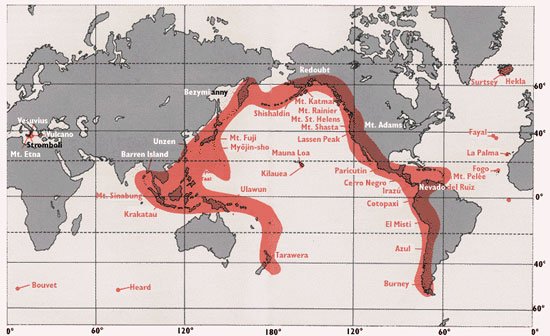
This is the name for the chain of volcanos around the edge of the Pacific Plate.
a)
Circle of Fire
b)
Ring of Lava
c)
Ring of Fire
d)
Circle of Magma
50.
What force is responsible for erosion and deposition in landslides?
a)
gravity
b)
ice
c)
wind
d)
temperature
51.

The huge pieces of the earth's crust are called ____________________________.
a)
crust
b)
plates
c)
directions
d)
seismos
52.

What Geologic Activity is occurring in this picture?
a)
Sea-floor Spreading
b)
Volcano forming
c)
Earthquake
d)
Mountain building
53.
The breaking down of rocks into smaller pieces is called
a)
Erosion
b)
Weathering
c)
Tsunamis
d)
Sedimentation
54.
The type of plate boundary where two plates come together is a .....
a)
Convergent Boundary
b)
Divergent Boundary
c)
Transform Boundary
d)
Plate Boundary
55.

What type of event will occur at this boundary?
a)
Earthquake
b)
Volcano Eruption
c)
Tornado
d)
Mountain Building
56.
A divergent boundary occurs when plates ....
a)
Pull apart
b)
Come together
c)
Slide past each other
d)
subducting
57.
Which of the following is the name of the ancient supercontinent formed 28 Million Years ago.
a)
Pangea
b)
Gondwanda
c)
Laurasia
d)
Neverland
58.
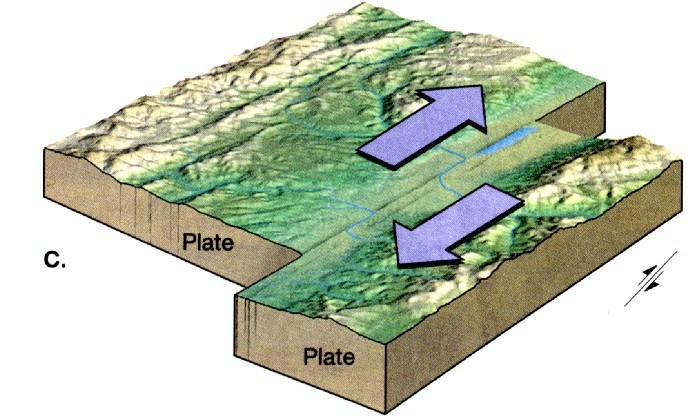
What type of plate boundary is this?
a)
Transform
b)
Convergent
c)
Divergent
d)
Plate
59.
Oceanic Trenches are formed by _______ plate boundaries
a)
Convergent
b)
Transform
c)
Plate
d)
Divergent
60.
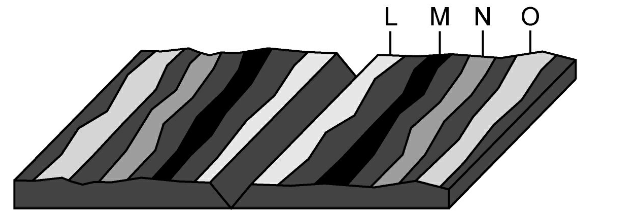
Where would the oldest rock be found?
a)
L
b)
M
c)
N
d)
O
61.
This landform can occur at a divergent plate boundary.
a)
ocean trench
b)
mid-ocean ridge
c)
tall mountains
d)
transform fault
62.
The movement of weathered material (sediment) is called?
a)
weathering
b)
erosion
c)
deposition
d)
cementation
63.
This rock was formed when molten rock cooled into a solid. What type of rock is it?
a)
Igneous Rock
b)
Metamorphic Rock
c)
Sedimentary Rock
64.
Which type of rock is formed from INTENSE heat and pressure?
a)
igneous
b)
sedimentary
c)
metamorphic
65.
What are the 3 major types of rocks?
a)
Igneous, Metamorphic, Sedimentary
b)
Metamorphic, Igneous, Cementation
c)
Brown, Red, Gray
d)
Streak, Hardness, Breakage
66.

Each rock type can follow only one pathway of the rock cycle.
a)
True
b)
False
67.
The layer of soil which the topsoil is found.
a)
Horizon A
b)
Horizon B
c)
Horizon C
d)
Horizon D or R
68.
The MAIN thing Decomposers do for the the soil is the following:
a)
Store moisture
b)
Burrow deep in the soil
c)
Make space for air and water
d)
Break down and digest dead organisms
69.
Decayed organic material in soil is called______.
a)
Litter
b)
Silt
c)
Humus
d)
Clay
70.
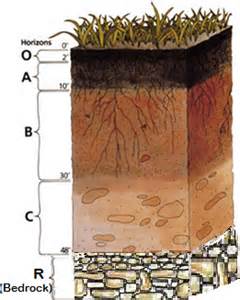
Which horizon is made up of partially weathered rocks?
a)
Horizon A
b)
Horizon B
c)
Horizon C
d)
Horizon D or R
71.
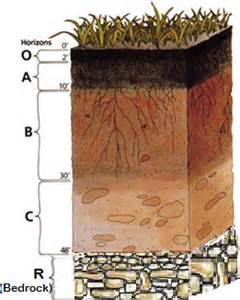
In which horizon is most of the HUMUS?
a)
Horizon A
b)
Horizon B
c)
Horizon C
d)
Horizon D or R
72.
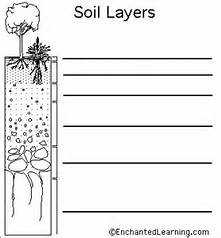
Which horizon contains clay, silt, minerals, and a little humus?
a)
Horizon A
b)
Horizon B
c)
Horizon C
d)
Horizon D or R
73.
In which horizon is the Bedrock
a)
Horizon A
b)
Horizon B
c)
Horizon C
d)
Horizon D or R
74.
Which of the following is NOT one of the three types of soil?
a)
clay
b)
sand
c)
silt
d)
mud
75.

_______ is the type of soil used most often with plants and on farms. It is a mixture of clay, sand, and silt.
a)
loam
b)
humus
c)
soil
d)
dirt
76.

Are there minerals in soil?
a)
Yes
b)
No
77.
Which of the following is the largest particle in soil?
a)
sand
b)
silt
c)
humus
d)
clay
78.
You dig a small hole in the soil and the next day it rains. The hole fills with water, but does not empty even after several days of dry weather. What is the soil mostly made of?
a)
clay
b)
sand
c)
humus
d)
silt
79.
Many plants cannot grow in sandy soil. Why is this true?
a)
Sandy soil does not hold enough water.
b)
Air cannot pass through sandy soil.
c)
Roots cannot easily push through sandy soil.
d)
Sandy soil has too many nutrients.
80.
What is the male part of the flower?
a)
Petals
b)
Stamen
c)
Pistil
d)
Sepals
81.
What is the female part of the flower?
a)
Petals
b)
Stamen
c)
Pistil
d)
Sepals
82.
What part of the male part of the flower makes pollen?
a)
Ovary
b)
Anther
c)
Filament
d)
Stigma
83.
What part of the male part of the flower holds up the anther?
a)
Ovary
b)
Anther
c)
Filament
d)
Stigma
84.
What part of the female part of the flower gathers pollen?
a)
Ovary
b)
Style
c)
Filament
d)
Stigma
85.
What part of the female part of the flower is a tube that pollen travels through?
a)
Ovary
b)
Style
c)
Filament
d)
Stigma
86.
What part of the female part of the flower is the place that holds the eggs?
a)
Ovary
b)
Style
c)
Filament
d)
Stigma
87.
What is the male reproductive material of plants?
a)
Seeds
b)
Pollen
c)
Fruit
d)
Sepals
88.
What are the small, green leaf-like structures that protect the flower when it is a bud?
a)
Seeds
b)
Pollen
c)
Petals
d)
Sepals
89.
What are the openings on the underside of leaves that let carbon dioxide into the leaf and let oxygen out?
a)
Chloroplasts
b)
Stomata
c)
Stomach
d)
Cuticle
90.
What is pollination?
a)
the transfer of pollen from the anther to the stigma
b)
the union of pollen and egg cells in the ovary of the flower
c)
the dispersal of seeds to a new location
d)
the transfer of cash in a business transaction between plants
91.
What is fertilization?
a)
the transfer of pollen from the anther to the stigma
b)
the union of pollen and egg cells in the ovary of the flower
c)
the dispersal of seeds to a new location
d)
the transfer of cash in a business transaction between plants
92.
Which of the following is the correct equation for PHOTOSYNTHESIS?
a)
CO2 + light + H2O --> O2 + Sugar
b)
CO2 + sugar + H2O --> O2 + light
c)
O2 + light + H2O --> CO2 + Sugar
d)
CO2 + O2 + H2O --> Light+ Sugar
93.
Which gas is removed from the atmosphere during photosynthesis?
a)
hydrogen
b)
oxygen
c)
nitrogen
d)
carbon dioxide
94.
What are the products of photosynthesis?
a)
water and carbon dioxide
b)
oxygen and glucose
c)
oxygen and carbon dioxide
d)
oxygen and water
95.
All living things do which of the following?
a)
Chemosynthesis
b)
Respiration
c)
photosynthesis
d)
all of the answers
96.
What is one of the reactants of cellular respiration?
a)
energy
b)
glucose
c)
carbon dioxide
d)
water
97.
This is referred to as the energy currency of the cell
a)
ADP
b)
ATP
c)
Mitochondria
d)
Nucleus
98.
Field mice eat corn. Which would most likely happen if the field mouse population grew?
a)
There would be more corn to feed the field mice.
b)
There would be less corn due to the mice eating it.
c)
The habitat would get overpopulated because the mice woudl eat too much.
99.
If the population of prey increases, the population of predators will ________because of the availability of food.
a)
decrease
b)
stay the same
c)
increase
100.
All the members of one species that live within an area of an ecosystem
a)
population
b)
community
c)
niche
101.
All of the populations that live in one area together
a)
limiting factors
b)
populations
c)
community
d)
speed limit
102.

Something that limits the size of a population.
a)
maxfactor
b)
factor tree
c)
the x factor
d)
limiting factor
103.

Which organisms are in competition for the same food?
a)
fox and owl
b)
spider and fly
c)
rabbit and mouse
d)
deer and owl
104.

Which of the following is a herbivore?
a)
cricket
b)
frog
c)
hawk
d)
shrew
105.
Roots of a tree growing towards the water line of a house.
a)
Gravitropism
b)
Phototropism
c)
Thigmotropism
d)
Hydrotropism
106.
The shoot of a plant growing up.
a)
Positive Gravitropism
b)
Negative Gravitropism
c)
Thigmotropism
d)
Hydrotropism
107.
The root of a plant growing down.
a)
Positive Gravitropism
b)
Negative Gravitropism
c)
Thigmotropism
d)
Hydrotropism
108.
Which of the following responses is a plant growing toward or leaning toward touch?
a)
thigmotropism
b)
hydrotropism
c)
phototropism
d)
geotropism
109.
The Venus flytrap closing in response to a bug touching it is an example of...
a)
Phototropism
b)
Hydrotropism
c)
Geotropism
d)
Thigmotropism
100 %

