
 Worksheets
Ridgeview Semester 2 Final Review 8th
Total questions: 44
Worksheet time: 31mins
Name
Class
Date
1.
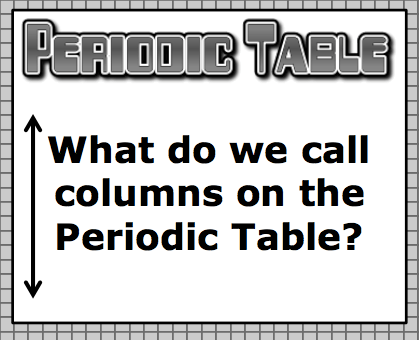
a)
Periods
b)
Groups
2.
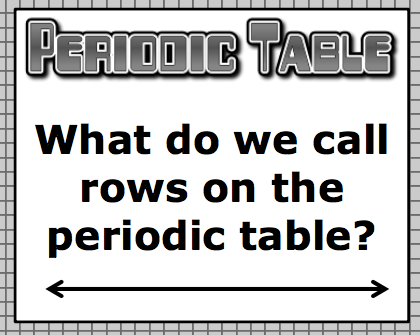
a)
Periods
b)
Groups
3.

a)
energy levels
b)
valence electrons
c)
protons
d)
neutrons
4.
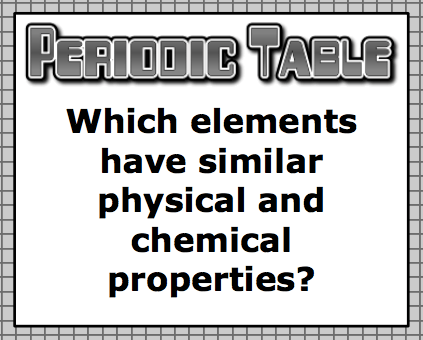
a)
Same group
b)
Same period
5.

Sodium has an atomic number of 11, how many protons does this atom have?
a)
22
b)
11
c)
12
d)
2
6.

Where is the proton located?
a)
In the very dense nucleus
b)
Floating around in the negative electron cloud
c)
the loose nucleus
d)
the positive electron cloud
7.

The following element key shows how many protons?
a)
16
b)
15.999
c)
Oxygen
d)
8
8.
What is the atomic mass?
a)
the number of protons
b)
the number of protons and neutrons
c)
the number of neutrons
d)
the number of protons and electrons
9.
Which is the largest atom below?
a)
Hydrogen (H)
b)
Fluorine (F)
c)
Cesium (Cs)
d)
Helium (He)
10.
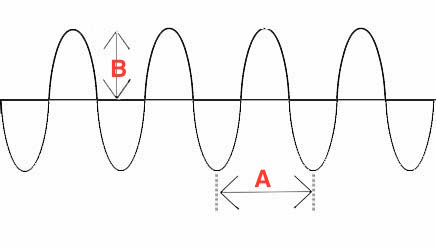
What property of this wave is represented by the letter "A"
a)
amplitude
b)
crest
c)
trough
d)
wavelength
11.
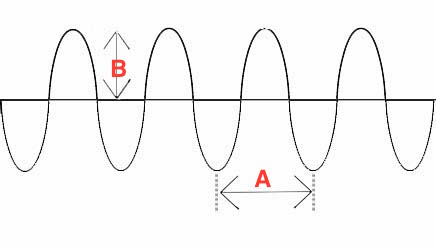
What property of the wave is represented by the letter "B"?
a)
amplitude
b)
crest
c)
trough
d)
wavelength
12.
The highest point on a wave is:
a)
the crest
b)
the trough
c)
the top
d)
the coast
13.
The lowest point on a wave is the:
a)
Amplitude
b)
Crest
c)
Trough
d)
Wavelength
14.
The number of wavelengths that pass a point each per second is:
a)
frequency
b)
period
c)
longitudinal
d)
transverse wave
15.
The type of waves that require medium to pass:
a)
Mechanical Waves
b)
Electromagnetic Waves
16.
When the frequency of a wave increases, what happens to the wavelength?
a)
The wavelength is not directly affected by the frequency of a wave.
b)
The wavelength increases.
c)
The wavelength decreases.
d)
More specific information is needed to form a conclusion about the wavelength.
17.
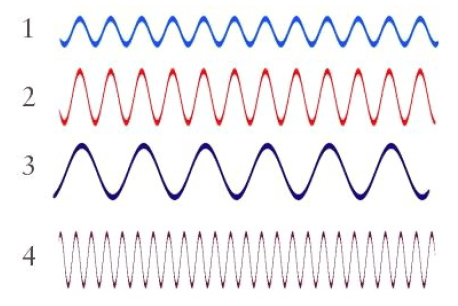
Which wave in the diagram has the greatest frequency?
a)
1
b)
2
c)
3
d)
4
18.
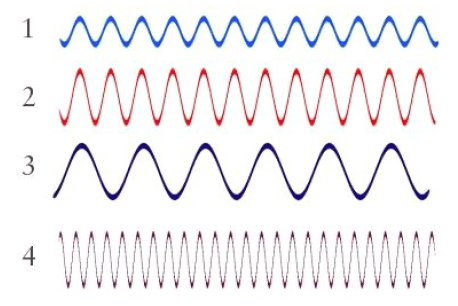
Which wave in the diagram has the greatest wavelength?
a)
1
b)
2
c)
3
d)
4
19.
The bending of a wave as it passes at an angle from one medium to another is called?
a)
Convex Lens
b)
Refraction
c)
Concave Lens
20.

_____?______ materials do not allow light waves to pass through.
a)
Opaque
b)
Transparent
c)
Translucent
21.

_____?_____ materials allow some light to partially pass through, but not in a straight path.
a)
Opaque
b)
Transparent
c)
Translucent
22.

_____?_____ materials allow light waves to pass through easily.
a)
Opaque
b)
Transparent
c)
Translucent
23.
If you see a green leaf on a tree, that means...
a)
Green is the color being reflected off the leaf.
b)
Green is the color being absorbed by the leaf.
c)
All the colors are being reflected off the leaf.
d)
All the colors are being absorbed by the leaf.
24.
What about an electromagnetic wave decides the color a light is?
a)
The amplitude
b)
The frequency and wavelength
25.

The picture shows an example of what kind of signal?
a)
Analog
b)
Digital
26.
An analog signal is...
a)
continuous
b)
in pulses
27.
What is true about a digital signal?
a)
They are easily distorted or affected by interference
b)
They take up more space
c)
They require more information
d)
They are generally considered more reliable
28.
The number of digits that can be assigned to a binary code are:
a)
1
b)
2
c)
3
d)
4
29.
Smooth and continuous data
a)
analog
b)
digital
c)
pulse
d)
binary
30.
An analog signal is sent in Discrete pulses in two states, on= 1 or off= 0.
a)
True
b)
False
31.
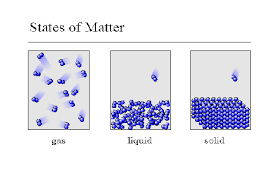
At higher temperatures
a)
particles in an object have less energy
b)
particles in an object move faster
c)
a gas contracts
32.
Freezing
a)
Solid to gas
b)
Liquid to solid
c)
Gas to solid
d)
Liquid to gas
33.
Boiling
a)
liquid to gas
b)
gas to solid
c)
gas to liquid
d)
solid to liquid
34.
The slower the particles in a substance move,
a)
the colder it is.
b)
the warmer it is.
c)
the more energy it has.
d)
the less energy it has.
35.
What is an example of a Chemical change?
a)
Ripped paper
b)
boiled egg
c)
cracked egg
d)
sugar in water
36.
Which is a physical change?
a)
burning match
b)
vinegar in baking soda
c)
melting butter
d)
cooking an egg
37.
Which of the following is a chemical property of water?
a)
Reacts with pure sodium.
b)
Boils at 100 oC.
c)
Dissolves sugar easily.
d)
Has a density of 1 gm/mL
38.
Which of the following is a sign that a chemical reaction has occurred?
a)
change in shape
b)
melting
c)
formation of a gas
d)
dissolving
39.
What characteristic defines all chemical changes?
a)
There is a change of state.
b)
Electricity is produced.
c)
A new material is formed.
d)
Bubbles are produced.
40.
When two atoms share electrons, a chemical bond is formed. This type of bond is called:
a)
covalent bond
b)
ionic bond
c)
crystal bond
d)
polyatomic bond
41.
How many valence electrons does nitrogen have?
a)
3
b)
2
c)
5
d)
1
42.
The number of _____ is most important in determining how an atoms will bond.
a)
Neutrons
b)
Protons
c)
Valence Electrons
d)
Electron sin the innermost shell
43.
Ionic Bonding involves...
a)
The transfer of protons
b)
The transfer of nuetrons
c)
The transfer of electrons
d)
None Of the above
44.
How many electrons do atoms need to be stable?
a)
1
b)
2
c)
6
d)
8
100 %

