
 Worksheets
Math 2 NCFE Review
Total questions: 64
Worksheet time: 2hrs 16mins
Name
Class
Date
1.
A plane is named by...
a)
Any 1 point on the plane.
b)
Any 3 collinear points on the plane or a lowercase script letter.
c)
Any 3 non-collinear points on the plane or an uppercase script letter.
d)
All points on the plane that aren't part of a line.
2.

a)
x=3/17
b)
x=9
c)
x=3
d)
x= -3
3.

a)
m∠GHK=90, m∠KHJ=45
b)
m∠GHK=45, m∠KHJ=45
c)
m∠GHK=45, m∠KHJ=90
d)
m∠GHK=90, m∠KHJ=90
4.
Find the endpoint of the segment with endpoint (4, 12) and midpoint (-1, 13)
a)
(-6, 14)
b)
(-4, -12)
c)
(13, -1)
d)
(5, 13)
5.
What is the midpoint between (-4, 4) and (-2, 2)
a)
(-6, 6)
b)
(-3, 3)
c)
(1, 3.5)
d)
(-6, 3)
6.

Which pair of angles are alternate exterior angles?
a)
Angle 7 and Angle 4
b)
Angle 2 and Angle 6
c)
Angle 8 and Angle 1
d)
Angle 2 and Angle 8
7.

Name the angle relationship.
a)
Alternate Interior
b)
Alternate Exterior
c)
Corresponding
d)
Vertical Angles
8.

Solve for y.
a)
y = 20
b)
y = 120
c)
y = 60
d)
y = 10
9.

Find the measure of angle 1.
a)
28o
b)
136o
c)
44o
d)
6o
10.

What is the intersection of planes R and P?
a)
point I
b)
point H
c)
line HI
d)
ray IH
11.
Translations, reflections and rotations are all known as ________________________.
a)
Geometry
b)
Transformations
c)
Congruent
12.
When you translate, (x,y+6) will move _____.
a)
6 units right
b)
6 units left
c)
6 units up
d)
6 units down
13.

Identify the transformation.
a)
Reflection across y-axis
b)
90 Rotation counter clockwise
c)
Translation 5 units left, 1 unit up.
d)
Translation 5 units right, 1 unit down
14.

Reflect the figure across the y-axis. What are the coordinates of A'?
a)
(-2, -4)
b)
(2, 4)
c)
(-2, 4)
d)
(2, -4)
15.

Identify the transformation from ABC to A'B'C'.
a)
90o clockwise rotation
b)
90o counter clockwise rotation
c)
Reflection across the y-axis
d)
Reflection across the x-axis
16.

Triangle GHI is reflected across the x-axis. What are the coordinates of I'?
a)
(-2, 6)
b)
(2, 6)
c)
(-6, -2)
d)
(6, 2)
17.
If the triangle is transformed following the rule (x,y)⊣(x+5,y-3), what transformation is modeled?
a)
Dilation
b)
Reflection
c)
Translation
d)
Rotation
18.
If the triangle is transformed following the rule (x,y)⊣(x,-y), what transformation is modeled?
a)
Dilation
b)
Reflection
c)
Translation
d)
Rotation
19.
If the triangle is transformed following the rule (x,y)⊣(-x,-y), what transformation is modeled?
a)
Dilation
b)
Reflection
c)
Translation
d)
Rotation
20.

Solve for x.
a)
10.5
b)
5
c)
8.5
d)
6
21.

Find the missing length.
a)
x = 15
b)
x = 13
c)
x = 12
d)
x = 11
22.

The figure is an example of a(n) ...
a)
median
b)
altitude
c)
midsegment
d)
angle bisector
23.

Solve for x.
a)
72
b)
67
c)
65
d)
54
24.

Find the value of x by using the exterior angle theorem.
a)
A
b)
B
c)
C
d)
D
25.

What is the measure of angle b?
a)
36o
b)
56o
c)
63o
d)
117o
26.

What additional information is required for the 2 triangles to be congruent by ASA?
a)
A
b)
B
c)
C
d)
D
27.

Are these triangles congruent? If so, state the rule which you used to determine congruence.
a)
SAS
b)
ASA
c)
AAS
d)
Not enough information
28.
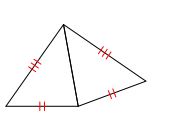
Are these triangles congruent? If so, state the rule which you used to determine congruence.
a)
SSS
b)
SAS
c)
ASA
d)
AAS
29.
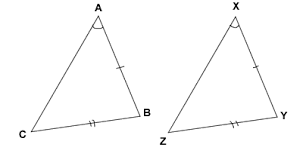
Are these triangles congruent? If so, state the rule which you used to determine congruence.
a)
SSA
b)
AAS
c)
ASA
d)
Not necessarily congruent
30.

Find the length of the missing side.
a)
17 cm
b)
22 cm
c)
15 cm
d)
13 cm
31.
You need a ladder that will reach up a 25 foot tall house when placed 10 feet away from the house. How tall does the ladder need to be?
a)
25 feet
b)
26 feet
c)
27 feet
d)
28 feet
32.

State if the triangle is acute, obtuse, or right.
a)
acute
b)
obtuse
c)
right
33.
State if the three sides lengths form an acute, obtuse, or right triangle:
4.8 km, 28.6 km. 29 km
4.8 km, 28.6 km. 29 km
a)
acute
b)
obtuse
c)
right
34.

Use the crown theorem to find the value of y.
a)
2√110
b)
440
c)
√440
d)
52
35.
What is the ratio for Sine?
a)
Hyp/Opp
b)
Opp/Hyp
c)
Opp/Adj
d)
Adj/Opp
36.
What is the ratio for Tangent
a)
Opp/Adj
b)
Adj/Opp
c)
Opp/Hyp
d)
Hyp/Opp
37.
What is the ratio for Cosine?
a)
Opp/Hyp
b)
Opp/Adj
c)
Adj/Opp
d)
Adj/Hyp
38.
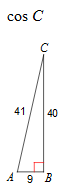
What is the correct ratio?
a)
9/41
b)
40/41
c)
9/40
d)
40/9
39.

What is the correct equation to solve for x?
a)
tan (45) = x/13
b)
cos (45) = x/13
c)
sin (45) = 13/x
d)
sin (45) = x/13
40.
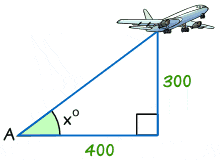
Solve for the missing angle.
a)
50.5 degrees
b)
12.7 degrees
c)
36.9 degrees
d)
72.2 degrees
41.
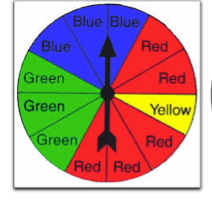
What is the probability of spinning green?
a)
0
b)
1/4
c)
1/2
d)
3/4
42.

Find the probability of drawing a 10 from a standard deck of 52 cards.
a)
1 out of 52
b)
13 out of 52
c)
26 out of 52
d)
4 out of 52
43.

If you choose from the following M & M colors, what is the probability that you choose blue?
5 green
6 yellow
8 blue
7 brown
5 green
6 yellow
8 blue
7 brown
a)
8/26
b)
4/13
c)
8/25
d)
1/3
44.
Clare picks a marble at random, puts it back, and then picks another marble at random.
a)
Dependent
b)
Independent
45.
Clara picks a card at random, puts it back, and then picks another card at random.
a)
Independent
b)
Dependent
46.

If you draw one card from a standard deck, what is the probability of drawing a 5 or a diamond? Are the events inclusive or mutually exclusive?
a)
Inclusive
b)
Mutually Exclusive
47.
If you draw one card from a standard deck, what is the probability of drawing a spade or a red card? Are the events inclusive or mutually exclusive?
a)
Inclusive
b)
Mutually exclusive
48.
Which formula do you use when two events are NOT mutually exclusive? (Mutually Inclusive)
a)
P(A or B) = P(A) + P(B)
b)
P(A or B) = P(A) + P(B) - P(A and B)
c)
P(A and B) = P(A) * P(B)
d)
P (A and B) = P(A) * P(B|A)
49.
Which formula do you use when two events are Independent or Dependent?
a)
P(A or B) = P(A) + P(B)
b)
P(A or B) = P(A) + P(B) - P(A and B)
c)
P(A and B) = P(A) * P(B)
d)
P (A and B) = P(A) * P(B|A)
50.
The graph of a quadratic function is called a
a)
Parabola
b)
Vertex
c)
Axis of Symmetry
d)
Vertex Form
51.

Use the graph of y=-x2+6x-5 to solve the equation -x2+6x-5=0
a)
(-1,-5)
b)
{3,4}
c)
{1,5}
d)
{2,4}
52.
What is the discriminant?
a)
b²-4ac
b)
b2/2a
c)
4ac
d)
b2±4ac
53.
If the discriminant equals 0, then the quadratic has:
a)
1 Real Solution
b)
2 Real Solutions
c)
Half a Solution
d)
No Real Solution
54.
Which of the following equations shows the vertex form of a quadratic?
a)
x = -b/2a
b)
x = (-b ±√b2 - 4ac)/2a
c)
y = ax2 + bx + c
d)
y = a(x - h)2 + k
55.
Solve 5 = -2x + x2
a)
No Solution
b)
-3.5 or 1.5
c)
2 or 3
d)
-1.5 or 3.5
56.
Solve 3x2 - 192 = 0
a)
-32 or 32
b)
No Solution
c)
-8 or 8
d)
-64 or 64
57.
Solve 2x2 + 7x - 15 = 0
a)
-1.5 or 5
b)
No Solution
c)
-5 or 1.5
d)
0.7 or 5
58.
Convert the equation y= x2-2x-5 into vertex form.
a)
y= (x-1)2-6
b)
y= -(x-1)2-6
c)
y= (x+1)2-6
d)
y= -(x+6)2-1
59.
If given the equation y = 3(x + 5)2 - 4, what is the vertex of the parabola?
a)
(5, -4)
b)
(-5, -4)
c)
(-15, -4)
d)
(15, -4)
60.
Solve for x:
(x + 2)1/2 - 5 = -2
(x + 2)1/2 - 5 = -2
a)
1
b)
5
c)
7
d)
9
61.
How do you isolate a variable raised to the (2/3) power?
a)
cube it
b)
square it
c)
raise both sides to the (3/2) power
d)
raise both sides to the (2/3) power
62.
Solve for x:
(x + 2)1/2 - 5 = -2
(x + 2)1/2 - 5 = -2
a)
1
b)
5
c)
7
d)
9
63.
Rewrite √(y)5 in exponential form.
a)
y5/2
b)
y2/5
c)
y-5/2
d)
y-2/5
64.
Evaluate 4√(81).
a)
3
b)
9
c)
27
d)
243
100 %

