wayground logo

Free Printable Worksheets

NEW

Font size

S
M
L
XL
Worksheets

2nd Semester Review

Total questions: 70

Worksheet time: 50mins

Name
Class
Date
1.
The medieval Church was a unifying force in Europe after the fall of Rome because it offered:
a)
indulgences for sinners
b)
stability and security
c)
redistribution of wealth
d)
multiple sets of beliefs 
2.
Granted certain rights to the people and said that the king must obey the law.
a)
Constitution
b)
Magna Carta
c)
Declaration of Independence
3.
Caused by  rats carrying diseased fleas from infested trading ships and houses.
a)
Ebola
b)
Leprosy
c)
Black Death
4.
What was the main role of serfs in the feudal system?
a)
Laborers
b)
Making laws
c)
Trading goods
5.
Which of these was a major effect of the Crusades on Europe?
a)
Reuniting the Roman Empire
b)
Everyone in the "East" became Christian
c)
Increased trade with non-European cultures
6.
What was the goal of the First Crusade?
a)
To take Jerusalem  away from the Muslims
b)
To convert Christians to Islam
c)
To conquer Europe
7.
Castles were known for their.....
a)
Comfort
b)
Defense
c)
Vulnerability
8.
Vassals owed loyalty to....
a)
Higher lords
b)
Serfs
c)
Peasants
9.
A piece of land, given in exchange for loyalty and protection.
a)
Manor
b)
Fief
c)
Estate
10.
Knights were governed by a code of honor called....
a)
Chivalry
b)
Homage
c)
Vassalage
11.
Who 1) ruled the Franks from
768 to 814 C.E.
2) united the Christian lands of Europe
3)was crowned Holy Roman emperor
in 800 C.E.
a)
Charlemange
b)
King Arthur
c)
Joan of Arc
12.
 William of Normandy won the Battle of 
a)
The Gulf
b)
Hastings
c)
Camelot
13.
The crusades were wars between Christians and 
a)
Hindus
b)
Buddhists
c)
Muslims
d)
Catholics
14.

What is the Crusades?

a)

Military campaigns the Catholic Church began to force Muslims out of Europe and reclaim the holy land.

b)

Political system based on bonds of loyalty between lords and vassals.

c)

The most powerful organization in Europe during the Middle Ages/Renaissance

d)

A noble who held land from and served a higher-raking lord, and in return was given protection

15.
In what sea was Rome a peninsula, which allowed it to prosper in trade and interact with and conquer other lands? 
a)
Red
b)
Black
c)
Mediterranean
d)
Arabian
16.
What were wealthy landowners called who made up Rome's ruling class? 
a)
Plebeians
b)
Patricians
c)
Monarchs
d)
Aristocrats
17.
What commoners such as artisans shopkeepers, and owners of small farms were called 
a)
Aristocrats
b)
Patricians
c)
Monarchs
d)
Plebeians
18.
What were the wars called that were fought for 20 years between Rome and Carthage? 
a)
Twenty-year Wars
b)
Mediterranean Wars
c)
Punic Wars
d)
Elephant Wars
19.
Who made himself dictator for life and was seen as a hero to the plebeians because he gave them land & food, but was power-hungry to the patricians?
a)
Julius Caesar
b)
Mark Antony
c)
Scipio
d)
Caesar Augustus
20.
By expanding the empire and reorganizing the military and government to make it safe and strong, Caesar Augustus created a new era of prosperity that lasted 200 years called 
a)
Pax Romana
b)
Golden Years
c)
Pax Augustus
d)
Age of Prosperity
21.
Who divided the empire into 2 parts, to make it easier to rule?
a)
Constantine
b)
Nero
c)
Caesar
d)
Diocletian
22.
Rome was located near what body of water, which was a MAJOR trade route?
a)
Pacific Ocean
b)
Atlantic Ocean
c)
Red Sea
d)
Mediterranean Sea
23.
Who was the first emperor of Rome?
a)
Julius Caesar 
b)
Caesar  
c)
Caesar Augustus 
d)
Caesar Constantine 
24.
Which was NOT a cause of the fall of the Empire? 
a)
Political Instability 
b)
The empire became too small
c)
Economic problems 
d)
It became too large to manage effectively.
25.
Who moved the capital from Rome to Byzantium?
a)
Augustus 
b)
Nero
c)
Constantine 
d)
Caesar 
26.
Why was the Roman Empire split into two parts?
a)
It was too big for one person to rule 
b)
an emperor's two sons took over
c)
There wasn't a split 
d)
Germanic tribes invaded 
27.
In what year did the Roman Empire collapse? 
a)
776 BC
b)
776 AD
c)
476 BC
d)
476 AD
28.
When the empire split, what was the new capital?
a)
Rome 
b)
Constantinople 
c)
Carthage 
d)
Istanbul 
29.
What language was created by the Romans where many words from today are from?
a)
Portuguese
b)
Italian
c)
Latin
d)
French
30.
What was created by the Romans to transport water into the city of Rome?
a)
aqueducts
b)
domes
c)
standardized law
d)
roads
31.
Justinian's lasting contribution was .:
a)
His permanent retaking of the western half of the Roman Empire
b)
His uniting political and religious authority into a single leader
c)
His updating of previous legal (law) traditions
d)
His conquest of the Ottoman Turks
32.
What was the capital city of the Byzantine Empire? 
a)
Rome 
b)
Athens 
c)
Constantinople 
d)
Italy 
33.
What does the word "Renaissance" mean?
a)
Rebirth
b)
Stagnation
c)
Traditional
d)
A Latin term for art
34.
Which of the following is associated with Humanism?
a)
the ideas of the middle ages
b)
the ideas of Greece & Rome
c)
the ideas of ancient China
d)
the ideas of ancient India
35.
Where did the Renaissance begin?
a)
Italy
b)
France
c)
England
d)
Germany
36.
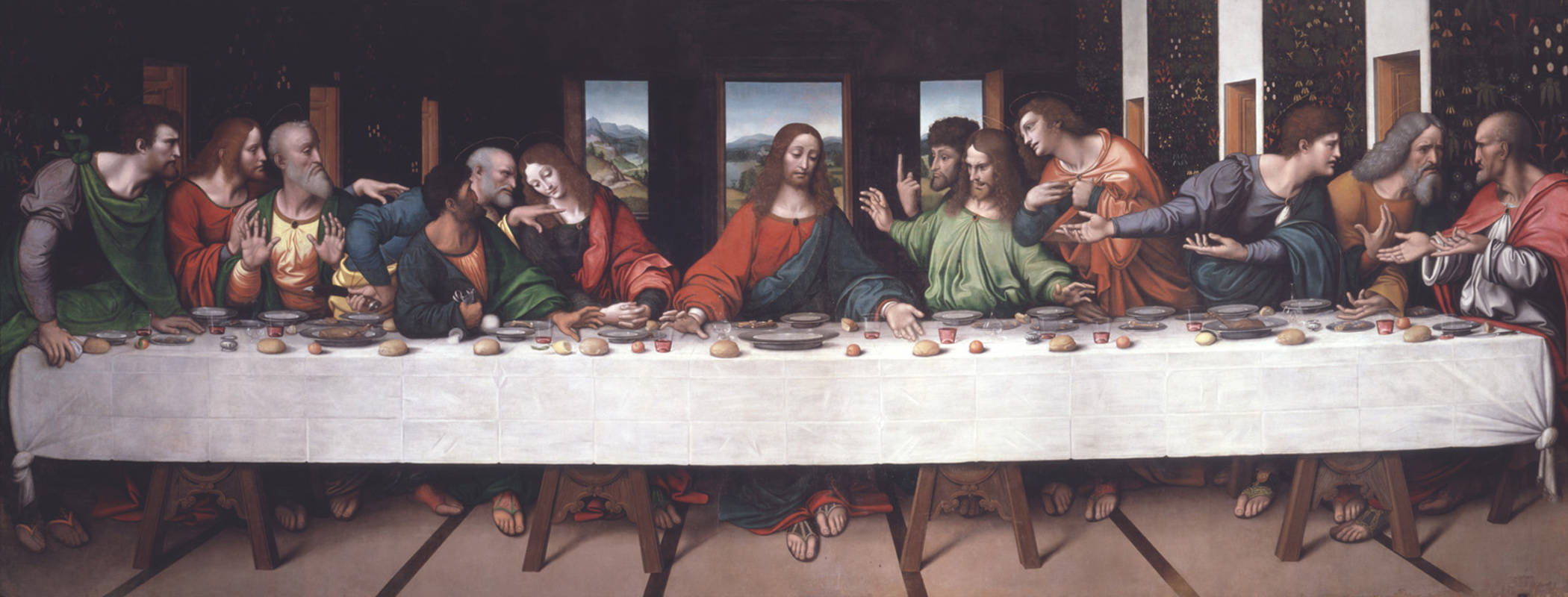
Who painted "The Last Supper"?
a)
Machiavelli
b)
Botticelli
c)
Kepler
d)
Leonardo da Vinci
37.
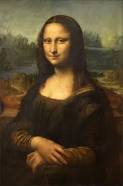
Who painted the Mona Lisa?
a)
Michelangelo
b)
Boticceli
c)
Leonardo da Vinci
d)
Donatello
38.
During the Renaissance, why was Florence significant?
a)
Birthplace and symbol of the Renaissance
b)
Birthplace of Michelangelo
c)
The last place the Black Plague hit
d)
Home of all of the significant artists and sculptors 
39.
The Medici Family...
a)
Were the first mafia family to live in Italy
b)
Were the most famous painters in Florence
c)
Were the family of Mona Lisa
d)
Were patrons of the arts in Florence
40.
Which of the following was NOT a pillar of the Renaissance?
a)
Individualism
b)
Humanism
c)
Mannerism
d)
Secularism
41.
"The end justifies the means" was a key belief of this man, who wrote "The Prince" 
a)
Machiavelli
b)
Castiglione
c)
Shakespeare 
d)
Petrarch
42.
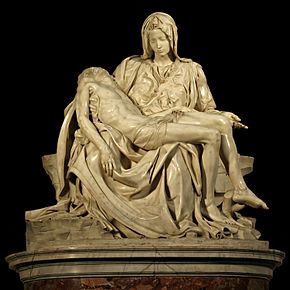
Who is the creator of this sculpture? 
a)
Michelango
b)
Raphael
c)
Leonardo da Vinci
d)
Donatello
43.
Which of the following is NOT a characteristic of Renaissance art?
a)
Perspective
b)
Incorporation of nature
c)
Flat/2-D
d)
Realistic/3-D
44.
Advantages of Johannes Gutenberg's printing press include all of the following EXCEPT:
a)
Cheaper book prices
b)
Increase in education/literacy
c)
Increase in church power
d)
Rapid spread of ideas
45.

Martin Luther's main complaint was against what?

a)

Inquisitions

b)

Indulgences

c)

The Bible

d)

Ice Cream

46.
Fill in the blank. Luther believed that ________________ was how people would end up in heaven.
a)
faith
b)
indulgences
c)
good deeds
d)
going to church
47.
What historical invention allowed Reformers like Martin Luther to reach a large audience and challenge the Church?
a)
train
b)
plane
c)
internet
d)
printing press
48.
T or F: Protestants and Catholics both believe the Bible is their holy book. 
a)
True
b)
False
49.

What was an indulgence?

a)

a Christian who separated from the Roman Catholic Church during the Reformation

b)

a common practice of selling and buying positions in the Catholic Church

c)

a grant by the Catholic Church that released a person from punishment for sins

50.

What does it mean to be excommunicated?

a)

to be offered a high-ranking position within the Church.

b)

to be condemned to death by burning at the stake.

c)

to no longer be allowed membership in the Church.

51.

King Henry VIII of England wanted to end his marriage so that he could marry Anne Boleyn. What happened when the pope refused to allow a divorce?

a)

Henry broke with the Catholic Church and formed the Church of England.

b)

Henry decided that if he could not marry Anne, he would banish her to a convent.

c)

Henry sent his army to kidnap the pope until he agreed to the divorce.

52.

What was the Inquisition?

a)

a body of highly disciplined thought developed by the Jesuits

b)

a court to try people who violated Catholic Church law

c)

the movement that encouraged people to become Protestants

d)

the study of religious beliefs, faith, and free will

53.

Which of the following religions is a result of the Reformation?

a)

Eastern Orthodox

b)

Judaism

c)

Protestantism

d)

Roman Catholicism

54.

Martin Luther believed that

a)

only the Catholic CHurch can interpret the Bible.

b)

only the pope can absolve a person's sins.

c)

people can absolve their sins by buying indulgences.

d)

people do not need priests to interpret the Bible.

55.

How did the invention of the printing press help the Reformation?

a)

Bibles printed allowed more people to read them.

b)

People could read translations of the Bible in their language.

c)

It allowed reformers to spread their ideas.

d)

All of the Above

56.

Why did the Reformation begin?

a)

Luther wanted to start a new religion.

b)

The Church was poor and needed a new leader.

c)

Calvin wanted to head the Church.

d)

There were abuses in the Church that needed changing.

57.

What was the list of complaints against the Church called?

a)

95 Theses

b)

Peace of Augsburg

c)

Magna Carta

d)

New Testament

58.

What was the Counter Reformation?

a)

Pope's decision to go to war

b)

Protestants moving to new lands

c)

Printing Bible in other languages

d)

Catholic Church making changes

59.
What was the primary reason that European explorers had for wanting to explore new land?
a)
They were searching for an all-water route to Asia to acquire silks and spices.
b)
They wanted to practice their navigating skills.
c)
They wanted to spread their religion to Asia.
d)
They wanted to spread their ideas about government with the Native Americans.
60.
The voyage of Magellan was the first to do what?
a)
travel around the horn of Africa
b)
circumnavigate the globe
c)
bring enslaved Africans to Europe
d)
reach the Americas
61.
Which of the following best describes the concept of capitalism?
a)
An economic system based on individuals making a profit.
b)
An economic system based on equality.
c)
An economic based on government control to make a profit.
d)
An economic system based on isolationism.
62.
Conquered Mexico and defeated Aztec 
a)
Francisco Pizarro 
b)
Sir Francis Drake 
c)
Hernan Cortez 
d)
Henry the Navigator 
63.
Conquered Incan Empire and established Lima Peru 
a)
Prince Henry 
b)
Christopher Columbus 
c)
SIr Francis Drake 
d)
Francisco Pizarro 
64.
First to sail directly from Europe to India
a)
Bartolomeu Dias 
b)
Vasco Da Gama 
c)
Hernan Cortez
d)
Christopher Columbus 
65.
A patron of explorers;established navigation school 
a)
Hernan Cortez 
b)
Prince Henry 
c)
Bartolomeu Dias 
d)
Vasco da Gama 
66.
tool used to determine direction (N,S,E,W)
a)
Compass
b)
Astrolabe 
c)
caravel 
d)
telescope 
67.
Sleek ships that could carry large loads long distances 
a)
telescope 
b)
Compass 
c)
Astrolabe 
d)
Caravel 
68.
Mother countries growing wealthy via controlled trade with colonies 
a)
trade 
b)
stealing 
c)
colonies 
d)
Mercantilism 
69.
Explorer credited with the discovery of the New World
a)
Ferdinand Magellan 
b)
Christoper Columbus
c)
Bartolomeu Dias 
d)
Sir Francis Drake 
70.

Where did the Vikings originate?

a)

Northern Africa

b)

Iberian Peninsula

c)

Scandanavia