
 Worksheets
Civil War Cumulative Review
Total questions: 76
Worksheet time: 48mins
What was the major killer during the Civil War?
weather exposure
disease
battlefield deaths
famine
Which best describes combat during the Civil War?
mostly naval warfare
trench warfare
lots of artillery
man-to-man
One effect of the Civil War was__.
families and friends often fought against one another
all families fought on the same side
most soldiers were protected from exposure to weather
plantations continued to prosper
True or False?
The Confederacy used enslaved African Americans as ship workers, laborers, cooks, and camp workers. The Union moved to enlist African American sailors and soldiers during the war.
TRUE
FALSE
Which of the following best describes Southern troops during the Civil War?
All Southern enlisted men were of legal age to be soldiers
Southern troops were very well trained and prepared for war
Southern troops became increasingly younger and poorly equipped
Southerners had fancy uniforms and expensive weapons
Confederate money became worthless after the Civil War because of __.
the collapse of the Union
excess money was printed
insufficient money was printed
the collapse of the Confederacy
Which of the following would be a way women contributed to the Civil War effort?
SELECT ALL THAT APPLY
Women worked on farms and plantations
Women served as officers in the Union Army
Women nursed the wounded on both sides
Women were left to run businesses in the North
True or False?
Much of the Union was left devastated after the war. Major cities like Richmond and Atlanta had been burned, bridges were torn down, and roads and railroads had been destroyed.
TRUE
FALSE
Which statement best describes the income of African American soldiers during the Civil War?
African American soldiers were never paid for fighting
African American soldiers were well paid
African American soldiers were paid more than white soldiers
African American soldiers were not paid as much as white soldiers
Which best describes the African American participation in the Civil War?
African American soldiers mainly fought with the Confederacy
African American soldiers mainly fought with the Union
African Americans served as officers in both the North and the South
African Americans were not permitted to fight on either side
True or False?
White soldiers were paid less than African American soldiers, were discriminated against, and served in segregated units under the command of African American officers.
TRUE
FALSE
___ were critical elements influencing important developments in the Civil War, including major battles.
Location and the element of surprise
Topography and Strategy
Location and Topography
The firing on ___ began the Civil War. (April 1861)
Fort Sumter
Manassas
Vicksburg
Gettysburg
Appomattox Court House
The first battle of ___ in Northern Virginia was the first major battle of the Civil War. (July 1861)
Fort Sumter
Manassas
Vicksburg
Gettysburg
Appomattox Court House
The siege at ___ in southern Mississippi divided the South and the North gained control of the Mississippi River. (May-July 1863)
Fort Sumter
Manassas
Vicksburg
Gettysburg
Appomattox Court House
The Battle of ___ in southern Pennsylvania was the turning point of the war in which the North repelled Lee’s invasion. (July 1863)
Fort Sumter
Manassas
Vicksburg
Gettysburg
Appomattox Court House
Lee’s surrender to Grant at ___ in 1865 ended the war. (April 1865)
Fort Sumter
Manassas
Vicksburg
Gettysburg
Appomattox Court House
The signing of ___ made “freeing the slaves” the new focus of the war.
Lee's surrender to Grant
the Gettysburg Address
the Emancipation Proclamation
the 13th Amendment to the Constitution
After ___ Many free slaves joined the Union army. (January 1863)
Lee's surrender to Grant
the Gettysburg Address
the Emancipation Proclamation
the 13th Amendment to the Constitution
___ sent ships to the Atlantic Ocean and Gulf of Mexico to prevent enemy troops and supplies getting out and European aid from getting in.
The Confederates
The Union
England
The Union blockade of Southern ports included the ports in ___.
SELECT ALL THAT APPLY
Savannah
Charleston
Washington D.C.
New Orleans
Vicksburg
The ___ was vital for moving Confederate troops and supplies throughout the South.
Missouri River
Ohio River
Mississippi River
The Battle of ___ resulted in the North taking control of the Mississippi River, splitting the South in half.
Manassas
Gettysburg
Appomattox
Vicksburg
Battle locations were influenced by the struggle to capture ___.
capital cities
all railroads
all bodies of water
Which city was the capital of the Union during the Civil War?
Gettysburg
Washington D.C.
Manassas
Richmond
Which city was the capital of the Confederacy during the Civil War?
Gettysburg
Washington D.C.
Manassas
Richmond
Which topographical advantage would have soldiers not tire as quickly, would be able to move faster, and would be able to see farther when in formation, aiding them in making smart battle plans?
capture of the capital
gaining control of the major rivers
control of the high ground
blockading ports
The Battle at Gettysburg is an example of when ___ influenced the outcome of a battle.
capture of the capital
gaining control of the major rivers
control of the high ground
blockading ports
Who was a sailor and later a Union naval captain and was highly honored for his feats of bravery and heroism?
Robert E. Lee
Thomas "Stonewall" Jackson
Robert Smalls
Ulysses S. Grant
Who became a Representative in the House of Representatives after the Civil War?
Robert E. Lee
Abraham Lincoln
Robert Smalls
Jefferson Davis
Who believed the United States was one nation, not a collection of independent states?
Robert E. Lee
Abraham Lincoln
Ulysses S. Grant
Jefferson Davis
Thomas "Stonewall" Jackson
Who issued the Emancipation Proclamation?
Robert E. Lee
Abraham Lincoln
Ulysses S. Grant
Jefferson Davis
Thomas "Stonewall" Jackson
Who opposed secession, but did not believe the union should be held together by force?
Robert E. Lee
Abraham Lincoln
Ulysses S. Grant
Jefferson Davis
Thomas "Stonewall" Jackson
Who urged Southerners to accept defeat at the end of the war and reunite as Americans when some wanted to fight on?
Robert E. Lee
Abraham Lincoln
Ulysses S. Grant
Jefferson Davis
Thomas "Stonewall" Jackson
Who frightened the South by opposing the spread of slavery?
Robert E. Lee
Abraham Lincoln
Ulysses S. Grant
Jefferson Davis
Thomas "Stonewall" Jackson
Who was a skilled Confederate general from Virginia?
Robert E. Lee
Abraham Lincoln
Ulysses S. Grant
Jefferson Davis
Thomas "Stonewall" Jackson
Who was determined to preserve the union by force if necessary?
Robert E. Lee
Abraham Lincoln
Ulysses S. Grant
Jefferson Davis
Thomas "Stonewall" Jackson
Who was General of the Union army that defeated Lee?
Robert E. Lee
Abraham Lincoln
Ulysses S. Grant
Jefferson Davis
Thomas "Stonewall" Jackson
Who was leader of the Army of Northern Virginia?
Robert E. Lee
Abraham Lincoln
Ulysses S. Grant
Jefferson Davis
Thomas "Stonewall" Jackson
Who was offered command of the Union forces at the beginning of the war but chose not to fight against his home state of Virginia?
Robert E. Lee
Abraham Lincoln
Ulysses S. Grant
Jefferson Davis
Thomas "Stonewall" Jackson
Who was president of the Confederate States of America?
Robert E. Lee
Abraham Lincoln
Ulysses S. Grant
Jefferson Davis
Thomas "Stonewall" Jackson
Who was president of the United States during the Civil War?
Robert E. Lee
Abraham Lincoln
Ulysses S. Grant
Jefferson Davis
Thomas "Stonewall" Jackson
Who wrote the Gettysburg Address that said the Civil War was to preserve a government “of the people, by the people, for the people”?
Robert E. Lee
Abraham Lincoln
Ulysses S. Grant
Jefferson Davis
Thomas "Stonewall" Jackson
Who was a Civil War nurse known as the "Angel of the Battlefield," who created the American Red Cross?
Susan B. Anthony
Elizabeth Cady Stanton
Clara Barton
Harriet Tubman
Florence Nightingale
Who was a former slave who promoted African American involvement in the Civil War?
Robert Smalls
Robert E. Lee
William Lloyd Garrison
Frederick Douglass
Northernmost slave states that stayed in the Union (did not secede with the South) are known as ___.
Union States
Union Border States
Confederate States
Several counties in one state refused to secede from the Union and later formed the new state of ___ in 1863.
Missouri
Kentucky
Maryland
Delaware
West Virginia
Which map shows the Union?
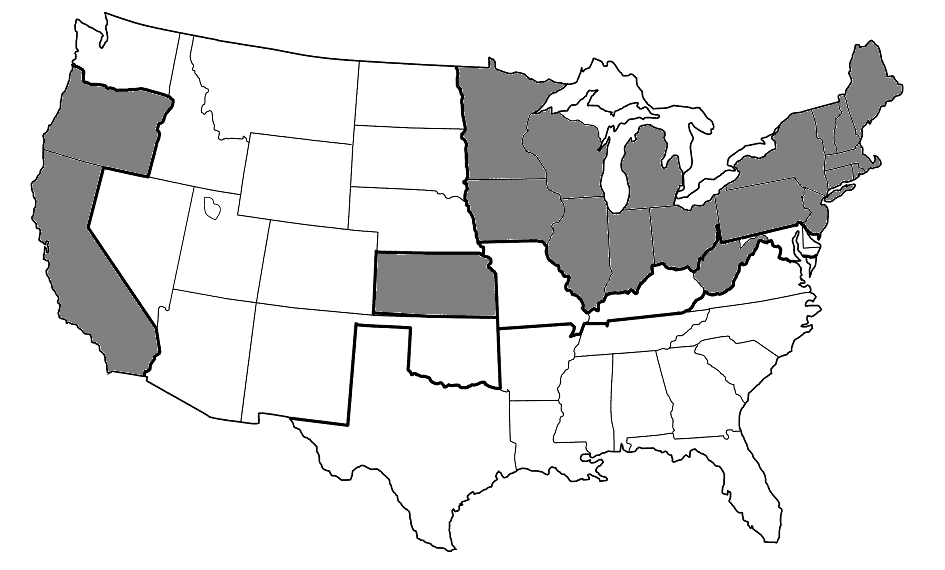
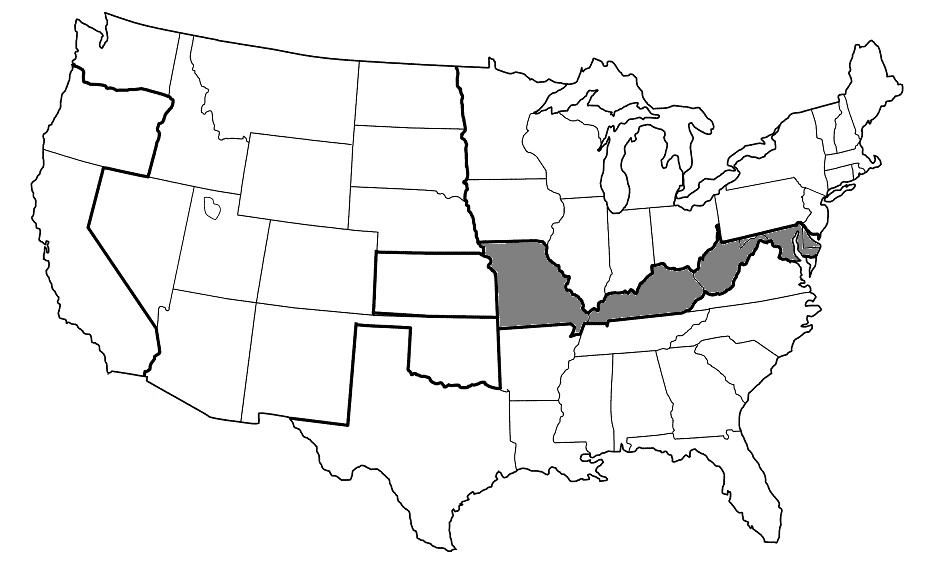
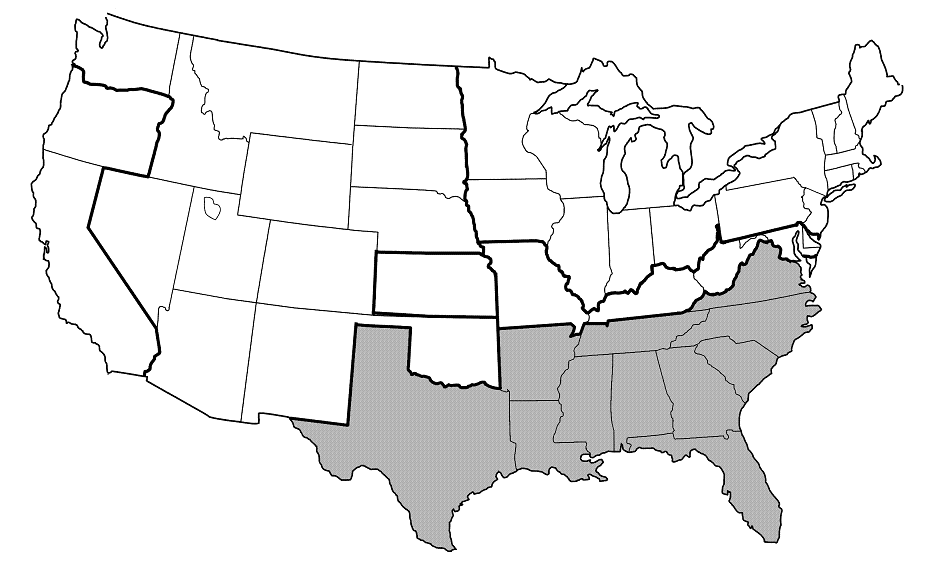
Which map shows the Union Border States?
Which map shows the Confederate States?
Tensions over the issue of slavery increased as ___.
new territories opened up in the West
Southerners began promoting slavery in the North
the US lost the Mexican-American War
Once a territory had 60,000 people, it could apply to become a state. This was difficult because ___.
most territories would never get 60,000 people to live there
adding new states would upset the balance of power in Congress
most people did not want the US to expand to the West
The South feared the North would take control of Congress and began proclaiming ____ as a way to protect their way of life.
Southern secession
national supremacy
states' rights
Which of the following statements are true?
SELECT ALL THAT APPLY
The South believed the individual states should have more power than the national government (Congress).
The North believed the individual states should have more power than the national government (Congress).
The South believed the national government has more authority/power.
The North believed the national government has more authority/power.
Which pre-war compromise or Supreme Court Decision allowed Missouri to join the Union as a slave state and Maine to join as a free state?
Compromise of 1850
Dred Scott Decision
Kansas-Nebraska Act
Missouri Compromise
Which pre-war compromise or Supreme Court Decision created an imaginary line below Missouri's Southern border and said no territory above this line could allow slavery?
Compromise of 1850
Dred Scott Decision
Kansas-Nebraska Act
Missouri Compromise
Which pre-war compromise or Supreme Court Decision allowed California to join the Union as a free state?
Compromise of 1850
Dred Scott Decision
Kansas-Nebraska Act
Missouri Compromise
Which pre-war compromise or Supreme Court Decision divided the Mexican Cession into two Southwest territories, and allowed these two territories to vote on the issue of slavery?
Compromise of 1850
Dred Scott Decision
Kansas-Nebraska Act
Missouri Compromise
Which pre-war compromise or Supreme Court Decision made stricter fugitive slave laws, requiring the North to return runaway slaves to the South?
Compromise of 1850
Dred Scott Decision
Kansas-Nebraska Act
Missouri Compromise
Which pre-war compromise or Supreme Court Decision gave popular sovereignty to the people in the Kansas and Nebraska territories?
Compromise of 1850
Dred Scott Decision
Kansas-Nebraska Act
Missouri Compromise
Which pre-war compromise or Supreme Court Decision said slaves were not citizens, but property, and could be taken into any state or territory by their masters?
Compromise of 1850
Dred Scott Decision
Kansas-Nebraska Act
Missouri Compromise
Which pre-war compromise or Supreme Court Decision canceled out all pre-war compromises by opening up all of the US and its territories to slavery?
Compromise of 1850
Dred Scott Decision
Kansas-Nebraska Act
Missouri Compromise
Why did the Southern states start to secede and form the Confederate States of America?
A Constitutional amendment banned slavery
Abraham Lincoln was elected president
The Supreme Court prevented slavery from spreading to the West
___ believed that the United States was one nation, a union, that could not be separated or divided.
the founding fathers
Abraham Lincoln and many Northerners
Most Southerners
___ believed that states had freely created and joined the Union and could freely leave it.
A majority of all U.S. Citizens
Abraham Lincoln and many Northerners
Most Southerners
What happened after several states seceded from the Union that caused the other Southern states to secede and marked the beginning of the Civil War.
Lincoln was elected president
the Dred Scott Decision
the Confederate attack on Fort Sumter
The North was mainly an _____ society in which people held jobs.
urban
rural
suburban
A tariff is ___.
a Civil War Sheriff
a long battle or attack
a tax on imports (goods from other countries)
The South was primarily an ______ society in which people lived in small villages and on farms and plantations.
urban
rural / agricultural
suburban
The North favored tariffs because ___.
it would make goods cheaper
it would increase imports
it would protect factory owners and workers from foreign competition
The South opposed tariffs because ___.
SELECT ALL THAT APPLY
it would increase the price of manufactured goods
it would increase imports
it would protect farmers from foreign competition
England might stop buying American cotton
Which statement best describes the South's beliefs about the power of government according to the Constitution?
The National Government is supreme over State governments
State governments should have more power than the National Government (States' Rights)
The National and State Governments should have equal power
Which statement best describes the North's beliefs about the power of government according to the Constitution?
The National Government is supreme over State governments
State governments should have more power than the National Government (States' Rights)
The National and State Governments should have equal power
Which statement best describes the North's beliefs about slavery?
It was necessary to keep Northern textile mills running
The Northern economy would be destroyed if slavery ended
Slavery was morally wrong and violated the principles of democracy
Which statement best describes the South's beliefs about slavery?
Slavery should not expand to any new Western territory
The Southern economy would be destroyed if slavery ended
Slavery was morally wrong and violated the principles of democracy
Which major issues divided the Nation?
SELECT ALL THAT APPLY
Cultural Differences
Constitutional Differences
Economic Differences
Slavery

