Wayground logo

Free Printable Worksheets

Font size

S
M
L
XL
Worksheets

Plants Review

Total questions: 53

Worksheet time: 37mins

Name
Class
Date
1.
What  anchor plants to the ground and absorb water and nutrients?
a)
Roots
b)
Stem
c)
Xylem
d)
Leaves
2.
What is the tissue that is used to transport necessary materials throughout the plant?
a)
Circulatory tissue
b)
Transport tissue
c)
Vascular tissue
d)
Pathway tissue
3.
Which of the following statements best describes xylem's function in the plant?
a)
transpports water and minerals up from the roots to the rest of the plant
b)
transports food down from the leaves to the rest of the plant
c)
transports water and minerals down from the roots to the rest of the plant
d)
transports food up from the leaves to the rest of the plant
4.
Which of the following statements best describes phloem's function in the plant?
a)
transpports water and minerals up from the roots to the rest of the plant
b)
transports food down from the leaves to the rest of the plant
c)
transports water and minerals down from the roots to the rest of the plant
d)
transports food up from the leaves to the rest of the plant
5.
What is the part of the flower that is brightly colored to attract pollinators?
a)
Petals
b)
Stamen
c)
Pistil
d)
Sepals
6.
What is the male part of the flower?
a)
Petals
b)
Stamen
c)
Pistil
d)
Sepals
7.
What is the female part of the flower?
a)
Petals
b)
Stamen
c)
Pistil
d)
Sepals
8.
What part of the male part of the flower makes pollen?
a)
Ovary
b)
Anther
c)
Filament
d)
Stigma
9.
What part of the male part of the flower holds up the anther?
a)
Ovary
b)
Anther
c)
Filament
d)
Stigma
10.
What part of the female part of the flower gathers pollen?
a)
Ovary
b)
Style
c)
Filament
d)
Stigma
11.
What part of the female part of the flower is a tube that pollen travels through?
a)
Ovary
b)
Style
c)
Filament
d)
Stigma
12.
What part of the female part of the flower is the place that holds the eggs?
a)
Ovary
b)
Style
c)
Filament
d)
Stigma
13.
What is the male reproductive material of plants?
a)
Seeds
b)
Pollen
c)
Fruit
d)
Sepals
14.
What organelle in the leaves of plants capture light energy from the sun to complete photosynthesis?
a)
Chloroplasts
b)
Mitochondria
c)
Nucleus
d)
Ribosomes
15.
What is the waxy layer on leaves?
a)
Chloroplasts
b)
Plastic
c)
Wax
d)
Cuticle
16.
What is the function of the cuticle on a leaf?
a)
to keep water from entering the leaf
b)
to keep water from leaving the leaf
c)
to keep bacteria out of the leaf
d)
to keep oxygen in the leaf
17.
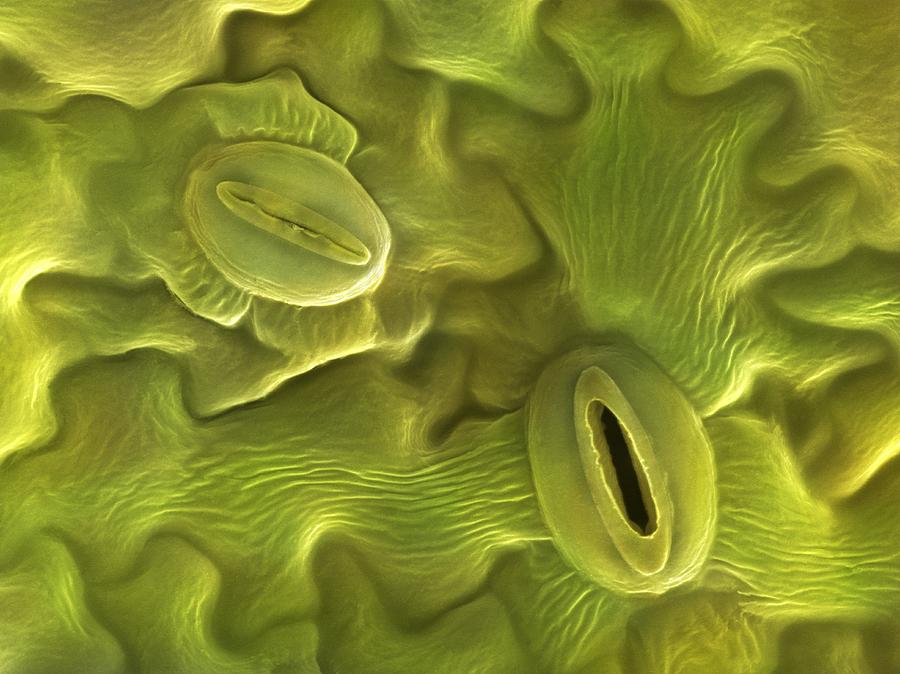
What are the openings on the underside of leaves that let carbon dioxide into the leaf and let oxygen out?
a)
Chloroplasts
b)
Stomata
c)
Stomach
d)
Cuticle
18.
What is pollination?
a)
the transfer of pollen from the anther to the stigma
b)
the union of pollen and egg cells in the ovary of the flower
c)
the dispersal of seeds to a new location
d)
the transfer of cash in a business transaction between plants
19.
What is fertilization?
a)
the transfer of pollen from the anther to the stigma
b)
the union of pollen and egg cells in the ovary of the flower
c)
the dispersal of seeds to a new location
d)
the transfer of cash in a business transaction between plants
20.
What helps plants pollinate by carrying pollen from one plant to another?
a)
Mailman
b)
Pollinator
c)
Terminator
d)
Commentator
21.
In which type of growth response does the plant grow toward a light source?
a)
Phototropism
b)
Heliotropism
c)
Geotropism
d)
Hydrotropism
22.
A flowering plant with leaves that have parallel veins.
a)
gymnosperms
b)
angiosperms
c)
dicot
d)
monocot
23.
Any seed plant that has no woody stem.
a)
monocot
b)
dicot
c)
herbaceous 
d)
gymnosperm
24.
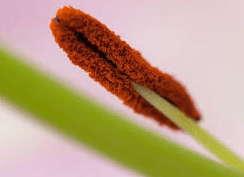
The part of a flower that produces the male reproductive cells.
a)
anther
b)
style
c)
stigma
d)
filament
25.
Their leaves are not veined, and the flower parts are usually in fours or fives.
a)
monocot
b)
dicot
c)
angiosperm
d)
gymnosperm
26.
The stalk connecting the ovaries and stigmas.
a)
filament
b)
pistil
c)
style
d)
anther
27.
They enclose the egg cells inside the ovaries.
a)
ovules
b)
anther
c)
seeds
d)
angiosperms
28.
The transfer of pollen, containing the sperm cells, to the female part of the flower. 
a)
seed disperal
b)
pollination 
c)
germination
d)
fertilization
29.
When a seed sprouts and begins the early growth of a young plant.
a)
germination
b)
pollination
c)
seed dispersal
d)
fertilization
30.
Plants need sunlight to survive because _________ .
a)
they need to stay very warm.
b)
they need to be able to see danger.
c)
they get minerals from sunlight.
d)
they make food from sunlight.
31.
What is the substance in plants that make them green?
a)
stigma
b)
carbon dioxide
c)
photosynthesis
d)
chlorophyll
32.
Opening that allows gas exchange
a)
Stomata
b)
Leaves
c)
Roots
d)
Vascular tissue
33.
___ opens and closes the stomata.
a)
Guard cells
b)
Xylem
c)
Roots
d)
Phloem
34.
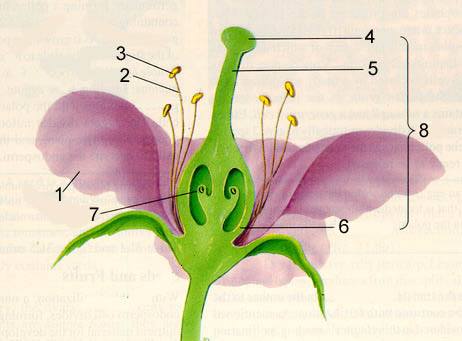
What is #4 pointing to?
a)
anther
b)
style
c)
stigma
d)
ovary
35.
Plants need the following:
a)
air, water, space, sunlight
b)
air, water, oxygen, space
36.

Almost all plants are__________________

a)

Producers

b)

Consumers

c)

Decomposers

37.

The process that plants and other organisms use to convert solar energy to chemical energy is called ____________________.

a)

Photosynthesis

b)

Glucology

c)

Chlorophyl

38.

In plants, photosynthesis occurs in an organelle called a ______________________.

a)

Chloroplasts

b)

Ribosomes

c)

Nucleus

d)

Chlorophyll

39.

____________________is a green pigment that captures energy from sunlight.

a)

Chloroplasts

b)

Ribosomes

c)

Nucleus

d)

Chlorophyll

40.

•Chloroplasts use this energy, along with carbon dioxide and water, to make food in the form of a sugar called _______________.

a)

Glucose

b)

Sucrose

c)

Fructose

41.

What things do plants take in during Photosynthesis?

a)

Carbon Dioxide

b)

Water

c)

Oxygen

d)

Sun's Energy

42.

What do plants make during Photosynthesis?

a)

Sugar (Glucose)

b)

Food

c)

Oxygen

d)

Carbon Dioxide

43.

Mosses and their relatives, such as liverworts and hornworts, are _______________ plants.

a)

nonvascular

b)

vascular

44.

______________________ are plants that produce seeds that are not enclosed in a fruit.

a)

Gynosperms

b)

Angiosperms

45.

_______________________ are vascular plants that produce flowers and fruits that surround and protect seeds.

a)

Angiosperms

b)

Gymnosperms

46.

What does the seed coat do?

a)

Protects the embryo and food store

b)

Grows into a new shoot and root

c)

Provides energy for the embryo to grow

d)

Affects the rate of a chemical reaction

47.

What method of reproduction involves one parent?

a)

Sexual

b)

Asexual

48.

What is the name of the female gamete in plants

a)

Sperm

b)

Egg

c)

Pollen

d)

Ovule

49.
Tell whether it is monocot or dicot.
 
a)
Monocot
b)
Dicot
50.

What is this the chemical equation for: 6CO2+6H2O+Sunlight➡️C6H12O6+O2

a)

Respiration

b)

Transpiration

c)

Photosynthesis

51.

What do non flowering plants produce instead of seeds?

a)

Spores

b)

Fruit

c)

Leaves

d)

Pollen

52.

What is this the chemical equation for: C6H12O6+6O2➡️6CO2+6H2O

a)

Cellular Respiration

b)

Photosynthesis

c)

Transpiration

53.

What are three ways seeds travel?

a)

walking, flying, wind

b)

wind, ice, animals

c)

wind, water, animals

d)

wind, ice, animals