wayground logo

Free Printable Worksheets

Font size

S
M
L
XL
Worksheets

Practice Final

Total questions: 245

Worksheet time: 3hrs 58mins

Name
Class
Date
1.
A magician pulls a tablecloth out from under dishes and glasses on a table without disturbing them.
a)
Newton's 1st Law
b)
Newton's 2nd Law
c)
Newton's 3rd Law
2.
Pushing a child on a swing is easier than pushing an adult on the same swing, because the adult has more mass and requires more force to accelerate.
a)
Newton's 1st Law
b)
Newton's 2nd Law
c)
Newton's 3rd Law
3.
This person bought coffee and put it on the seat next to them. If they stopped quickly and the coffee spilled which law would that represent?
a)
Newton's 1st Law
b)
Newton's 2nd Law
c)
Newton's 3rd Law
4.
When you step on a Lego. You push on the Lego and the Lego pushes back on you.
a)
Newton's 1st Law
b)
Newton's 2nd Law
c)
Newton's 3rd Law
5.

Which one of Newton's Laws is best described by inertia?

a)

1st

b)

2nd

c)

3rd

6.
What is the definition of "weight"?
a)
measure of the force of gravity on your body
b)
the time it takes to get on a ride 
c)
the amount of matter in an object
d)
the size of an object
7.
A measure of how much matter an object has is--
a)
weight
b)
gravity
c)
mass
d)
volume
8.
The weight of an object _________ as it moves away from the center of Earth.
a)
increases
b)
stays the same
c)
triples
d)
decreases
9.
The mass of an object ___________ as it moves away from the center of Earth
a)
stays the same
b)
decreases
c)
increases
d)
doubles
10.
On which celestial object would you weigh the most?
a)
Earth
b)
Jupiter
c)
Sun
d)
You would weigh the same on all celestial objects
11.

On which celestial object (outer space) would your mass be the greatest?

a)

Earth

b)

Jupiter

c)

Sun

d)

Your mass doesn't change on different celestial objects
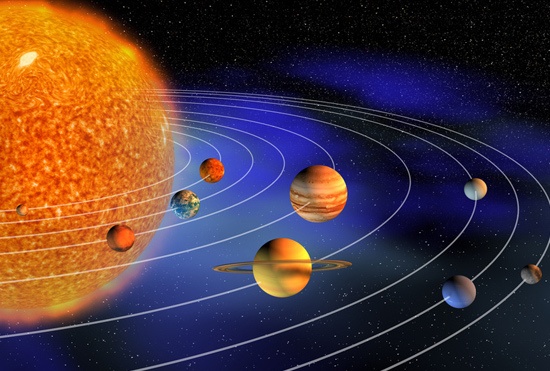
12.

Why do all of the planets orbit the sun rather than Earth?

a)

the sun has more mass

b)

the sun is a star

c)

the Earth is heavier

d)

the sun is in the middle of the milky way
13.
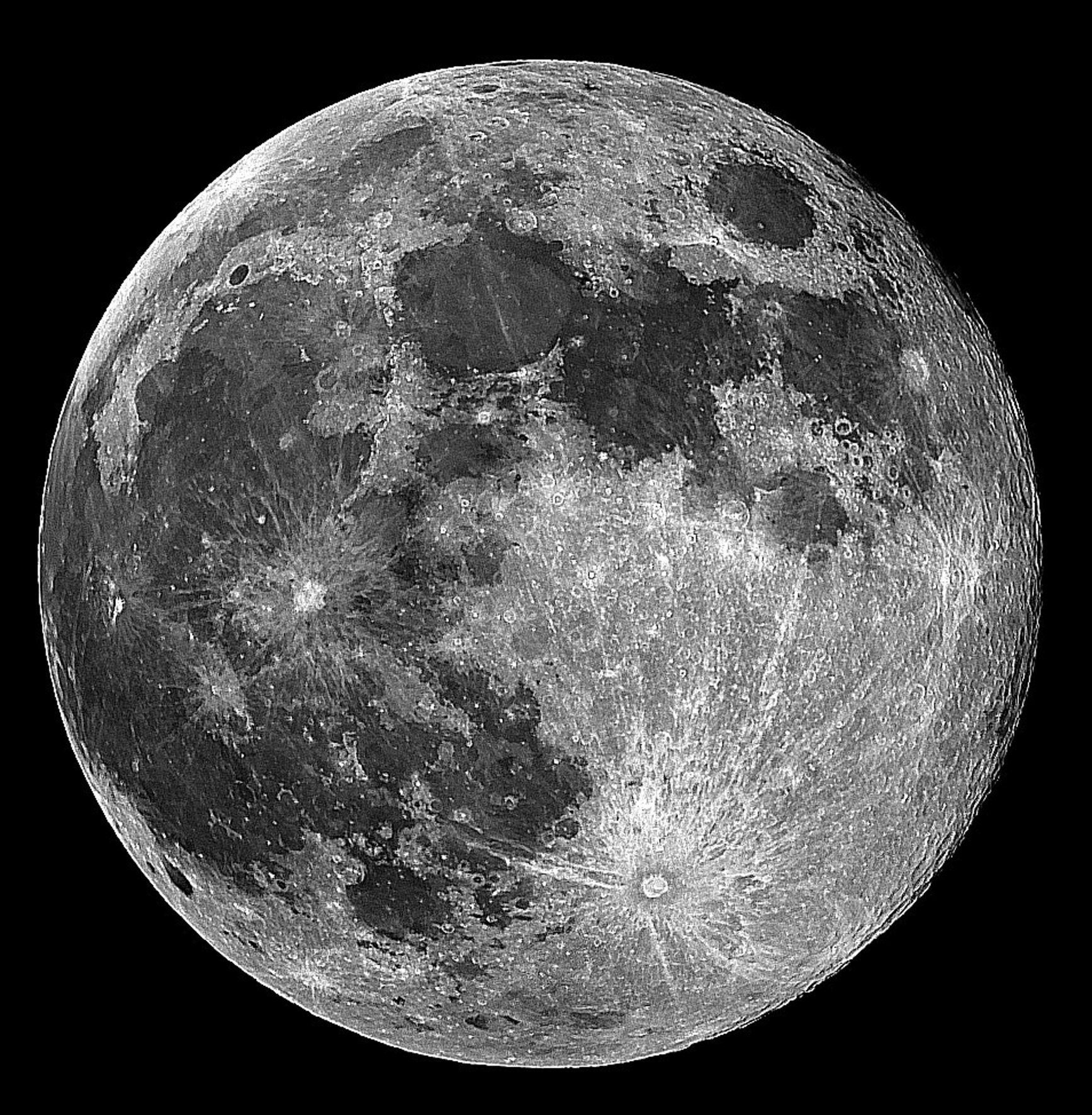
As an object's mass increases, its gravitational pull will ____________.
a)
decrease
b)
increase
c)
stay the same
d)
get weaker
14.
If an object has more mass, then it will
a)
weigh more.
b)
weigh less.
c)
weigh the same as an object with less mass.
d)
always have more volume than an object with less mass.
15.
Why would you weigh less on the moon compared to Earth?
a)
less air
b)
less sunlight
c)
more gravitational pull
d)
less gravitational pull
16.

Which one of Newton's Laws is best represented by the image?

a)

1st

b)

2nd

c)

3rd

17.

Which one of Newton's Laws is best represented by the image?

a)

1st

b)

2nd

c)

3rd

18.

Which one of Newton's Laws is best represented by the image?

a)

1st

b)

2nd

c)

3rd

19.

Which one of Newton's Laws is best represented by the image?

a)

1st

b)

2nd

c)

3rd

20.

Which one of Newton's Laws is summarized by: An object at rest stays at rest.

a)

1st

b)

2nd

c)

3rd

d)

None

21.

Which one of Newton's Laws is summarized by: F = MxA

a)

1st

b)

2nd

c)

3rd

22.

Which one of Newton's Laws is summarized by: Acceleration is due to a force put on an object's mass.

a)

1st

b)

2nd

c)

3rd

d)

None

23.

Which one of Newton's Laws is summarized by: Action/Reaction

a)

1st

b)

2nd

c)

3rd

d)

None

24.

Which one of Newton's Laws is summarized by: Equal and Opposite

a)

1st

b)

2nd

c)

3rd

d)

None

25.
What is the unit to MEASURE force?
a)
Kilogram
b)
Meter
c)
Pascal
d)
Newton
26.
What is the net force?
a)
10 N
b)
0 N
c)
25 N
d)
1 N
27.
If these teams are pulling with the same amount of force what will happen?
a)
The boy in blue will win.
b)
They will not move at all.
c)
The boy in red will win.
d)
Both will fall down.
28.
Balanced or Unbalanced?
a)
Balanced 
b)
Unbalanced
29.
What is the net force?
a)
400 N Up
b)
400 N Down
c)
- 400 N Down
d)
800 N Down
30.

Unit of mass

a)

m/s2

b)

m/s

c)

newtons

d)

kg

31.

45 m/s2 is the...

a)

Mass

b)

Force

c)

Acceleration

d)

Weight

32.
What is the tendency of an object to resist a change in motion?
a)
coffee
b)
motion
c)
inertia
d)
gravity
33.
A rocket with less ________ will have a greater acceleration.
a)
Mass
b)
At Rest
c)
Reaction
d)
Resist
34.
Force exerted between the surfaces of two objects. 
a)
Friction
b)
Inertia
c)
Force
d)
Gravity
35.
Push or Pull
a)
Friction
b)
Inertia
c)
Force
d)
Gravity
36.

Objects' attraction to one another - like us to earth.

a)

Friction

b)

Inertia

c)

Force

d)

Gravity

37.
Which of the following does not happen to an atom when it loses an electron?
a)
It becomes positively charged
b)
It becomes negatively charged
c)
It attracts atoms with a negative charge
d)
It repels atoms with a positive charge
38.
Friction between 2 objects causes which part of the atom to jump from one object to the other?
a)
electrons
b)
neutrons
c)
protons
d)
nucleus
39.
Static electricity is created when
a)
the number of protons and electrons in an atom are equal
b)
there is an unequal distribution of electrons
c)
protons jump from one object to another
d)
there are more neutrons than protons or electrons in the atoms
40.
Lightning and a spark are essentially the same thing because
a)
they both result from an exchange of protons
b)
they both result from an exchange of neutrons
c)
they both result from static electricity
d)
they are not the same
41.
A balloon is rubbed on someone's hair, then placed next to a stream of water, what happens?
a)
the water stream bends towards the balloon
b)
the water stream bends away from the balloon
c)
nothing
d)
the balloon gets wet
42.
A balloon is rubbed on someone's hair, then placed next to a stream of water.  Why does the water stream bend towards the balloon?
a)
the balloon and the water repel because they have like charges
b)
the balloon and the water attract because they have like charges
c)
the balloon and the water repel because they have opposites charges
d)
the balloon and the water attract because they have opposite charges
43.
Which charges inside an atom flow and create electricity?
a)
neutral
b)
positive
c)
negative
d)
protons
44.
Which part of the atom has a negative charge?
a)
electron
b)
neutron
c)
nucleus
d)
proton
45.
Which part of the atom has a positive charge?
a)
electron
b)
neutron
c)
orbitals
d)
proton
46.
Which part of the atom has a neutral charge?
a)
electron
b)
neutron
c)
nucleus
d)
proton
47.
Friction can cause an object to have a positive or negative charge because it creates an unequal balance of ____________ in the object.
a)
electrons
b)
neutrons
c)
protons
d)
nuclei
48.
Which of the following does not happen to an object that collects electrons on its surface?
a)
It repels other negatively charged objects
b)
It attracts other positively charged objects
c)
It becomes negatively charged
d)
It attracts other negatively charged objects
49.
Which of the following would not increase the strength of an electromagnet?
a)
more current flowing through the wires
b)
a magnet with two north poles
c)
more coils in the wire
d)
a bigger iron bar
50.
What is the mass of an electron?
a)
1 amu
b)
2 amu
c)
nearly nothing
51.
What is the mass of a neutron?
a)
1 amu
b)
2 amu
c)
nearly nothing
52.
What is the mass of a proton?
a)
1 amu
b)
2 amu
c)
nearly nothing
53.
A proton has about the same mass as a neutron.
a)
True
b)
False
54.
Static electricity and magnetism are both invisible forces.
a)
true
b)
false
55.
Static electricity and magnetism both involve movement of ___________.
a)
atoms
b)
electrons
c)
neutrons
d)
protons
56.
_____________ are materials that keep their built up charges and ______________ are materials that pass on their charges when enough are built up.
a)
conductors, insulators
b)
non-conductors, insulators
c)
conductors, non-conductors
d)
insulators, conductors
57.
Why was the plastic band repelled by the balloon after both were rubbed with a flannel cloth?
a)
both had neutral charges
b)
they had different charges
c)
they had the same charge
d)
only the balloon was charged
58.
Like charges ___________, opposite charges _____________.
a)
repel, repel
b)
attract, attract
c)
attract, repel
d)
repel, attract
59.
The hottest layer
a)
crust
b)
inner core
c)
mantle
d)
outer core
60.
The coolest layer
a)
crust
b)
inner core
c)
mantle
d)
outer core
61.
The thinest layer
a)
crust
b)
inner core
c)
mantle
d)
outer core
62.
The thickest layer
a)
crust
b)
inner core
c)
mantle
d)
outer core
63.
The least dense layer
a)
crust
b)
inner core
c)
mantle
d)
outer core
64.
The most dense layer
a)
crust
b)
inner core
c)
mantle
d)
outer core
65.
This layer is completely liquid
a)
crust
b)
inner core
c)
mantle
d)
outer core
66.
This layer is a mix between solid and liquid often referred to as plastic
a)
crust
b)
inner core
c)
mantle
d)
outer core
67.
This layer is completely solid due to the intense pressure it is under
a)
crust
b)
inner core
c)
mantle
d)
outer core
68.
This layer is solid
a)
crust
b)
asthenosphere
c)
mantle
d)
outer core
69.
A can of Coke will sink in a bowl of water.  A can of Diet Coke will float in a bowl of water.  What does this tell you about the density of the Diet Coke?
a)
it is bigger than 1
b)
it is smaller than 1
c)
it is equal to 1
d)
it is equal to -1
70.

Johnny finds a gold colored rock in a river. It has a mass of 9.65 grams and a volume of 0.5 cm3. What is the density of the rock?

a)

10.15 g/cm3

b)

19.3 g/cm3

c)

9.15 g/cm3

d)

4.825 g/cm3

71.
Which property of matter is determined by dividing its mass by its volume?
a)
elasticity
b)
buoyancy
c)
density
d)
viscosity
72.
The following liquids are poured together in a beaker: alcohol (density=0.79), corn syrup (density=1.38), water (density=1.0), and cooking oil (density=0.93).  Which of these liquids will sink to the bottom of the beaker?
a)
alcohol
b)
corn syrup
c)
water
d)
cooking oil
73.
A brick sinks in water while a wooden block of the same size floats.  This is because the brick has a
a)
lower volume than the wooden block
b)
lower density than the wooden block
c)
higher volume than the wooden block
d)
higher density than the wooden block
74.
A scientist has four different liquids and pours them all into a bottle.  The silver liquid sinks to the bottom, the red liquid settles on top of the silver one, and the pink liquid stays at the surface. Which liquid has the smallest density?
a)
the pink liquid
b)
the silver liquid
c)
the red liquid
d)
the water
75.
What is the density of water?
a)
0 g/ml
b)
1 g/ml
c)
10 g/ml
d)
100 g/ml
76.

Which of these would be correct to put at the end of a density answer?

a)

g/cm

b)

cm3

c)

g/ml

d)

g/lb

77.
Which box has a higher density?  
a)
Box A
b)
Box B
c)
cannot be determined
d)
they are the same
78.
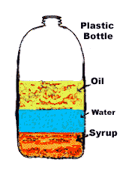
Which liquid is the least dense?
a)
oil
b)
water
c)
syrup 
d)
plastic bottle
79.

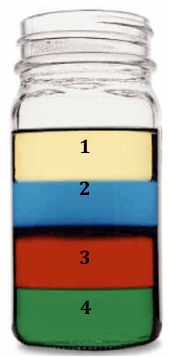
Put the liquids in order from most dense to least dense.

a)

4, 3, 2, 1

b)

1, 2, 3, 4

c)

3, 4, 2, 1,

d)

4, 3, 1, 2

80.
The tool used to measure the mass of a substance or object is a ______________.
a)
balance
b)
graduated cylinder
c)
ruler
d)
thermometer
81.
What is the formula for density?
a)
density = mass x volume
b)
density = mass / volume
c)
density = mass + volume
d)
density = mass - volume
82.

As you travel from the inner core to the crust, how would temperature, pressure and density of the material change?

a)

They would all increase

b)

They would all decrease.

c)

They would stay the same.

d)

Temperature would decrease, but pressure and density would increase.

83.
Which layer of Earth is located above the outer core?
a)
crust
b)
inner core
c)
mantle
d)
lithosphere
84.
What would happen to the convection currents if the heat from the inner core disappeared? 
a)
They would stop. 
b)
They would change directions. 
c)
It would not change. 
d)
They would speed up. 
85.
If you traveled from the center of Earth to the surface, the pressure would...
a)
increase
b)
decrease
c)
stay the same
d)
unsure
86.
Which of the following occurs because of convection currents?
a)
Tectonic plates on the crust move.
b)
The mantle increases in size.
c)
Pressure in the crust increases.
d)
Pressure in the crust decreases.
87.
Scientists think that convection currents that move the plates flow in Earth's
a)
Continental crust
b)
Oceanic crust
c)
Asthenosphere
d)
Lithosphere
88.
The mantle of Earth is made partly of magma. When magma rises and sinks, this is called ______________. 
a)
a conduction current
b)
a hot spot
c)
a volcanic eruption
d)
a convection current
89.
What was the name given to all the continents when they were joined as one super continent? 
a)
Supreme Continent
b)
Eurasia
c)
Plate tectonics
d)
Pangea
90.
Which of the following is NOT evidence to support the theory of plate tectonics?
a)
Fossils
b)
Mountains
c)
Glaciers
d)
Sand Erosion
91.
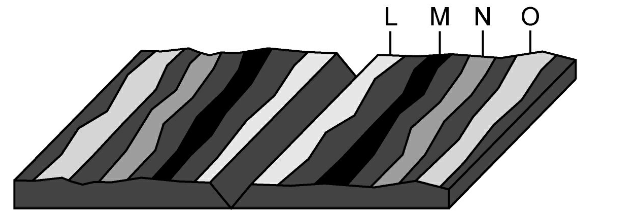
If a mid-ocean ridge is in the center of this picture, where would the oldest rock be found?
a)
L
b)
M
c)
N
d)
O
92.
How is it possible for new crust to be formed without increasing the surface area of the Earth?
a)
Crust is destroyed at the same time it is created
b)
New crust is underwater where it sinks
c)
New crust breaks more easily than old crust
93.
The Great Rift Valley in Africa and the Mid-Ocean Ridge were all created by this type of boundary
a)
Divergent
b)
Convergent
c)
Reform
d)
Transform
94.
What are the two types of crust
a)
continental and oceanic
b)
ocean and upper
c)
lower and upper
d)
pizza and subway
95.
Earthquakes and volcanoes are most likely found in which locations?
a)
At plate boundaries
b)
in oceans
c)
in the middle of continents
d)
in the middle of plates
96.
The Himalayas in Asia are an example of what type of plate boundary?
a)
divergent
b)
continent-to-continent convergent
c)
ocean-to-continent convergent
d)
transform
97.
The area where two tectonic plates meet.
a)
mantle
b)
focus
c)
plate boundary
d)
convection
98.
This landform can occur at a divergent plate boundary.
a)
ocean trench
b)
mid-ocean ridge
c)
tall mountains
d)
transform fault
99.
Supporting Evidence: fossils, continent shape, landforms
a)
Continental Drift
b)
Seafloor Spreading
c)
Plate Tectonics
100.
Supporting Evidence: subduction, earthquakes, volcanoes, Mid-Atlantic Ridge, older theories
a)
Continental Drift
b)
Seafloor Spreading
c)
Plate Tectonics
101.
Supporting Evidence: discovery of Mid-Atlantic Ridge, core rock samples showing older rocks the farther that you get from the mid ocean ridge
a)
Continental Drift
b)
Seafloor Spreading
c)
Plate Tectonics
102.
Ocean trenches always form at subduction zones where dense oceanic crust subducts.
a)
True
b)
False
103.
Volcanoes never form along subduction zones.
a)
True
b)
False
104.
The tectonic plates float on the 
a)
lithosphere
b)
lower mantle
c)
outer core
d)
asthenosphere
105.
Continental crust is more dense than oceanic crust.
a)
True
b)
False
106.
This area contains over 70 percent of volcanoes and 90 percent of earthquakes in the world.
a)
North American plate
b)
ring of fire
c)
fiery rings 
d)
African plate
107.
Mountains form from ...
a)
plates sliding past one another
b)
collision of plates
c)
plates moving away from each other
108.
What did Wegener think happened during continental drift?
a)
continents froze over
b)
continents moved
c)
the mantle warmed
d)
convection stopped
109.
The vibration and shaking of the Earth...
a)
volcanism
b)
plateau
c)
earthquake
d)
richter scale
110.
Younger sea floor crust is located...
a)
farther from the mid-ocean ridges
b)
at the mid ocean ridges
c)
at the subduction zone
d)
near the continents
111.
Which ocean is expanding due to a mid-ocean ridge?
a)
Indian
b)
Dead Sea
c)
Atlantic
d)
Artic
112.
Particles of rock, sand, soil, plant and animal remains
a)
erosion
b)
sediment
c)
weathering
113.
When rocks are broken down into smaller pieces
a)
erosion
b)
weathering
c)
sediment
114.
When water, ice and wind move particles of rock and soil from one place to another
a)
sediment
b)
weathering
c)
erosion
115.
A mass of ice that covers a large area and moves slowly
a)
gravity
b)
glacier
c)
sediment
116.

Erosion occurs when water, ice wind and gravity move __________________ and __________________ from one place to another

a)

water, air

b)

waves, rock

c)

rock, sediment

117.
Erosion caused by _______________ changes beaches and lakes
a)
glaciers
b)
ice
c)
waves
118.
Soil is a mixture of
a)
weathered rock particles
b)
plant and animal remains
c)
all of the above
119.

Water, wind, gravity, ice, plants are all part of this kind of weathering

a)

Chemical

b)

Mechanical

c)

Humid

120.
Earth's surface features are continually changing... this is due to
a)
wearing away of the surface
b)
building up of the surface
c)
Both wearing away and building up
121.
Which event is an example of erosion?
a)
Snow falls during a storm
b)
Rocks slide down a hill slide
c)
A plant grows on a sandy beach
122.
"Mountains are constantly being washed into the sea" ... this statement refers to the effects of
a)
Weathering and erosion
b)
Folding and faulting
c)
Fossil formation
123.
Carbon dioxide in rainwater dissolves limestone
a)
Chemical weathering
b)
Mechanical weathering
124.
The iron in the stones of the Grand Canyon turn the color of red
a)
Mechanical Weathering
b)
Chemical Weathering
125.

Based on the law of superposition, where would the oldest rocks be found.

a)

at the bottom

b)

at the top

c)

second from the bottom

d)

second from the top

126.

What is an unconformity?

a)

A layer of sedimentary rock

b)

A layer of rocks with unusual fossils

c)

An intrustion

d)

A missing time or gap in the rock record because of erosion

127.

Which technique can be used to determine the exact age of a rock?

a)

Radiometric dating

b)

Relative dating

128.

What are fossils?

a)

the oldest layers of rock in a region

b)

living creatures with habitats in or around rocks

c)

preserved remains or traces of once living things

d)

objects that people of long ago left behind as artifacts

129.

Which letter matches with the OLDEST layer of rock?

a)

W

b)

X

c)

Y

d)

Z

130.

The time that it takes 50% of an element to decay is called what?

a)

the daughter product

b)

the half-wit

c)

the half-life

d)

the half-time

131.

If the original mass of a radioactive element was 36 grams how much would be left after 1 half life?

a)

36 grams

b)

18 grams

c)

9 grams

d)

4.5 grams

132.

What kind of rock would you typically find fossils in?

a)

igneous

b)

metamorphic

c)

sedimentary

133.

Index fossils are used by geologists to

a)

match rocks of the same age in different regions

b)

determine the relative age of rocks in one place

c)

identify organisms that did not leave fossil evidence behind

d)

determine why some organisms became extinct

134.

What kind of dating is used to compare the age of a rock to those around it?

a)

Radiometric

b)

Relative

135.
What is one cause of an earthquake?
a)
weathering by glaciers
b)
movements along faults
c)
deposition by moving water
d)
tsunamis forming in the ocean
136.
How can some of the impacts of earthquakes be reduced?
a)
by building structures that can sway with the motion
b)
by building structures that do not move with the motion
c)
by using satellites to monitor warning buoys in the ocean
137.

Landslides may be triggered by rain or ground shaking due to earthquakes.

a)

TRUE

b)

FALSE

138.

This hazard is caused when minerals in rocks such as limestone or sandstone are dissolved, creating holes inside the rock that eventually collapse.

a)

sinkhole

b)

liquefaction

c)

land subsidence

d)

ground rupture

139.
Earthquakes happen every day. Most are too small for humans to notice.
a)
True
b)
False
140.

Which type of rock results from melting and cooling of magma or lava?

a)

Igneous

b)

Metamorphic

c)

Sedimentary

d)

Extrusive

141.
Which type of rock forms from extreme heat and pressure?
a)
Igneous
b)
Sedimentary
c)
Organic
d)
Metamorphic
142.
A metamorphic rock changes into an igneous rock by what two processes?
a)
Melting and cooling
b)
Extreme heat and pressure
c)
Compaction and cementation
d)
Weathering and erosion
143.
Wind, water, and ice breaking down rock is called
a)
Erosion
b)
Deposition
c)
Compaction
d)
Weathering
144.
What is the MAIN way rocks are classified?
a)
Their color and shapes
b)
How they form
c)
Mineral bands
d)
Where they form
145.
True/False: Igneous rocks can only turn into metamorphic rocks.
a)
True
b)
False
146.
The process in which dissolved minerals crystallize and glue sediment together.
a)
compaction
b)
deposition
c)
organic rock
d)
cementation
147.

When sediments are pressed together tightly, this is called ____________.

a)

Compaction

b)

Cementation

c)

Weathering

d)

Erosion

148.
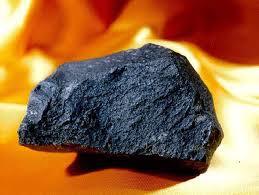
This rock was found near the mouth of a volcano. What type of rock is this?
a)
Sedimentary
b)
Igneous
c)
Metamorphic
149.
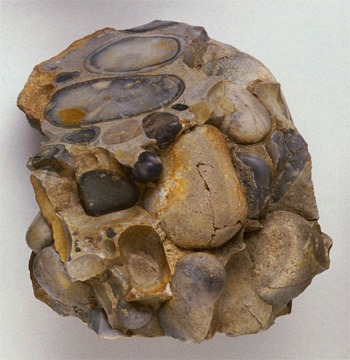
This rock was formed by smaller pieces of rock that settled at the bottom of a lake millions of years ago. What type of rock is this?
a)
Sedimentary
b)
Igneous
c)
Metamorphic
150.
What are the 3 major types of rocks?
a)
Igneous, Metamorphic, Sedimentary
b)
Metamorphic, Igneous, Cementation
c)
Brown, Red, Gray
d)
Streak, Hardness, Breakage
151.
This rock started as lava that cooled and then was heated and put under pressure over time. What type of rock is this?
a)
Sedimentar
b)
Igneous
c)
Metamorphic
152.
This rock started as molten magma. What type of rock is this?
a)
Sedimentary
b)
Igneous
c)
Metamorphic
153.
This rock is made from tiny pieces of other rocks that settled to the bottom of a valley millions of years ago. What type of rock is this?
a)
Sedimentary
b)
Igneous
c)
Metamorphic
154.
This rock was molten magma that slowly cooled under the ground. What type of rock is this?
a)
Sedimentar
b)
Igneous
c)
Metamorphic
155.
This rock cooled on the outside of a volcano and contained air bubbles when it was forming. What type of rock is this?
a)
Sedimentary
b)
Igneous
c)
Metamorphic
156.
After lots of time, pressure, and heat, you get this kind of rock. What type of rock is this?
a)
Sedimentary
b)
Igneous
c)
Metamorphic
157.
Each rock type can follow only one pathway of the rock cycle.
a)
True
b)
False
158.
Fossils are often found in ____________ because it is formed from the remains of once living things.
a)
metamorphic
b)
magma
c)
igneous
d)
sedimentary
159.

Which of the following changes to Earth's surface take place over a large spatial scale?

a)

mudslides/landslides

b)

canyon formation

c)

mountain building

d)

weathering of an arch

160.

Which of the following changes to Earth's surface take place over a small time scale?

a)

mudslides/landslides

b)

canyon formation

c)

mountain building

d)

volcanic eruption

161.

Which of the following changes to Earth's surface take place over a large time scale?

a)

mudslides/landslides

b)

canyon formation

c)

mountain building

d)

weathering of an arch

162.

Which of the following changes to Earth's surface take place over a small spatial scale?

a)

mudslides/landslides

b)

canyon formation

c)

mountain building

d)

weathering of an arch

163.
This is a picture of
a)
Cell wall
b)
Cell membrane
c)
chloroplast
d)
mitochondria
164.
The cell membrane is selectively permeable, which means...
a)
All materials can enter and leave the cell
b)
Certain things can enter while others cannot
c)
The cell manually sorts through all materials
d)
Only certain cells can interact with the cell.
165.
A can of air freshener is sprayed in the opposite side of the room.  Ten minutes later you start to smell the scent.  This is an example of 
a)
diffusion
b)
active transport
c)
endocytosis
d)
osmosis
166.
What is the name of the process in which molecules move from an area of high concentration to an area of low concentration across a selectively permeable membrane?
a)
Diffusion
b)
Osmosis
c)
Active Transport
d)
Facilitated Diffusion 
167.
What is homeostasis?
a)
How the body releases oxygen
b)
Passive transportation 
c)
How the body regulates itself for survival
d)
Active transport
168.
Permeable means
a)
things can pass through
b)
the concentration levels are different
c)
it is permanent
d)
things are stuck
169.
Against the concentration gradient
low to high
uses energy/ATP
a)
facilitated diffusion
b)
osmosis
c)
active transport
d)
simple diffusion
170.
A cell will _____________________ in a hypertonic solution.
a)
swell
b)
shrink
c)
will not change
d)
will explode
171.
A cell will __________________ in a hypotonic solution.
a)
swell and perhaps burst (lyse)
b)
shrink
c)
the size of the cell will not change
d)
the size of the cell will change from large to small and from small to large
172.
Active transport requires ______, moves materials from __________________, and goes _______ the concentration gradient.
a)
No energy, low to high, against
b)
ATP, high to low, with
c)
ATP, low to high, with
d)
ATP, low to high, against
173.
Osmosis is the movement of _____ across a membrane.
a)
food
b)
energy
c)
oxygen
d)
water
174.
Which is true about active transport?
a)
It requires energy
b)
it does not require energy
c)
It moves substances down the concentration gradient
d)
it moves material from high to low concentration
175.
The concentration of water is higher in the soil than in plant root cells. Water moves into root cells of a plant by...
a)
Facilitated Diffusion
b)
Simple Diffusion
c)
Active Transport
d)
Osmosis
176.
Due to the higher concentration of oxygen in the air than your blood, oxygen goes from the lungs into the red blood cells by....
a)
Facilitated Diffusion
b)
Simple Diffusion
c)
Active Transport
d)
Osmosis
177.
This cell organelle helps organisms maintain homeostasis by controlling what substances may enter or leave cells.
a)
vacuole
b)
nucleus
c)
cell membrane
d)
cell wall
178.
The dispersal of ink in a breaker of water is an example of 
a)
osmosis
b)
diffusion
c)
active transport
179.
The cell below is in a _________ solution.
a)
Hypotonic
b)
Hypertonic
c)
Isotonic
180.
A cell in an isotonic solution will
a)
swell
b)
shrink
c)
stay the same size
d)
impossible to tell
181.
Which system absorbs oxygen and releases carbon dioxide?
a)
respiratory
b)
excretory
c)
endocrine
d)
immune
182.
Which system acts as a barrier from the sun and helps regulate body temperature?
a)
integumentary
b)
muscular
c)
digestive
d)
circulatory
183.
Which system controls voluntary and involuntary movement?
a)
muscular
b)
skeletal
c)
immune
d)
excretory
184.
This system transports oxygen and nutrients around the body.
a)
circulatory
b)
respiratory
c)
skeletal
d)
digestive
185.
This system breaks down food into nutrients that the body can absorb.
a)
digestive
b)
excretory
c)
reproductive
d)
immune
186.
This system fights pathogens (germs) and produces and stores white blood cells.
a)
immune
b)
muscular
c)
endocrine
d)
integumentary
187.
This system supports the body and protects vital organs.
a)
skeletal
b)
muscular
c)
circulatory
d)
nervous
188.
This system sends chemical messagengers (hormones) that regulate growth, development, and metabolism.
a)
endocrine
b)
nervous
c)
immune
d)
skeletal
189.
Which system sends electrical messages that helps control the body's responses to internal and external changes?
a)
nervous
b)
endocrine
c)
reproductive
d)
integumentary
190.
Which of these is the least complex level of organization?
a)
earthworm
b)
digestive system
c)
skin cell
d)
stomach
191.
Cells need oxygen for
a)
diffusion
b)
cellular respiration
c)
photosynthesis
d)
osmosis
192.
What two systems work together to provide the cells with glucose?
a)
circulatory and respiratory
b)
digestive and resoiraory
c)
digestive and circulatory
d)
skeletal and muscular
193.
What two systems work together to supply the body with oxygen?
a)
respiratory and muscular
b)
respiratory and circulatory
c)
circulatory and digestive
d)
muscular and digestive
194.
Which example best shows structures that make up the digestive system in the human body? 
a)
Lungs, Heart, Arteries
b)
Brain, Spinal Cord, Nerves
c)
Stomach, Intestines, Esophagus
d)
Nose, Lungs
195.
What is included in the nervous system?
a)
Heart
b)
Skin
c)
Brain
d)
Lungs
196.
What is the function of the digestive system?
a)
Helps different parts of the body to move
b)
Carries digested food, water and oxygen in the blood to all parts of the body
c)
Carries waste materials away from different parts of the body
d)
Breaks down food into simple substances
197.
What is the function of the skeletal system?
a)
Supports the body
b)
Removes air from the body
c)
Absorbs substances so that they can be used by the body
d)
Breaks down food into simple substances
198.
The Golgi apparatus _____.
a)
packages cell products for export
b)
eliminates waste
c)
stores DNA
d)
makes energy
199.
Which organelle is only found in a plant cell? 
a)
nucleus
b)
chloroplast
c)
mitochondria
d)
cell membrane
200.
This organelle creates energy.
a)
Nucleus
b)
Ribosome
c)
Mitochondria
d)
ER
201.
Where is DNA stored in a cell? 
a)
Lysosomes
b)
Golgi Complex
c)
Ribosomes
d)
Nucleus
202.
What is the fluid inside a cell called? 
a)
Endoplasimic Reticulum
b)
Orange Juice
c)
Water
d)
Cytoplasm
203.
Which of these is NOT a part of the Cell Theory?
a)
All cells are independent.
b)
Cells are the basic unit of living things. 
c)
All living things are one or more cells.
d)
Cells come from cells.
204.
This organelle helps plants keep their rigid structure. 
a)
Cell wall
b)
Cell membrane
c)
Chloroplast
d)
Nucleus
205.
This organelle moves materials throughout the cell. 
a)
ER
b)
Ribosomes
c)
FedEx
d)
Golgi Complex
206.
This organelle eliminates waste. 
a)
Nucleus
b)
ER
c)
Vacuole
d)
Lysosome
207.
This organelle makes proteins. 
a)
Cell membrane
b)
Nucleus
c)
Ribosome
d)
ER
208.
Which structure helps plants stand up?
a)
cell membrane
b)
lysosome
c)
Golgi apparatus
d)
cell wall
209.
Plant and animal cells are identical. 
a)
True
b)
False
210.
The chloroplast _____.
a)
uses sugar to make energy
b)
eliminates waste products from the cell
c)
uses light energy to make sugar
d)
manufactures proteins for cell export
211.
What organelle destroys bacteria in the cell?
a)
lysosomes
b)
peroxisome
c)
centrosomes
d)
ribosomes
212.
This is a double layer of phospholipids that creates a barrier between the cells internal and external environments; it controls what comes in or out of the cell (selective permeable)
a)
Nucleus
b)
Cilia
c)
Cell membrane
d)
Flagella
213.
You are made up of...
a)
eukaryotic cells
b)
prokaryotic cells
c)
plant cells
d)
bacterial cells
214.
This stores the DNA that contains information for the cell. It is covered by a double membrane, called the nuclear envelope.
a)
nucleus
b)
nucleolus
c)
mitochondria
d)
endoplasmic reticulum
215.
This is a system of membranous tubules and sacs in eukaryotic cells that functions as a path along which molecules move from one part of the cell to another. Can be rough or smooth.
a)
Mitochondria
b)
Chloroplast
c)
Endoplasmic reticulum
d)
Centrioles
216.
A large fluid-filled vesicle located in the cytoplasm of a plant cell; stores water, enzymes, and waste; keeps toxic wastes away from the rest of the cell.
a)
Lysosome
b)
Vacuole
c)
Flagella
d)
Centrioles
217.
This organelle creates ATP.
a)
Nucleus
b)
Ribosome
c)
Mitochondria
d)
ER
218.
B=brown eyes
b= blue eyes
What is true about two brothers that have brown eyes?
One has genotype BB the other Bb.
a)
they have same phenotype and genotype
b)
they have different genotypes and phenotypes
c)
they have same phenotype but different genotypes
d)
they have same genotype but different phenotypes
219.
A dog gives birth to 5 puppies. What percentage of the chromosomes does each puppy share with the mother?
a)
25%
b)
50%
c)
75%
d)
100%
220.
What does heterozygous mean?
a)
An organism that has the same genes for a trait (TT or tt)
b)
An organism that has different genes for a trait (Tt)
c)
When neither gene is fully dominant; offspring is a mixture of both
d)
the different forms of a trait (hair color--> brown, blonde, red
221.
If a heterozygous tall pea plant is crossed with a short pea plant, what are the possible genotypes of the future offspring?
a)
100% Tt
b)
50% Tt, 50% tt
c)
75%Tt, 25%tt
d)
25%TT, 50%Tt, 25%tt
222.
This is an example of what?
a)
Complete dominance
b)
Incomplete dominance
c)
Codominance
d)
None of the above
223.
If T=Tall & t=short, what is the genotypic ratio?
a)
1:3
b)
3:1
c)
1:2:1
d)
2:2
224.
Two brown eyed parents (Bb) have a baby. What is the chance the baby is blue eyed?
a)
0 %
b)
25%
c)
50%
d)
75%
225.
A corn plant heterozygous for tall sprouts mates with a corn plant with short sprouts. If tall sprouts are dominant, how many different phenotypes are possible in the offspring?
a)
1
b)
2
c)
3
d)
4
226.
If a Homozygous red snapdragon and a Heterozygous pink snapdragon were crossed - what percentage of the offspring would be homozygous white?
a)
0%
b)
25%
c)
50%
d)
75%
227.
A heterozygous yellow pea plant's genotype would be:
a)
YY
b)
yy
c)
Yy
d)
Yg
228.
What is one advantage of sexual reproduction?
a)
offspring are identical to parents
b)
offspring are resistant to viruses
c)
offspring are born live, rather thna from eggs
d)
offspring inherit a wider variety of genetic information
229.
Incomplete dominance means that the traits are
a)
expressed equally
b)
dominant
c)
recessive
d)
blended
230.
W=white hair
w= non-white hair
If you cross a horse with WW and a horse with ww what fraction of the offspring would be expected to have white hair?
a)
none
b)
3/4
c)
1/2
d)
all
231.
What is a phenotype?
a)
The expression of a trait; what you see.
b)
refers to the genetic makeup of an individual
c)
An organism that has the same genes for a trait (ex. TT or tt)
d)
the passing of traits from parent to offspring
232.
What does heterozygous mean?
a)
An organism that has the same genes for a trait (TT or tt)
b)
An organism that has different genes for a trait (Tt)
c)
When neither gene is fully dominant; offspring is a mixture of both
d)
the different forms of a trait (hair color--> brown, blonde, red
233.

The inherited combination of alleles or genes is known as the offspring's

a)

heredity

b)

phenotype

c)

genotype

d)

redigree

234.

An organism's physical appearance is known as its

a)

heredity

b)

phenotype

c)

genotype

d)

pedigree

235.
Creates the greatest diversity, & therefore the ability to survive changing environments is
a)
sexual reproduction
b)
asexual reproduction
c)
cloning
d)
fragmentation
236.
Which of the following describes the main advantages of sexual reproduction
a)
requires lots of time/energy
b)
no new gene combos can arise 
c)
diversity
d)
looks identical to the parent
237.
Requires only ONE parent creating a clone of themselves-no diversity, large amounts of offspring
a)
natural selection
b)
selective breeding
c)
sexual reproduction
d)
asexual reproduction
238.
Passes genetic information
onto future generations
a)
sexual reproduction
b)
asexual reproduction
c)
both
239.

All of the offspring of an organism have the same genetic material, which is identical to the parent organism. From this, we can conclude that this organism -

a)

makes its own food

b)

is unicellular

c)

live in a marine habitat

d)

reproduces asexually

240.
What are some of the facts about asexual reproduction?
a)
Takes only one mate to reproduce and takes a longer time to reproduce
b)
Takes a shorter amount of time to reproduce and it takes two mates to reproduce
c)
Reproduces diverse offspring and takes a longer time to reproduce
d)
Takes only one mate to reproduce and takes a shorter time to reproduce
241.
What are some of the facts about sexual reproduction?
a)
Takes two mates to reproduce and takes a longer time to reproduce
b)
Takes one mate to reproduce and takes a shorter amount of time to reproduce
c)
Takes two mates to reproduce and takes a shorter amount of time to reproduce
d)
Takes one mate to reproduce and takes a shorter amount of time to reproduce
242.
Where does an off spring get its traits in asexual reproduction?
a)
From both parents
b)
From only one parent
c)
From neither parent
d)
There are no traits handed down
243.
What percentage of chromosomes are handed down by a sperm cell?
a)
75%
b)
25%
c)
50%
d)
100%
244.
What is an advantage of sexual reproduction?
a)
Allows genetic variation
b)
Only needs one parent
c)
Happens very quickly
d)
Offspring are exact copies of parent
245.

A human zygote, like most other human cells, contains 46 chromosomes. How many chromosomes does a zygote receive from the mother?

a)

0

b)

23

c)

46

d)

92