
 Worksheets
Unit 5 Final review
Total questions: 15
Worksheet time: 34mins
Name
Class
Date
1.
What is the Law of Conservation of Mass?
a)
It states that no matter can be created or destroyed.
b)
It states that no energy can be created or destroyed.
c)
It states that matter can be created or destroyed.
d)
It states that no sound can be created or destroyed.
2.
At the end of chemical reactions, what is the total mass of the reactants compared to the total mass of the products?
a)
the product is doubled
b)
the product is half the mass of the reactants
c)
the mass is the same
d)
the mass changes depending on the reaction
3.
Balance this equation.
_CF4 + _Br2 -- _CBr4 + _F2
_CF4 + _Br2 -- _CBr4 + _F2
a)
2,1,2,1
b)
1,2,2,1
c)
1,2,1,2
d)
2,2,2,2
4.
Balance this equation-
_SeCl6+_O2 ->_SeO2+_Cl2
_SeCl6+_O2 ->_SeO2+_Cl2
a)
1,2,1,2
b)
1,1,1,3
c)
1,2,1,1
d)
2,1,1,1
5.
Balance this equation.
_SnO2 +_H2-->_Sn +_H2O
_SnO2 +_H2-->_Sn +_H2O
a)
1,1,2,1
b)
1,2,1,1
c)
1,2,1,2
d)
1,2,2,1
6.
4Si + S8 --> 2Si2S4
a)
Synthesis
b)
Decomposition
c)
Single displacement
d)
Double displacement
7.
3Ca + 2AlCl3 --> 3CaCl2 + 2Al
a)
Synthesis
b)
Decomposition
c)
Single diplacement
d)
Double displacement
8.
3KOH + H3PO4 --> K3PO4 + 3H2O
a)
Synthesis
b)
Decomposition
c)
Single displacement
d)
Double displacement
9.
2Pb(NO3)2 --> 2PbO + 4NO2 + O2
a)
Synthesis
b)
Decomposition
c)
Single displacement
d)
Combustion
10.
C4H12 + O2 --> CO2 + H2O
a)
Synthesis
b)
Combustion
c)
Single Replacement
d)
Double Replacement
11.
Which reaction type is the following: C5H10O4 + O2 --> CO2 + H2O
a)
Decomposition
b)
Single Replacement
c)
Combustion
d)
Double Replacement
12.
What is the left part of a chemical equation called?
H2 + O → H2O
H2 + O → H2O
a)
Reactants
b)
Products
c)
Yields
d)
Chemical Equation
13.
What is the right part of a chemical equation called?
H2 + O → H2O
H2 + O → H2O
a)
Reactants
b)
Products
c)
Yields
d)
Chemical Equation
14.
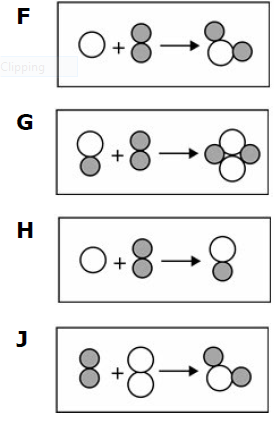
Which of the following models best demonstrates a balanced chemical equation?
a)
F
b)
G
c)
H
d)
J
15.
Si + S8 →Si2S4
a)
Synthesis (combination)
b)
Decomposition
c)
Single replacement
d)
Double replacement
100 %

