
 Worksheets
Phys Sci Semester 2 EOC Review Pt. 2
Total questions: 56
Worksheet time: 48mins

Hydrogen is element number 1. If you were given an atom of Hydrogen with a mass of 1 amu, how many neutrons does it have?
0
1
2
3

What is the mass of an atom of hydrogen that has 1 neutron?
0 amu
1 amu
2 amu
3 amu

How many valence electrons are in the atom above?
2
6
10
16
How many valence electrons does Lithium have? You may want to look at a periodic table.
1
2
3
4
How many valence electrons do most elements (that we learned about) want to have in their outer shells?
1
2
5
8


Exceptions to the octet rule include...
H and He
N and O
F and Fr
Ne and Ar
An atom with 3 valence electrons "wants" a full outer shell, so it can either gain 5 or lose 3. Which is more likely to occur?
Gain 5
Lose 3
Nothing

How many electrons can the second energy level hold?
1
2
8
0
An electron has what kind of charge?
no charge
positive
negative
it depends
a proton has what charge?
positive
negative
no charge
it depends
When the number of electrons equals the number of protons the atom has what charge?
sponge bob
positive charge
negative charge
neutral charge
An atom that has gained or lost electrons is called ...
a winner
an isotope
an ion
a loser
Atoms that lose electrons become...
negatively charged
postively charged
remain neutral, no charge
losers
Atoms that gain electrons become...
negatively charged
positively charged
remain neutrally charged
21
If an oxygen atom has 8 protons (+) and 10 electrons (-), what is it's charge?
O10-
O8+
O2-
O10+
An ionic bond is the attraction between:
(choose all correct answers)
oppositely charged ions
similarly charged ions
two metal ions
A metal ion and a non-metal ion
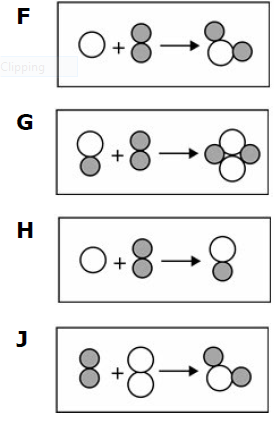
How do covalent bonds form?
Atoms taking other atom's electrons
Opposite slight charges attract each other between compounds.
Scientists are still not sure how they form.
Sharing valence e- between atoms.

What kind of bond are shown here?
covalent single bonds
covalent double bonds
ionic bonds
metallic bonds
Name this compound.
MgF2
(make note of what kind of bond it is...)
magnesium fluoride
manganese Phosphide
magnesium difluoride
dimagnesium fluoride
N2O4
In a chemical reaction, substances are changed in a way that creates new substances. The starting substances are called
Reactants
Products
Atoms
Catalysts
How many Al atoms are in this formula? 4Al2O3
2
8
6
4
_BaS + _PtF2 → _BaF2 + _PtS
which of the following shows this reaction balanced? (5 minutes)
1 BaS + 1 PtF2 → 1 BaF2 + 1 PtS
4 BaS + 2 PtF2 → 1 BaF2 + 1 PtS
1 BaS + 2 PtF2→ 2 BaF2 + 2 PtS
1 BaS + 3 PtF2 →1 BaF2 + 2 PtS
At the end of chemical reactions, what is the total mass of the reactants compared to the total mass of the products?
the product is doubled
the product is half the mass of the reactants
the mass is the same
the mass changes depending on the reaction
_K + _Cl2 →_KCl
which of the following shows this reaction balanced? (3 minutes)
2 K + 16 Cl2 → 8 KCl
2 K + 1 Cl2 → 2 KCl
3 K + 4 Cl2 → 3 KCl
1 K + 1 Cl2 →1 KCl
NH3 + HCl → NH4Cl
What happens in a decomposition reaction?
putting substances together
breaking substances apart
element replacing another element in a compoud
burning of a subtance
Substance that changes the rate of a chemical reaction without being consumed in the reaction
bonding
catalyst
chemical reaction
activation energy
A catalyst
is added to a reaction to make it slow down
breaks apart and is changed
raises activation energy
lowers activation energy
What is the activation energy?
The energy of the products
The energy of the reactants
The amount of energy needed to start the reaction
The energy lost in the reaction
If an endothermic reaction happens in a beaker, and we touched the beaker, it would feel _______.
Warm
Cold
Taste sour
acid
base
both
Are caustic or corrosive
acids
bases
both
Feels slippery
acids
bases
both
Conducts an electric current
acids
bases
both
Turns blue litmus red
acid
base
both


Source of quick energy
carbohydrates
lipids
proteins
nucleic acids



