wayground logo

Free Printable Worksheets

Font size

S
M
L
XL
Worksheets

2nd Semester Final Exam

Total questions: 44

Worksheet time: 1hrs 4mins
Name
Class
Date
1.
In what organelle is the genetic material (DNA) found inside?
 
a)
Endoplasmic Reticulum
b)
Golgi Complex
c)
Nucleolus
d)
Nucleus
2.
The two kinds of cells are Prokaryotes and Eukaryotes. How are they different?
a)
Prokaryotes have a nucleus.
b)
Eukaryotes have a nucleus.
c)
Prokaryotes are plant cells.
d)
There is no difference.
3.
The cell membrane regulates what enters and leaves the cell and also protects and supports the cell.
a)
True
b)
False
4.
When talking about the cell membrane, "selectively permeable" means...
a)
It doesn't allow any substance into the cell
b)
It only allows water out of the cell
c)
It only allows water into the cell
d)
Only some substances can pass through while others can't
5.
What is diffusion?
a)
when molecules move from a low concentration to a high concentration 
b)
when molecules move from a high concentration to a low concentration.
c)
no movement 
d)
molecules move everywhere
6.
Where is there a high concentration of bbq smoke?
a)
In the bbq pit
b)
In the house
c)
Two streets over
d)
In the atmosphere
7.
If a person sprays cologne in a room and someone across the room smells it, what is the process of the molecules dispersing across the room evenly called?
a)
Osmosis 
b)
Diffussion
c)
Dispersion
d)
Equilibrium
8.
Osmosis
a)
diffusion of water molecules through a semi-permeable mebrane from an area of low concentration to an area of high concentration
b)
the diffusion of particles from an area of high concentration to an area of low concentration
c)
diffusion of water molecules through a semi-permeable membrane from an area of high concentration to an area of low concentration
d)
the diffusion of particles from an area of low concentration to an area of high concentration
9.

Which of the following is the correct equation for PHOTOSYNTHESIS?

a)

6CO2 + light + 6H2O --> 6O2 + C6H12O6

b)

CO2 + C6H12O6 + H2O --> O2 + light

c)

O2 + light + H2O --> CO2 + C6H12O6

d)

CO2 + O2 + H2O --> Light + C6H12O6

10.

Light energy is converted to chemical energy during which process.

a)

Photosynthesis

b)

Cellular Respiration

c)

Calvin Cycle

d)

Chloroplast

11.

What is the name of the sugar formed during photosynthesis?

a)

Sugar

b)

Glucose

c)

Oxygen

d)

Carbon Dioxide

12.

What is the name of the pigment responsible for the absorption of light?

a)

Chlorophyll

b)

Thylokoids

c)

Stroma

d)

Chloroplast

13.

Which of the following is a product of photosynthesis? (hint: there is more than one answer)

a)

Oxygen

b)

Chlorophyll

c)

Carbon Dioxide

d)

Glucose

14.
Chloroplasts are...
a)
Structures of animal cells to produce ATP
b)
Organelles where lipids are elaborated
c)
Specialized structures of plants where food is made
d)
Waste organelle of plants
15.

Leaves look green because.....

a)

they eat their vegetables

b)

to blend into their environment

c)

they contain a molecule named chlorophyll which reflects green light

d)

genes in their DNA

16.

What are the reactants of Photosynthesis?

a)

Oxygen & Carbon Dioxide

b)

Glucose & Carbon Dioxide

c)

Carbon Dioxide & Water

d)

Carbon Dioxide, Water, & Light

17.

Which color is the least absorbed by a plants chlorophyll A?

a)

Pink

b)

Blue

c)

Red

d)

Green

18.

Jan Baptist van Helmont conducted an experiment in order to determine where a plants mass derives from. He reached the conclusion that the mass comes from...

a)

The Soil

b)

The Air (Carbon Dioxide)

c)

The Water

d)

The Nutrients & Minerals

19.

What is the definition of phenotype?

a)

The physical characteristic you can see

b)

The genetic combination of alleles

c)

A gene on the DNA strand

20.

What is the definition of genotype?

a)

The physical expression of a trait

b)

The genetic combination of alleles

c)

the genes on a DNA strand

21.

Which of the following will only show if a dominant trait is not present?

a)

a dominant trait

b)

a recessive trait

22.
Which of the following genotypes would be considered heterozygous?
a)
BB
b)
gg
c)
Ff
d)
TT
23.

Which of the following is a phenotype?

a)

Bb

b)

Brown fur

24.
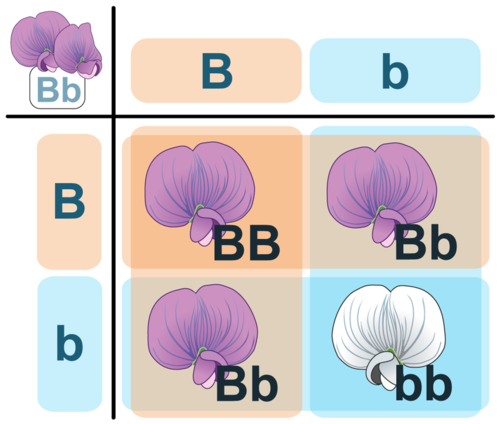
What is the phenotype of the heterozygous parent in the punnett square?
a)
green
b)
yellow
c)
hybrid
d)
purebred
25.
In this punnett square, which is the dominant trait?
The B stands for bud.
a)
purple flower bud
b)
white flower bud
c)
dominant
d)
recessive
26.
What percentage of the offspring in the punnett square are shown as a hybrid?
a)
100%
b)
75%
c)
50%
d)
25%
27.

What does homozygous mean?

a)

An organism that has the same genes for a trait (TT or tt)

b)

An organism that has different genes for a trait (Tt)

c)

When neither gene is fully dominant; offspring is a mixture of both

d)

the different forms of a trait (hair color--> brown, blonde, red

28.

The ability of an organism to survive and reproduce in its specific environment

a)

survival of the best

b)

evolution

c)

adaptation

d)

survival of the fittest

29.
Darwin wrote that organisms with traits that are best suited to the environment will ________________
a)
increase in number
b)
become extinct
30.

Which of the following is NOT an example of natural selection?

a)

People selectively breeding English Bulldogs.

b)

Insect populations developing resistance to certain pesticides.

c)

Bacteria becoming resistant to antibiotics.

d)

Male birds of certain species developing colorful feathers to attract female mates.

31.
Which term refers to the process by which individuals that are better suited to the environment survive and reproduce therefore passing down their genes to their offspring? 
a)
Evolution 
b)
Variation 
c)
Adaptation
d)
Natural Selection 
32.

Which species’ DNA is most similar to the DNA of the toothed whale?

a)

Hippopotamus

b)

Baleen Whale

c)

Grazing Mammals

d)

Camels

33.
The environment around Manchester, England, changed during the Industrial Revolution.  How did this change affect peppered moths living in the area?
a)
Natural selection favored moths with dark wings because predators could not see them on the soot-colored trees.
b)
Natural selection favored moths with white wings that were easy for predators to see.
c)
Natural selection favored moths with white wings because predators could not see them on the soot-colored trees.
d)
Natural selection caused moths with white wings to become extinct.
34.
Inherited trait that helps an organism survive is a(n) __________.
a)
Fossil
b)
Adaptation
c)
Ancestor
d)
Natural selection
35.

A trace of an organism from the past is called a _______.

a)

Ancestor

b)

Skeleton

c)

Fossil

d)

Imprints

36.

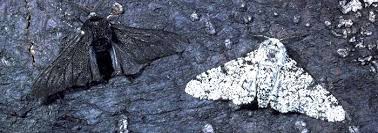
Predict which moth would increase in population given that the environment is depicted by the image

a)

light

b)

dark

37.

True or false: Genetics is the scientific study of genes.

a)

True

b)

False

38.
What does heterozygous mean?
a)
An organism that has the same genes for a trait (TT or tt)
b)
An organism that has different genes for a trait (Tt)
c)
When neither gene is fully dominant; offspring is a mixture of both
d)
the different forms of a trait (hair color--> brown, blonde, red
39.

A corn plant heterozygous for tall sprouts mates with a corn plant with short sprouts. If tall sprouts are dominant, how many different phenotypes are possible in the offspring?

a)

1

b)

2

c)

3

d)

4

40.
A heterozygous yellow pea plant's genotype would be:
a)
YY
b)
yy
c)
Yy
d)
Yg
41.

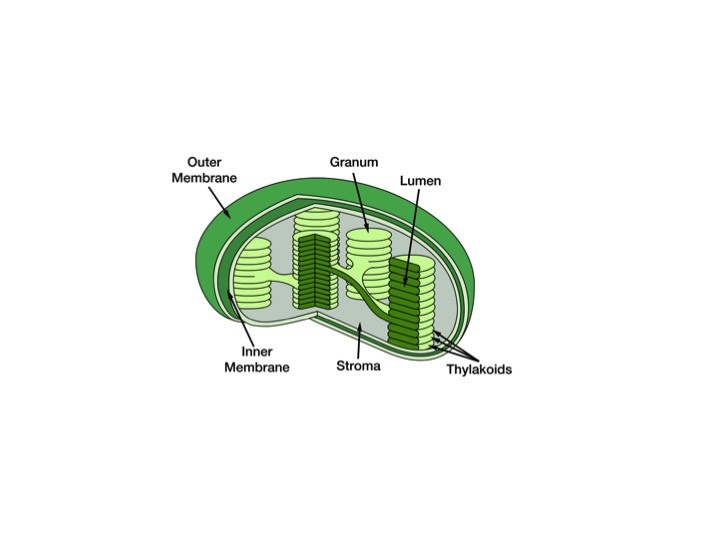
Which part of the chloroplasts contains the light absorbing molecules that initiate photosynthesis?

a)

Cytoplasm

b)

Stroma

c)

Thylokoids

d)

Cell Wall

42.
The diagram shows fossils in different rock layers. Which of these statements about the age of these fossils is most likely correct?
a)
Fossil A and C are the same age
b)
Fossil B is older than fossil C
c)
Fossils A is older than fossil B
d)
Fossil D is older than fossil C
43.
What does Darwin's theory of evolution suggest?
a)
species change over time
b)
extinct species are not related to living species
c)
different species can interbreed
d)
animals that look alike are most closely related
44.
According to this cladogram, birds are LEAST related to -
a)
Amphibians
b)
Sharks
c)
Ray Finned Fish
d)
Crocodiles