
 Worksheets
Compacted-Geometry Unit Test Review
Total questions: 74
Worksheet time: 2hrs 16mins
Name
Class
Date
1.

The angle relationship shown is -
a)
complementary angles
b)
supplementary angles
c)
vertical angles
d)
angle bisector
2.

∠1 and ∠3 can best be described as -
a)
complementary angles
b)
supplementary angles
c)
vertical angles
d)
adjacent angles
3.

∠AOB and ∠COB can best be described as -
a)
complementary angles
b)
supplementary angles
c)
vertical angles
d)
adjacent angles
4.

The angle relationship shown is -
a)
complementary angles
b)
supplementary angles
c)
vertical angles
d)
adjacent angles
5.

If m∠1 = 30°, then m∠3 =
a)
30°
b)
60°
c)
150°
d)
undetermined
6.
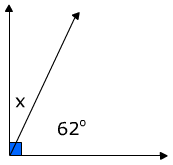
Find the value of x.
a)
18°
b)
28°
c)
38°
d)
118°
7.
How many degrees is a straight angle?
a)
90
b)
360
c)
180
d)
145
8.

What is the measure of angle b?
a)
36o
b)
56o
c)
63o
d)
117o
9.

Find the measure of the indicated angle.
a)
95
b)
85
c)
35
d)
45
10.

Find the measure of the indicated angle.
a)
34
b)
46
c)
62
d)
36
11.

Name the relationship between ∠2 and ∠7.
a)
corresponding angles
b)
alternate interior angles
c)
alternate exterior angles
d)
vertical angles
12.

Find m∠SVW
a)
84°
b)
116°
c)
74°
d)
104°
13.

What is the measure of ∠6?
a)
55
b)
155
c)
45
d)
135
14.

What is the measure of angle 1?
a)
68
b)
55
c)
112
d)
57
15.

Which is a pair of corresponding angles?
a)
∠4 and ∠3
b)
∠4 and ∠1
c)
∠4 and ∠2
d)
∠4 and ∠8
16.
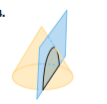
Describe the cross section.
a)
circle
b)
oval
c)
semi-circle
d)
trapezoid
17.
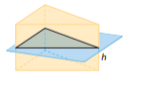
Describe the cross section.
a)
triangle
b)
rectangle
c)
oval
d)
trapezoid
18.

Describe the cross section.
a)
rectangle
b)
square
c)
parallelogram
d)
circle
19.
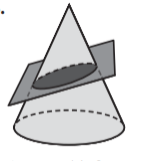
Describe the cross section.
a)
rectangle
b)
trapezoid
c)
oval
d)
parallelogram
20.

What shape will the horizontal cross-section of a sphere be?
a)
Dome
b)
Circle
c)
Ellipse
d)
Rectangle
21.

What shape will the horizontal cross-section of a cone be?
a)
Dome
b)
Circle
c)
Pyramid
d)
Triangle
22.

What shape will the vertical cross -section of a cylinder be?
a)
Circle
b)
Triangle
c)
Rectangle
d)
Ellipse
23.

What shape will the angled cross-section of a rectangular pyramid be?
a)
Triangle
b)
Rectangle
c)
Trapezoid
d)
Square
24.
A slide is also called a _________.
a)
Translation
b)
Reflection
c)
Rotation
d)
Transformation
25.
A turn is also called a ___________.
a)
Translation
b)
Reflection
c)
Rotation
d)
Transformation
26.
Translations, reflections and rotations are all known as ________________________.
a)
Geometry
b)
Transformations
c)
Congruent
27.

Name the transformation.
a)
Translation
b)
Reflection
c)
Rotation
28.
When you translate, you ______ a number to x and y.
a)
Add or subtract
b)
Multiply or divide
c)
Add or multiply
d)
Subtract or divide
29.
Translation are always _______
a)
Congruent
b)
Bigger
c)
Smaller
d)
Rotated
30.
When you translate, (x-4,y) will move _____.
a)
4 units right
b)
4 units left
c)
4 units up
d)
4 units down
31.

Write a rule for the translation.
a)
(x -1, y + 2)
b)
(x -2, y + 1)
c)
(x +2, y - 1)
d)
(x +1, y - 2)
32.

Identify the transformation from ABC to A'B'C'.
a)
90o clockwise rotation
b)
90o counter clockwise rotation
c)
Reflection across the y-axis
d)
Reflection across the x-axis
33.

Identify the transformation.
a)
Reflection across y-axis
b)
90 Rotation counter clockwise
c)
Translation 5 units left, 1 unit up.
d)
Translation 5 units right, 1 unit down
34.
Point (-5,2) is reflected over the y axis. Where is the new point located?
a)
(5,2)
b)
(-5,-2)
c)
(-5,2)
d)
(5,-2)
35.
Point (7,2) is translated vertically 2 units and horizontally -5 units. Where is the new point located?
a)
(9,-3)
b)
(2,4)
c)
(2,0)
d)
12,4)
36.
Apply the following rule to the point (-5,6):
(x,y)-->(y,-x)
(x,y)-->(y,-x)
a)
(-5,-6)
b)
(5,-6)
c)
(6,5)
d)
(-6,5)
37.

The image shows what type of transformation
a)
Rotation
b)
Translation
c)
Reflection
38.

Identify the transformation from ABC to A'B'C'.
a)
(x+8, y+4)
b)
(x-8, y-4)
c)
(x+4, y+8)
d)
(x-4, y-8)
39.
Identify the transformation from ABC to A'B'C'.
a)
(x+8, y+4)
b)
(x-8, y-4)
c)
(x+4, y+8)
d)
(x-4, y-8)
40.

Reflect Point C over the y-axis:
a)
(-3, 2)
b)
(3,2)
c)
(-2,3)
d)
(3,0)
41.
A transformation that “turns” a figure about a fixed point at a given angle and a given direction.
a)
rotation
b)
translation
c)
reflection
d)
dilation
42.
The original figure prior to a transformation.
a)
Pre-image
b)
Image
43.
Dilate the figure by a scale factor of 3 with the origin as the center of dilation. What are the coordinates of the image?
A(3,3) B(6,6) C(9,3)
A(3,3) B(6,6) C(9,3)
a)
A'(9,9) B'(18,18) C'(27,9)
b)
A'(6,6) B'(9,9) C'(12,6)
c)
A'(0,0) B'(3,3) C'(6,0)
d)
A'(1,1) B'(2,2) C'(3,1)
44.
The __________ is the ratio of a length of the new figure to the corresponding length on the original figure.
a)
reduction
b)
enlargement
c)
scale factor
d)
center of dilation
45.
State the coordinate of the image of the given point B (-10,-6) under a dilation with center at the origin with the given scale factor k = 1/2.
a)
(5,3)
b)
(20,12)
c)
(-20,-12)
d)
(-5,-3)
46.
The point (8, 12) was dilated to become point (2, 3). What was the scale factor?
a)
½
b)
¼
c)
4
d)
2
47.
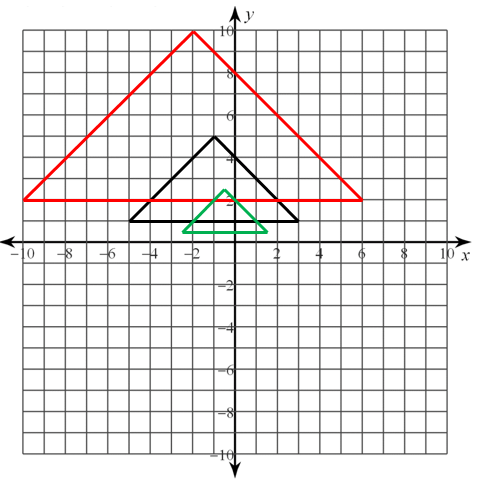
The red triangle has been dilated by a scale factor of 1/4, which triangle is it's new image?
a)
green triangle
b)
red triangle
c)
black triangle
d)
none of these
48.
A scale factor of less than one means
a)
that the image will be larger than the pre-image.
b)
That the image will be the same as the pre-image.
c)
That you need to subtract that amount off of each side.
d)
That the image will be a reduction of the pre-image.
49.
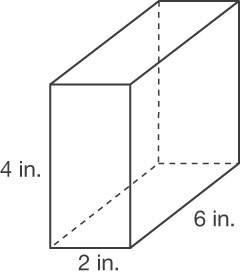
Find the total surface area of the prism.
a)
48 square inches
b)
64 square inches
c)
88 square inches
d)
76 square inches
50.
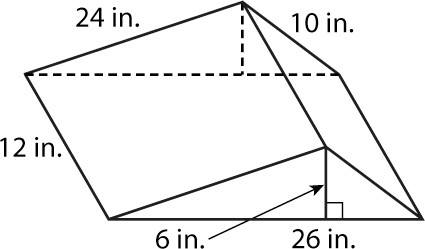
Find the total surface area of the prism.
a)
1,909,440 square inches
b)
876 square inches
c)
792 square inches
d)
1,872
51.

Paige is sewing a tent. If the material cost $0.04 per square in, determine how much it will cost her to make the tent.
a)
$480
b)
$560
c)
$640
d)
$736
52.
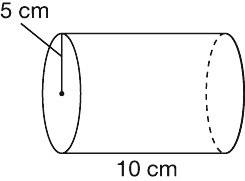
Find the surface area of the cylinder.
a)
471.24 square centimeters
b)
157.08 square centimeters
c)
314.16 square centimeters
d)
296.72 square centimeters
53.
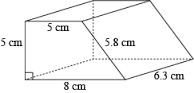
Find the surface area of the trapezoidal prism
a)
214.94 cm squared
b)
267.44 cm squared
c)
322.84 cm squared
d)
115.92 cm squared
54.

What is surface area?
a)
1339.73
b)
703.36
c)
320.78
d)
742.42
55.
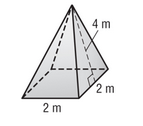
Find the Surface Area
a)
15m2
b)
16m2
c)
18m2
d)
20m2
56.

Find the volume.
a)
9156.24
b)
339.12
c)
1017.36
d)
3052.08
57.
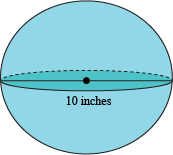
Find the surface area.
a)
314.16 in2
b)
314 in2
c)
166.67 in2
d)
521.24 in2
58.

a)
55 yd3
b)
121 yd3
c)
22 yd3
d)
330 yd3
59.

What shape is the base? What is the area of the base (B)?
a)
Rectangle; 60in2
b)
Triangle; 12 in2
c)
Rectangle; 32 in2
d)
Triangle; 6 in2
60.
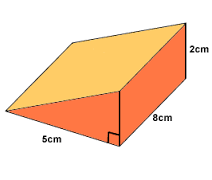
Find the volume of the figure. Round to the nearest tenth.
a)
80 cm³
b)
40 cm²
c)
80 cm2
d)
40 cm³
61.

What is the volume of the following rectangular pyramid?
a)
8085 cubic meters
b)
5390 cubic meters
c)
16170 cubic meters
d)
10780 cubic meters
62.

Find the volume of the prism
a)
98 cubic cm
b)
49 cubic cm
c)
130 cubic cm
d)
22 cubic cm
63.

V = ?
a)
14.13 in3
b)
56.52 in3
c)
169.56 in3
64.
Do the following side lengths form a triangle?
2 inches, 2 inches, 4 inches
2 inches, 2 inches, 4 inches
a)
Yes
b)
No
65.
9. Which of these lengths CANNOT represent the sides of a triangle?
a)
32, 34, 60
b)
28, 30, 58
c)
13, 20, 27
d)
2, 4, 5
66.
Could a triangle with these side lengths exist?
33, 16, 17
33, 16, 17
a)
Yes
b)
No
c)
I don't know.
67.
Which of the following does not represent the lengths of the sides of a triangle?
a)
2 cm, 6 cm, 7 cm
b)
5 cm, 2 cm, 5 cm
c)
5 cm, 5 cm, 8 cm
d)
3 cm, 10 cm, 15 cm
68.
Two sides of a triangle have side lengths of 17 meters and 12 meters. What is the range of possible lengths for the third side?
a)
12 < x < 17
b)
12 < x < 29
c)
5 < x < 17
d)
5 < x < 29
69.

What is the range of values the third side of the triangle could be?
a)
A
b)
B
c)
C
d)
D
70.
How many triangles exist with the given angle measures? 55°, 45°, 90°
a)
No triangle exists
b)
Exactly one unique triangle exists
c)
More than one triangle exists
71.

Which theorem is used in the folowing example?
BA = 12 cm
∠A = 70°
AC = 8 cm
BA = 12 cm
∠A = 70°
AC = 8 cm
a)
SSS
b)
SAS
c)
ASA
d)
AAS
72.

Which theorem is used in the following example?
AB = 12 cm
BC = 10 cm
CA = 8 cm
AB = 12 cm
BC = 10 cm
CA = 8 cm
a)
SSS
b)
SAS
c)
ASA
d)
AAS
73.
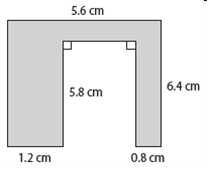
What is the area of the shaded region?
a)
19.8 cm2
b)
25.16 cm2
c)
32.6 cm2
d)
14.96 cm2
74.
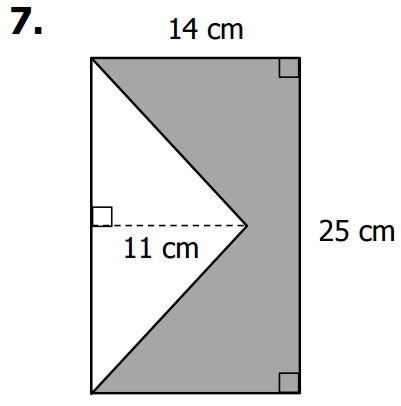
Find the area of the shaded region:
a)
350 cm2
b)
137.5 cm2
c)
212.5 cm2
d)
484.2 cm2
100 %

