
 Worksheets
Biochemistry
Total questions: 13
Worksheet time: 10mins
Name
Class
Date
1.
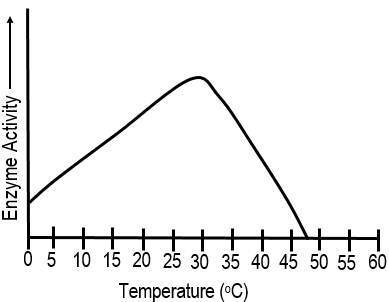
Based on the graph, what temperature does this enzyme work best?
a)
15 C
b)
40 C
c)
30 C
2.
Which of the following binds to the active site of an enzyme?
a)
substrate
b)
product
c)
codon
d)
none of the above
3.
What happens when enzymes are heated to a high temperature?
a)
The enzymes die.
b)
The shapes of the enzyme are altered or denatured
c)
The enzymes' amino acid sequence changes.
d)
The enzymes remain the same
4.
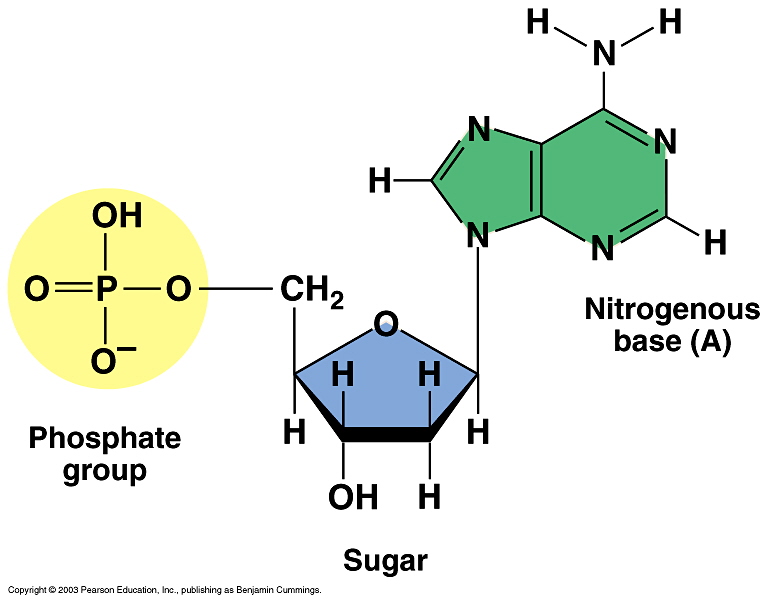
Identify the biomolecule
a)
Lipid
b)
Protein
c)
Carbohydrate
d)
Nucleic Acid
5.

In the picture, which represents a fatty acid?
a)
F
b)
G
c)
H
d)
J
6.
Proteins are compose of the elements ________
a)
C, H, O
b)
C,H,O,P
c)
C H, O P, N
d)
C, H, O, N
7.
Animals store carbohydrates as _______________ while plants store carbohydrates as ______________.
a)
glycogen, starch
b)
sugar, starch
c)
starch, glucose
d)
glycogen, glucose
8.
Substances that have a pH more than 7 are considered:
a)
acidic
b)
basic
c)
neutral
9.

What term describes when water is attracted to other substances?
a)
Cohesion
b)
Adhesion
c)
Capillary Action
d)
Surface Tension
10.
In the process of ______________ polymers can be broken down into monomer pieces by the addition of water.
a)
Condensation Cutting
b)
Dehydration Synthesis
c)
Pyrolysis
d)
Hydrolysis
11.
What is a substrate?
a)
The molecules that binds to the enzyme at the active site, and causes the enzyme to carry out a task.
b)
The molecule that does not fit into an enzyme, and has no effect on the enzyme.
c)
The molecule that binds to a place other than the active site, and caused the enzyme to carry out a task.
d)
A water molecule that breaks down monomers.
12.
These organic molecules are used by the body to store the genetic code.
a)
Carbohydrates
b)
Lipids
c)
Proteins
d)
Nucleic Acids
13.
Amino acids are the monomers of
a)
Carbohydrates
b)
Lipids
c)
Proteins
d)
Nucleic Acids
100 %

