
 Worksheets
Force and Motion Practice Test
Total questions: 75
Worksheet time: 1hrs 6mins
Name
Class
Date
1.
How is gravity affected by mass?
a)
the larger the mass of the object, the greater the gravity
b)
small objects have no gravity
c)
gravity is not affected by mass of objects, whether large or small
2.
What is a force that opposes motion between two surfaces?
a)
friction
b)
acceleration
c)
velocity
d)
motion
3.
What is the difference between mass and weight?
a)
mass is how much matter is in an object, and weight is the gravitational pull on that object
b)
mass and weight are the same
c)
weight affects how much mass is in an object
d)
weight is determined by how many atoms make up an object
4.
What slows down the motion of an object or keeps it from starting?
a)
mass
b)
friction
c)
gravity
d)
magnetism
5.
What are two examples of forces?
a)
Art and Music
b)
A push or pull
c)
A stand or ground
d)
The dark side and the light side
6.
What is motion?
a)
It's like the ocean
b)
Any change in an animal or person's position.
c)
Motion is like acting
d)
Any change in an object or person's position.
7.
What does force allow a ball player to do?
a)
To swing a baseball bat and hit a ball in a same direction
b)
To swing a baseball bat and drop a ball in a new direction
c)
To swing a baseball raquet and hit a ball in a new direction
d)
To swing a baseball bat and hit a ball in a new direction
8.
What pulls a ball back to earth?
a)
Gas
b)
Gravity
c)
Friction
d)
Molecules
9.
Why does a rolling ball stop?
a)
Gravity
b)
Friction
c)
Waterfalls
d)
Sand
10.
The measure of the force of gravity on your body is your _________________
a)
height
b)
length
c)
weight
d)
age
11.
The tendency of an object at rest to stay at rest unless it is acted upon by a force is ___________________
a)
inertia
b)
motion
c)
gravity
d)
lubricant
12.
A ball is moving in a certain direction. What would happen to the ball if a greater force was applied on the ball along its direction of motion?
a)
The speed of the ball would decrease.
b)
The speed of the ball would increase.
c)
The ball will stop instantly.
d)
The ball will change direction.
13.
A _____________________ must be exerted on an object at rest to cause it to move.
a)
weight
b)
inertia
c)
force
d)
gravity
14.
A push or pull that causes an object to move, stop, or change direction.
a)
force
b)
motion
c)
energy
d)
inertia
15.
If a tennis ball, a baseball, and a golf ball are dropped together from a high place, which ball will land first?
a)
They land at the same time.
b)
The baseball lands first.
c)
The golf ball lands first.
d)
The tennis ball lands first.
16.
Why does a crumpled piece of paper land before a flat sheet of paper?
a)
Gravity exerts more force on the crumpled paper.
b)
There is more air resistance on the flat paper.
c)
The crumpled paper is heavier
d)
The flat paper is lighter.
17.
A object with a lot of mass needs more force or less force to be moved?
a)
More
b)
Less
18.
A ball is rolled on four different types of materials. Which material will cause the least amount of friction between it and the ball?
a)
Tile Floor
b)
Carpet
c)
Grass
d)
Cement Sidewalk
19.
A _____ is a pull or a push.
a)
force
b)
friction
c)
gravity
d)
speed
20.
One way that a force can cause the change in an object's motion is to...
a)
do nothing.
b)
eat ice cream.
c)
start the object moving.
d)
shine on the object.
21.
When you type on the keys of your Chromebook you are using a
a)
pull
b)
push
c)
gravity
d)
friction
22.
A _____ moves an object closer to you.
a)
push
b)
pull
c)
friction
d)
cat
23.
How are a push and a pull alike?
a)
You can hear them both.
b)
They are both names of cats.
c)
You can do them both at the same time.
d)
They are both forces.
24.
What force moves an object away from you?
a)
pull
b)
push
c)
gravity
d)
Jedi force
25.
Another way that force can cause the change in an object's motion is to...
a)
change its color.
b)
change its pitch.
c)
change its direction.
d)
change its spots.
26.
_____ is the force that slows and stops motion between touching objects.
a)
Friction
b)
Gravity
c)
Pull
d)
Push
27.
Which has the least friction?
a)
snowboard on a snowy hill
b)
running on the playground
c)
sandpaper on wood
d)
a racer on a track
28.
Why is there less friction between two ice cubes touching than between sandpaper on wood?
a)
They have rough surfaces.
b)
They have loud surfaces.
c)
They have smooth surfaces.
d)
They have bright surfaces.
29.
How does friction help us move from place to place?
a)
Friction does not help us.
b)
Friction keeps us from slipping and sliding.
c)
Friction only helps cats.
d)
Friction makes us slip and fall.
30.

In the image, what force is acting on arrow A?
a)
friction
b)
gravity
c)
push
d)
Jedi force
31.
Is gravity a push or a pull?
a)
push
b)
pull
c)
neither
d)
both
32.

What keeps the Moon in orbit around Earth?
a)
Earth's rotation.
b)
Earth's atmosphere.
c)
Earth's gravity.
d)
Earth's shape.
33.
Choose the BEST answer that describes how the mass of an object affects its motion.
a)
The greater the mass of an object, the slower the motion of the object.
b)
The greater the mass of an object, the faster the motion of the object.
c)
The greater the mass of an object, the greater the force to move the object.
d)
The greater the mass of an object, the greater the distance the object will travel.
34.
Melissa and Gabe were testing the flight of leaves as they tossed them in the air. The leaves would go up and then came to a rest on the ground. What force made the leaves land on the ground?
a)
gravity
b)
friction
c)
air pressure
d)
mass
35.
The 5th graders were playing a game of tug-of-war. The class was divided equally with half the class on one side of the rope and the other half on the opposite side. For 5 minutes the students pulled and pulled but neither side could pull the flag to one side or the other. Choose the description of the forces during the 5th grade tug-of-war.
a)
The forces were unbalanced in the game.
b)
The forces were friction, gravity, and chemical energy.
c)
The students all had the same amount of strength.
d)
The forces were balanced in the game.
36.
David and Peter were moving a bookshelf across the carpet in their classroom. Even though they pushed as hard as they could, the bookshelf would only move a few inches at a time. Which of the following best explains what happened as they tried to push the bookshelf?
a)
The force of gravity opposed the motion of the bookshelf.
b)
The force of friction opposed the motion of the bookshelf.
c)
When they tried to push the bookshelf, air resistance acted against them.
d)
When they pushed the bookshelf, the bookshelf pushed back with an equal and opposite force.
37.
Speeding up, slowing down, or changing direction are all examples of ____________.
a)
momentum
b)
acceleration
c)
mass
d)
inertia
38.
What term means "an object's motion will not change unless an unbalanced force acts on it"?
a)
mass
b)
unbalanced force
c)
law of inertia
d)
friction
39.
What vocabulary word means "factor that determines the inertia of an object"?
a)
unbalanced force
b)
law of inertia
c)
net force
d)
mass
40.
Which force produces a change in motion?
a)
unbalanced force
b)
balanced force
c)
gravitational force
d)
frictional force
41.

What force brings the pencil down?
a)
Applied
b)
Magnetic
c)
Normal
d)
Gravitational
42.

__________ is the sum of all forces acting on an object. It is capable of accelerating a mass.
a)
velocity
b)
gravity
c)
net force
d)
distance
43.

Is it BALANCED?
a)
Yes
b)
No
44.

How will this object move?
a)
It won't move.
b)
It will move to the right.
c)
It will move to the left.
d)
It will move in both directions.
45.

"For every action, there is an equal and opposite reaction."
a)
Newton's 1st Law
b)
Newton's 2nd Law
c)
Newton's 3rd Law
d)
Newton's 4th Law
46.

Force = Mass x Acceleration
a)
Newton's 1st Law
b)
Newton's 2nd Law
c)
Newton's 3rd Law
d)
Newton's 4th Law
47.

"An object in motion (or at rest) will to stay in motion (or at rest) until an outside force acts upon it."
a)
Newton's 1st Law
b)
Newton's 2nd Law
c)
Newton's 3rd Law
d)
Newton's 4th Law
48.

The tendency of an object to resist changes in its motion is...
a)
inertia
b)
force
c)
acceleration
d)
velocity
49.

The tendency of a moving object to resist changes in its motion is...
a)
momentum
b)
force
c)
acceleration
d)
velocity
50.

A force that opposes motion between a surface in contact with the atmosphere.
a)
air resistance
b)
gravity
c)
momentum
d)
terminal velocity
51.
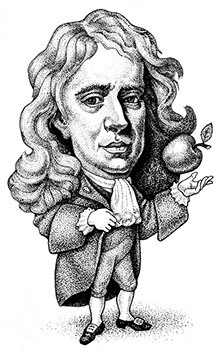
A Newton is a unit of...
a)
force
b)
inertia
c)
acceleration
d)
velocity
52.

When all the forces on an object are equal and opposite, & the net force is zero, that's...
a)
balanced forces
b)
unbalanced forces
c)
terminal velocity
d)
reaction forces
53.

The combination of all the forces acting on an object is the...
a)
net force
b)
action force
c)
reaction force
d)
balance force
54.

An archer pulls the bowstring back, then releases the string and the arrow flies forward. Pulling the string back is the...
a)
action force
b)
reaction force
c)
net force
d)
inertia
55.

An archer pulls the bowstring back, then releases the string and the arrow flies forward. The arrow flying forward is the...
a)
action force
b)
reaction force
c)
net force
d)
inertia
56.

A cannonball with a mass of 0.5 kg is flying at an acceleration of 10 m/sec/sec. What is it's force?
a)
50 Newtons
b)
5 Newtons
c)
20 Newtons
d)
9.5 Newtons
57.

A cannonball with a mass of 10 kg is flying at an acceleration of 5 m/sec/sec. What is it's force?
a)
50 Newtons
b)
5 Newtons
c)
20 Newtons
d)
9.5 Newtons
58.

When a moving object strikes another object, it will transfer this to the object it hits.
a)
force
b)
momentum
c)
gravity
d)
friction
59.

Mass x acceleration = ?
a)
force
b)
inertia
c)
momentum
d)
velocity
60.

In the picture, the blocks are flying out of the truck based on which of Newton's laws?
a)
Newton's 1st Law
b)
Newton's 2nd Law
c)
Newton's 3rd Law
d)
Newton's 6th Law
61.

In the picture, the vehicle will move because of...
a)
Newton's 1st Law
b)
Newton's 2nd Law
c)
Newton's 3rd Law
d)
Newton's 9th Law
62.

To compare the two pictures would require...
a)
Newton's 1st Law
b)
Newton's 2nd Law
c)
Newton's 3rd Law
d)
Newton's 11th Law
63.

Gravity is increased with...
a)
greater mass & shorter distance
b)
greater mass & farther distance
c)
lower mass & shorter distance
d)
lower mass & farther distance
64.

a)
1st
b)
2nd
c)
3rd
65.

a)
1st
b)
2nd
c)
3rd
66.

a)
1st
b)
2nd
c)
3rd
67.
a)
1st
b)
2nd
c)
3rd
68.
Object at rest stays at rest.
a)
1st
b)
2nd
c)
3rd
69.
F = MxA
a)
1st
b)
2nd
c)
3rd
70.
Acceleration is due to a force put on an objects mass.
a)
1st
b)
2nd
c)
3rd
71.
Equal and Opposite
a)
1st
b)
2nd
c)
3rd
72.
Unit of mass
a)
m/s 2
b)
m/s
c)
newtons
d)
kg
73.
What is the formula for force?
a)
F=M/A
b)
F=A/M
c)
F=M*A
d)
F=M*F
74.
Two balls that collide will have an equal but opposite force upon one another
a)
First Law
b)
Second Law
c)
Third Law
d)
Law of Inertia
75.

What is the tendency of an object to resist a change in motion?
a)
coffee
b)
motion
c)
inertia
d)
gravity
100 %

