wayground logo

Free Printable Worksheets

NEW

Font size

S
M
L
XL
Worksheets

Grade 8 Unit C

Total questions: 76

Worksheet time: 1hrs 20mins

Name
Class
Date
1.
Which explains why the fork looks different under water?
a)
light can't pass through the glass
b)
the wavelength of light lengthens
c)
the amount of light increases when going through water
d)
light is refracted at an angle
2.
Smooth surfaces _______ a lot of light.
a)
reflect
b)
bend
c)
absorb
d)
twist
3.
Why do we see objects as white?
a)
They absorb all light
b)
They reflect all light
c)
They absorb some light and reflect some light
4.
Another name for light bending is ....
a)
Reflaction
b)
Absorbing
c)
Refraction
d)
mirror
5.
The Law of Reflection:
The angle of incidence is _________ the angle of reflection
a)
bigger than
b)
the same as
c)
smaller than
6.
Luminous means...
a)
Gives out its own light
b)
Reflects light from other things
7.
Opaque means...
a)
No light passes through it
b)
All light passes through it
c)
Some light passes through it
8.
_____ is a lens that is thicker in the middle and makes an object appear bigger.
a)
prism
b)
convex lens
c)
concave lens
d)
mirror
9.
______ is a lens that is thicker on its edges and makes an object appear smaller?
a)
mirror
b)
convex lens
c)
concave lens
d)
prism
10.
What Does a Concave Lens Do?
a)
Make things bigger
b)
Make things smaller
c)
Make things closer
d)
Make things happy
11.
What Does a Convex Lens Do?
a)
Make things bigger
b)
Make things smaller
c)
Make things closer
d)
Make things sader
12.
Fill in the blank with the best answer: After light passes through a convex lens the light comes together at a __________. 
a)
Spot
b)
Focal point
c)
point
d)
Local Point
13.
Allows most light through
a)
eflection
b)
Refraction
c)
Translucent
d)
Transparent
14.
Blurs light as it passes through
a)
Transparent
b)
Translucent
c)
Opaque
d)
Refraction
15.
When light shines through a prism it creates a ________________
a)
colors
b)
ROY G. BIV
c)
spectrum
d)
electromagnetic wave
16.

What are the 3 primary colors of light?

a)

red, green, blue

b)

yellow, orange, violet

c)

red, black, green

d)

magenta, cyan, indigo

17.
_________________ is the transparent front surface of the eye
a)
Pupil
b)
Cornea
c)
Lens
d)
Iris
18.
____________________ is the hole through which light enters the eye.
a)
Cornea
b)
Iris
c)
Retina
d)
Pupil
19.
________________________ gives your eye its color/ Example: Brown, hazel, green, blue
a)
Iris
b)
Retina
c)
Lens
d)
Cornea
20.
What are materials that let's all light through?
a)
Transparent
b)
Translucent
c)
Opaque 
21.
What are materials that lets some light through?
a)
Transparent
b)
Translucent
c)
Opaque
22.
What are materials that doesn't let any light through?
a)
Opaque
b)
Transparent 
c)
Translucent
23.
1.  The intensity of light is related to the amount of light being seen.
a)
Brightness
b)
Color
c)
Visibile
24.
 What is the ability to make something move, happen, or change?
a)
Spectrum
b)
Energy
c)
Brightness
25.
What shape does light travel in?
a)
Waves
b)
Circles
c)
Squares
d)
Diamonds
26.
Light is predictable because it will always travel in a _________ line.
a)
Curvy
b)
Straight
c)
Backwards
d)
Crazy
27.
If someone is wearing a black shirt in the sunshine, what will the black do to the light?
a)
Reflect it
b)
Absorb it
c)
Refract it
d)
Diffuse it
28.
If light strikes a mirror at a 50⁰ angle, what angle will it come off of the mirror?
a)
50⁰
b)
70⁰
c)
45⁰
d)
30⁰
29.

Faith and Elijah are using a flashlight and their hands to make shadow puppets. What property of light creates the shapes on the wall?

a)

Light transmits through their hands.

b)

Light refracts when it passes through their hands.

c)

Light travels in a straight line.

d)

Light reflects off their hands back at them.

30.
Light produced by humans is called 
a)
Shadows
b)
Natural Light
c)
Artificial Light
d)
Color
31.

All are properties of light except

a)

travels in straight lines

b)

form of heat

c)

can bend

d)

form of energy

32.
A ______ telescope uses a mirror to focus light onto a small area.
a)
reflecting
b)
refracting
c)
radio
d)
spectrum
33.

refracting telescopes

a)

uses only lenses

b)

uses only mirrors

c)

uses lenses and mirrors

34.

miroscopes

a)

uses lenses to enlarge image

b)

uses mirrors to enlarge image

c)

uses lenses to shrink image

d)

uses mirrors to shrink image

35.

telescopes

a)

shrink light

b)

magnify and collect light

c)

refract light

36.
________is when a surface directs light beams in different directions.
a)
Refraction
b)
Diffuse reflection
c)
Absorption
37.

concave mirror focal point is

a)

behind mirror

b)

infront of mirror

38.

an object will appear ____________________ when it is far away from a concave mirror

a)

small and upside down

b)

small and upright

c)

big and upside down

d)

big and upright

39.

an object will appear ____________________ when it is in front of a focal point from a concave mirror

a)

small and upside down

b)

small and upright

c)

big and upside down

d)

big and upright

40.

the focal point of a convex mirror is

a)

in front of the mirror

b)

behind the mirror

41.

objects will appear _______________ when in a convex mirror

a)

small and upright

b)

small and upside down

c)

big and upright

d)

big and upside down

42.

An example of a real life convex mirror is

a)

telescope

b)

car head light

c)

flashlight

d)

car mirror

43.

An example of a real life concave mirror is

a)

car mirror

b)

flashlight

44.
The bending of a wave as it passes at an angle from one medium to another is called?
a)
Convex Lens
b)
Refraction
c)
Concave Lens
45.
A student placed a pencil in a cup of water.  The pencil appears broken because light-
a)
always travels in a straight line
b)
bends when it passes through water
c)
makes the water in the glass evaporate
d)
reflects the pencil on the water's surface
46.
The point where the rays meet is known as....
a)
Fire
b)
the focal point
c)
refraction
d)
Plane of the lens
47.
When light passes at an angle to the normal from one material into another material in which its speed is higher 
a)
it is bent toward the normal.
b)
it always lies along the normal.
c)
it is unaffected.
d)
it is bent away from the normal.
48.
When light passes at an angle to the normal from one material into another material in which its speed is lower
a)
it is bent towards the normal.
b)
it always lies along the normal.
c)
it is unaffected.
d)
it is bent away from the normal.
49.
Is a convex lens thicker or thinner in the middle?
a)
Thicker 
b)
Thinner 
50.

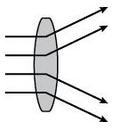
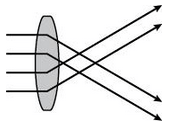
Which lens represents the path light takes through a concave lens?

a)
b)
c)
d)
51.

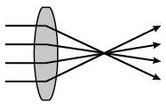
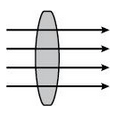
Which figure represents the path light takes through a convex lens?
a)
b)
c)
d)
52.
A magnifying glass is an example of what type of lens?
a)
convex
b)
concave
c)
mirror
d)
Cylinder
53.
This type of Electromagnetic wave shows a break in bones.
a)
gamma ray
b)
x-ray
c)
brokenometer
d)
radio wave
54.
Which has the LONGEST wavelength and, therefore, the lowest frequency/energy
a)
Gamma Rays
b)
Radio Waves
c)
Visible Light
d)
Infrared rays
55.
Which part of the electromagnetic spectrum has high enough energy to cause damage to eyes and skin, and sometimes even cancer? 
a)
infrared light
b)
visible light
c)
ultraviolet light
d)
microwaves
56.
Cancer can be treated with_______________waves.
a)
Penicillin
b)
Radio
c)
Infrared
d)
Gamma
57.
You have cool glow-in-the-dark stickers of Mickey Mouse. This is an example of 
a)
fluorescence
b)
chemiluminescence
c)
phosphorescence 
d)
incandescence
58.
What is an example of artificial light?
a)
the sun 
b)
the stars 
c)
bioluminescence 
d)
neon light 
59.
the ability to emit light
a)
phosphorescence
b)
magnetic resonance images (MRI)
c)
gamma rays 
60.
uses a filament to produce light 
a)
incandescent bulb
b)
fluorescent bulb
c)
phosphorescence 
61.
when living organisms produce their own light 
a)
luminescence
b)
bioluminescence
c)
phosphorescence
d)
photophore
62.
light producing organ on a firefly
a)
photophore
b)
phosphor
c)
phosphorescence
63.
Which nerve transmits information from the eye to the brain?
a)
Optic
b)
Olfactory
c)
Occulomotor
d)
Trigeminal
64.
Opens and closes to adjust the total amount of light entering the eye.
a)
Iris
b)
Scelera
c)
Cornea
d)
Human lens
65.
What part of the eye holds the lens in place?
a)
cornea
b)
ciliary muscles
c)
pupil
d)
retina
66.
This part of the eye focuses light/images onto the retina.
a)
lens
b)
cornea
c)
cones
d)
vitreous humor
67.
These photoreceptors have three different pigments.  Each receptor is associated with its own neuron resulting in crisp, clear color vision
a)
hair cells
b)
rods
c)
cones
d)
lens
68.
The part of the eye that sees black, white, and gray and has the lowest threshold for activation
a)
cones
b)
pupil
c)
optic nerve
d)
rods
69.
What is letter B
a)
Optic nerve
b)
Lens
c)
Cornea
d)
Retina
70.
What is letter E?
a)
Vitreous humor
b)
Retina
c)
Cornea
d)
Optic nerve
71.
What is letter F?
a)
Retina
b)
Pupil
c)
Vitreous humor
d)
Iris
72.
What is letter G?
a)
Sclera
b)
Retina
c)
Lens
d)
Vitreous humor
73.
What is letter H?
a)
Cornea
b)
Optic nerve
c)
Iris
d)
Retina
74.
What is letter I?
a)
Cornea
b)
Lens
c)
Vitreous humor
d)
Optic nerve
75.
What part of the eye are the cones located
a)
Iris
b)
lens
c)
retina
d)
pupil
76.

This part of the eye in animals reflects back light and allows the animal to see at night (acts like a mirror)

a)

Tapetum Lucidem

b)

Vitreous Humor

c)

Blind Spot

d)

Aqueous Humor