wayground logo

Free Printable Worksheets

Font size

S
M
L
XL
Worksheets

ECONOMICS

Total questions: 114

Worksheet time: 2hrs 4mins

Name
Class
Date
1.
What is opportunity cost?
a)
your choice
b)
what you give up to make a choice
2.
What is scarcity? 
a)
Having too many resources 
b)
Not  having enough resources 
3.
A garbage truck driver is an example of which Factor of Production?
a)
labor
b)
land
c)
entrepreneurship
d)
capital
4.
Iron, minerals, coal and plants are examples of which productive resource?
a)
land
b)
labor
c)
entrepreneurship
d)
capital
5.
Which factor of production would you consider a lawn mower?
a)
Land
b)
Labor
c)
Capital
d)
Entrepreneur
6.
The people who decide to buy.
a)
Producers
b)
Consumers
c)
Economist
d)
Entreprenuers
7.

Our desires for goods and services are unlimited

a)

true

b)

false

8.

What would mental abilities be classified as?

a)

Land

b)

Labor

c)

Capital

d)

Entrepreneurship

9.
What is the production possibilities curve?
a)
a graph that shows how much an economy can produce between 2 goods
b)
how much money something is
c)
the opportunity one has to give up in order to gain something else
d)
land, labor, capital, entrepreneurs
10.
What is opportunity cost?
a)
a graph that shows how much an economy can produce between 2 goods
b)
how much money something is
c)
the opportunity one has to give up in order to gain something else
d)
land, labor, capital, entrepreneurs
11.

Higher interest rates cause people to save more.

a)

Normative

b)

Positive

12.

Unemployment is more harmful than inflation.

a)

Normative

b)

Positive

13.

People should save more.

a)

Normative

b)

Positive

14.

Government should tax the rich to help the poor.

a)

Normative

b)

Positive

15.
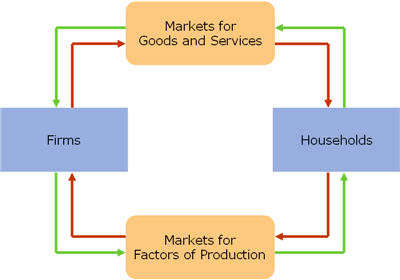
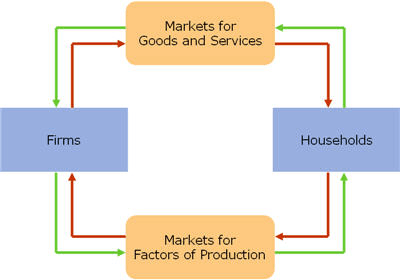
What is being represented by the "green flow lines"
a)
Flow of Money
b)
Flow of Goods and Services
c)
law
16.
What is being represented by the "red flow line"
a)
The flow of money
b)
The flow of goods and services
17.
In the circular flow model, what do individuals SELL to businesses
a)
Services
b)
Money
c)
Resources
d)
D Goods
18.
What do the households provide businesses?
a)
Labour
b)
Wages
c)
Resources
d)
Goods and services
19.
As prices go up, ______________ goes down.
a)
Supply
b)
Demand
c)
Utility
20.
The amount of money a person makes.
a)
Income
b)
Demand
c)
Elasticity
21.
What is this picture of?
a)
Demand Schedule
b)
Demand Curve
c)
Utility
22.
Jennifer Lopez is seen wearing a new short and sleek dress. People now want this dress. Which demand determinant is this most likely to fall under?
a)
Change in Consumer Income
b)
Change in Consumer Tastes
c)
Change in Price of Substitute Good
d)
Change in Consumer Price Expectations
23.
Oreo cookies are now extremely expensive to purchase. Instead of buying Oreo cookies, I now want to buy Chips Ahoy. What determinant of demand does this likely fall under?
a)
Change in Price of Complementary Good
b)
Change in Price of Substitute Good
c)
Change in Consumer Price Expectations
d)
Change in Number of Consumers in the Market
24.
The government is giving every individual 18 and above an extra $1,000.00 this year. What determinant of demand does this likely fall under?
a)
Change in Consumer Tastes
b)
Change in Consumer Price Expectations
c)
Change in Number of Consumers in the Market
d)
Change in Consumer Income
25.
I know that the iPhone 8 is coming out next year but really need a phone badly. I'm thinking about buying an iPhone 7 when the new iPhone comes to the market because it will be much cheaper than today's price. What determinant of demand does this suggest?
a)
Change in Price of Complementary Good
b)
Change in Consumer Price Expectations
c)
Change in Number of Consumers in the Market
d)
Change in Consumer Income
26.
McDonald's is having a special on their Big Mac purchases this week. Every Big Mac is $3 cheaper! When burger prices go down, this means you can buy more fries and a drink. What demand factor does this relate to?
a)
Change in Consumer Tastes
b)
Change in Price of Substitute Good
c)
Change in Price of Complementary Good
d)
Change in Number of Consumers in the Market
27.
Porterville, California is now a major immigration center for Russians. Over 10,000 Russians are living in Porterville now! What demand does this determine?
a)
Change in Consumer Income
b)
Change in Consumer Tastes
c)
Change in Consumer Price Expectations
d)
Change in Number of Consumers in the Market
28.
A brand new machine cooks, cleans, and never messes up a fast food order. This means we can sell more fast food than ever before, leading to producers cutting cost of fast food. Which supply factor does this most likely relate to?
a)
Change in Technology
b)
Change in Profit Opportunities Producing other Products
c)
Change in Producers' Price Expectations
29.
I foresee gas prices rising tremendously in the next summer. I as a gas supplier, want to cut my supply now so gas prices continue to rise. What supply factor does this best relate to?
a)
Change in Technology
b)
Government Action
c)
Change in Producers' Price Expectations
30.
The government has put a ban on all items that are unhealthy. No store can legally sell soda over 24 ounces. The supply of anything over 24 ounces becomes non-existent. What supply factor is this?
a)
Change in Technology
b)
Change in Cost of Factors of Production
c)
Government Action
31.
This determinant of supply includes both raw material and labor. It also states that when the price of it decreases, the supply increases. 
a)
Government Tools
b)
Prices of Resources
c)
Technology
d)
Competition 
32.
With regards to determinants of supply, loose government regulation tends to...
a)
decrease supply
b)
cause rebellion/revolts
c)
increase supply
d)
shift the curve to the left
33.
All of the following are determinants of supply except: 
a)
technology
b)
prices of related goods
c)
producer expectations
d)
consumers' price expectations
34.

Equilibrium is also called the

a)

E1

b)

intersection of two curves

c)

PEQ

d)

Market-Clearing Price

35.

When the quantity demanded at a specific price exceeds the quantity supplied, what will result in the market?

a)

Equilibrium occurs

b)

A shortage occurs

c)

A surplus occurs

d)

Supply increases

36.

Government imposed limits on the prices that producers charge in a given market are called

a)

social intervention

b)

price controls

c)

black market

d)

free market

37.

A surplus occurs when

a)

the quantity demanded exceeds the the quantity supplied

b)

there is equilibrium

c)

the quantity supplied exceeds the quantity demanded

d)

the quantity supplied equals the the quantity demanded

38.

When there are multiple substitutes for a product, demand tends to be

a)

elastic

b)

inelastic

c)

neutral

d)

low

39.

A minimum price set by the government to prevent prices from going to low is called

a)

a price ceiling

b)

a price floor

c)

equilibrium

d)

legal market control

40.

Which of the following will shift the Supply Curve to the right, increasing supply

a)

higher cost of inputs for production in market

b)

new technology in the market

c)

government regulations in the market

d)

fewer producers in the market

41.

When demand of a good increases,

a)

equilibrium price will fall

b)

equilibrium price will rise

c)

equilibrium quantity will fall

d)

equilibrium quantity will rise

42.

What happens to the market of Coke, when price of Pepsi increases?

a)

Quantity demanded of Coke rises

b)

Quantity demanded of Coke falls

c)

Demand for Coke rises

d)

Supply for Coke rises

43.

Supply of a good increases will result in

a)

Fall in equilibrium price and Fall in equilibrium quantity

b)

Fall in equilibrium price and Rise in equilibrium quantity

c)

Rise in equilibrium price and Fall in equilibrium quantity

d)

Rise in equilibrium price and Rise in equilibrium quantity

44.

When demand increases and supply decreases simultaneously,

a)

equilibrium price will rise while equilibrium quantity is uncertain

b)

equilibrium price will fall while equilibrium quantity is uncertain

c)

equilibrium quantity will rise while equilibrium price is uncertain

d)

equilibrium quantity will fall while equilibrium price is uncertain

45.

Total revenue of a good may increase when

a)

Demand of the good increases, ceteris paribus

b)

Demand of the good decreases, ceteris paribus

c)

Supply of the good increases, ceteris paribus

d)

Supply of the good decreases, ceteris paribus

46.
Which of the following items would be most inelastic?
a)
Cookies from the cafeteria
b)
Starbucks coffee
c)
Gasoline
d)
Red Pens
47.
Which of the following would be most price elastic?
a)
Sport's drinks
b)
Gatorade
c)
Cool Blue Gatorade
48.
Which of the following would be more price inelastic?
a)
A $.50 candy bar
b)
A $30,000 car
49.
Consumer surplus is equal to:
a)
Price - willingness to pay
b)
Cost - price
c)
Willingness to pay - price
d)
Price - cost
51.
Producer surplus is
a)
Cost - willingness to pay
b)
Price - cost to seller
c)
Cost to seller - price
d)
Willingness to pay - price
51.
Producer surplus is
a)
Cost - willingness to pay
b)
Price - cost to seller
c)
Cost to seller - price
d)
Willingness to pay - price
52.
On the graph, which area represents consumer surplus when the market is operating efficiently? 
a)
a,b
b)
d,e,f
c)
a,b,c
d)
a,b,d
53.
If the government imposes a price ceiling at P3, which area would represent consumer surplus?
a)
a,b,c
b)
a,b,c,d,e
c)
a,b,d
d)
f
54.
Tax levied by the government on a person’s income at the state or local level
a)
Property Tax
b)
Sales Tax
c)
Income Tax
d)
Sin Tax
55.
This tax is on money you receive from wages, rent, interest, and profit.
a)
excise tax
b)
estate tax
c)
income tax
d)
tariff
56.
VAT is an indirect tax
a)
True
b)
False
57.
The ability of one person or nation to produce more of a good than another person or nation
a)
Comparative Advantage
b)
Absolute advantage
c)
exports
d)
protectionism 
58.
A regional trade organization made up of European nations
a)
NAFTA
b)
EU
c)
ASEAN
d)
CARICOM
59.
Limit of the amount of a good that can be imported
a)
Subsidy
b)
Quota
c)
Exports
d)
Appreciation 
60.
A good that is sent to another country for sale
a)
export
b)
import
c)
quota
d)
subsidy 
61.
When a nation imports more than it exports, economists say it has which of the following?
a)
A trade surplus
b)
A balance of trade
c)
A trade deficit
d)
A national difference
62.
An exchange rate is used to
a)
promote the argument supporting free trade.
b)
promote the use of subsidies on foreign goods.
c)
determine the price of one country's imports in terms of another country's imports.
d)
determine the price of one country's currency in terms of another country's currency.
63.
What happens when a nation’s currency depreciates?
a)
Its products become more expensive to other nations
b)
Its products become cheaper to other nations and exports may increases
c)
Nothing
d)
It halts all trade
64.
An increase in the value of currency is called
a)
appreciation
b)
depreciation
c)
trade surplus
d)
exchange rate
65.
Price controls are 
a)
market forces that move a market to equilibrium
b)
legally mandated maximum or minimum prices for a good or service
c)
limits on the amount a company is allowed to produce
d)
limits on the amount a consumer is allowed to purchase
66.
A price ceiling 
a)
sets an upper limit on how much producers are allowed to purchase
b)
sets a minimum legal price for a product
c)
sets the maximum legal price for a product
d)
sets a lower limit on how much consumers are allowed to buy
67.
What is the definition of Revenue?
a)
Income from the sales of goods and services
b)
Income from the cost of goods and services 
c)
The money made on products
d)
Cash coming into the business from suppliers and customers
68.
What is the formula for Revenue?
a)
No. Sold  x  Selling Price
b)
No. Sold x Costs
c)
Selling Price x Costs
d)
Selling Price x Total sales
69.
Business expenses i.e. what the business spends in its running are referred to as...
a)
Expenses
b)
Outgoings
c)
Costs
d)
Revenue
70.
What is the formula for Profit?
a)
Revenue - Sales
b)
Revenue - Costs
c)
Revenue - Fixed Costs
d)
Revenue - Gross Profit
71.
What is the definition of a fixed cost?
a)
A cost that varies with output
b)
A cost that does not vary with output
c)
Costs that do not change
d)
Costs that change only when agreed
72.
What is the only curve that continues to fall as output increases?
a)
Average Fixed Cost
b)
Average Variable Cost
c)
Average Total Cost
d)
Marginal Cost
73.
Whay are the average total, average variblae, and marginal cost curves U shaped?
a)
They show the products increasing and decreasing quanitty in a market based on the laws of demand
b)
They show increasing marginal returns for small quantities of output  followed by decreasing marginal returns for larger quantities of output 
c)
They demonstrate the relationship between creating and buying with in a monopolistic market
d)
All of the above answer choices
74.
What does break even point show?
a)
where a business is neither making a profit or loss
b)
how many items to make
c)
how much profit they're making
d)
where a business has more fixed costs than variable
75.
Which one is not included in the Break Even formula?
a)
variable costs per unit
b)
total fixed costs
c)
selling price per unit
d)
cost price per unit
76.
The demand curve for a perfectly competitive firm is:
a)
perfectly inelastic.
b)
perfectly elastic.
c)
downward sloping.
d)
relatively but not perfectly elastic.
77.
a)
Shut Down
b)
Stay open and take a loss
c)
Making a normal profit
d)
Making a positive profit
78.
a)
Shut Down
b)
Take loss but stay open
c)
Normal Profit
d)
Positive Economic Profit
79.
a)
Shut Down
b)
Stay open and take a loss
c)
Normal Profit
d)
Positive Economic Profit
80.
a)
Shut Down
b)
Stay open and take a loss
c)
Positive Economic Profit
d)
Normal Profit
81.
According to the graph, which of the following MUST be true in the long run?
a)
The equilibrium price will be P2, since that is where marginal cost equals minimum average variable cost
b)
If the price is above P3, new firms will enter the industry
c)
If the price is above P2, new firms will enter the industry
d)
The equilibrium price will be above P3, since firms must make an economic profit to stay in business
82.

One of the requirements for a monopoly is that

a)

products are high priced

b)

there are several close substitutes for the product

c)

there is a unique product with no close substitutes

d)

the product cannot be produced by small firms

83.

A monopoly is a market with

a)

many suppliers

b)

no barriers to entry

c)

many substitutes

d)

one supplier

84.

Firms face competition when the good they produce

a)

is unique

b)

has a close substitute

c)

is in a market with natural barriers to entry

d)

is in a market with legal barriers to entry

85.

Which describes a barrier to entry?

a)

something that establishes a barrier to expanding output

b)

anything that protects a firm from new competitors

c)

a regulation that bars a monopoly from earning profit

d)

firms already in the market incur a loss so no firm wants to enter

86.

A barrier to entry is

a)

an economic term for economies of scale

b)

illegal in most markets

c)

anything that prevents new firms from entering the market

d)

a factor that increases competition

87.

A monopolist is

a)

a price taker

b)

able to ignore the demand for its product when setting price

c)

able to set the price for its product

d)

able to earn only a normal profit in the long run

88.

If a monopolist wants to sell a larger quantity, it must

a)

set a higher price

b)

maintain the current price

c)

set a lower price

d)

implement new technology

89.

A monopoly market has

a)

a few firms

b)

a single firm

c)

two dominating firms in the market

d)

only two firms in it

90.
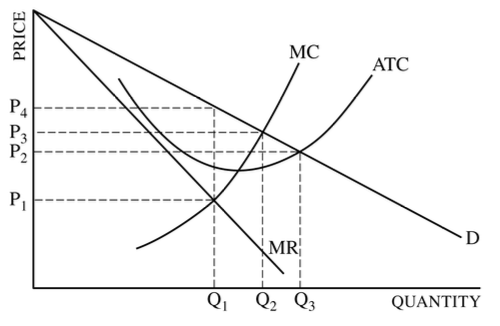
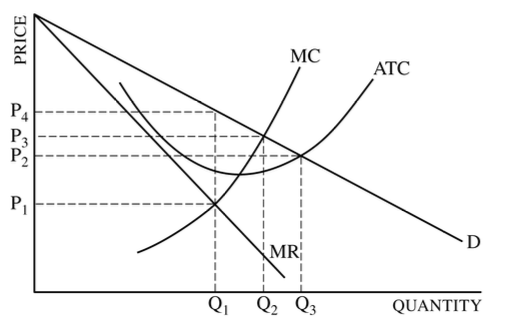
The profit-maximizing combination of output and price for a single-price monopoly is:
a)
Q1 & P1
b)
Q2 & P3
c)
Q1 & P4
d)
Q3 & P2
91.
If the monopolist could engage in perfect price discrimination, the monopolist’s total output and the price charged for the last unit of output sold would be:
a)
Q1 & P1
b)
Q2 & P3
c)
Q1 & P2
d)
Q3 & P2
92.
A firm with market power engages in price discrimination to:
a)
earn a higher profit
b)
increase consumer surplus
c)
decrease deadweight loss
d)
make its demand more elastic 
93.
Which of the following statements correctly identifies a difference between perfect competition and monopolistic competition? 
a)
In perfect competition there are no barriers to entry, but there are strong barriers in monopolistic competition. 
b)
In perfect competition there are many firms, but in monopolistic competition there are only a few firms. 
c)
In perfect competition the firms all sell products that are exactly the same, but in monopolistic competition each firm sells a slightly differentiated product. 
d)
In perfect competition there are few consumers, but in monopolistic competition there are many consumers. 
94.
Monopolistically competitive firms are considered inefficient in allocating society’s resources for which of the following reasons? 
a)
In long-run equilibrium, the marginal benefit exceeds the price charged by the firms. 
b)
In long-run equilibrium, the price is greater than the marginal cost. 
c)
In long-run equilibrium, average total costs are minimized.
d)
In long-run equilibrium, the firm is earning economic profits. 
95.
The graph shows a monopolistically competitive firm:
a)
making a profit in the short-run
b)
incurring a loss in the short-run
c)
making a profit in the long-run
d)
breaking even in the long-run
96.
In the long-run, the ATC will be tangent to the demand curve at:
a)
Q1
b)
Q2
c)
Q3
d)
none of the above
97.
Let P = price, MR = marginal revenue,
MC = marginal cost, and ATC = average total cost. In monopolistic competition, which of the following most accurately describes the long-run equilibrium conditions for a firm? 
a)
P>ATC, MR=MC, and P>MC 
b)
P=ATC, MR=MC, and P=MC 
c)
P=ATC, MR=MC, and P>MC 
d)
P=ATC, MR>MC, and P>MC 
98.
Which of the following is true of a monopolistically competitive firm in long-run equilibrium? 
a)
The firm produces the allocatively efficient level of output. 
b)
The firm produces an output level that minimizes average total cost. 
c)
The firm produces in the inelastic range of its demand curve. 
d)
The firm is allocatively inefficient, because it produces an output level at which price is greater than marginal cost. 
99.
An industry that is dominated by a few large firms is 
a)
monopolistic competition.
b)
a monopoly.
c)
perfect competition.
d)
an oligopoly.
100.
conspiring among business to set the prices of competing production
a)
pricing fixing
b)
trust
c)
market share
d)
oligopoly
101.
This is an illegal practice of an oligopoly working together to set prices. 
a)
collusion 
b)
monopolistic competition 
c)
competitive pricing
d)
priceline negotiation 
102.
The most recognizable form of non-price competition is? 
a)
More Locations 
b)
Better Customer Service
c)
Advertising 
d)
Low Price 
103.
Which of the following usually results from colluding firms? 
a)
more is produced
b)
profit decreases
c)
prices are higher
d)
more firms enter the market
104.

The study of how decisions are made when strategic interaction between firms exists is known as

a)

Game theory.

b)

Contestable market theory.

c)

Market power theory.

d)

Predatory pricing theory.

105.
Which best describes a public good?
a)
A good provided by the government 
b)
A good purchased by individuals
c)
A good that exists only in a free market
d)
A good that produces no externalites
106.
A market failure is best described as
a)
The idea that market forces of supply and demand always provide the maximum benefit for society
b)
The idea that market forces of supply and demand do not always provide the maximum benefit for society
c)
The concept that a decision made by one party can have negative effects on another party
d)
The concept that a decision made by one party can have positive effects on another party
107.
Government regulations exist to
a)
Increase economic freedom
b)
Protect consumers from negative externalities
c)
Punish people who intervene in the free market
d)
Provide incentives to privatize
108.
The goal of a subsidy is to
a)
Decrease the production of goods and services that will benefit society
b)
Increase the production of goods and services that will benefit society
c)
Limit the supply of goods and services that can benefit society
d)
Increase the supply of goods and services that will hurt society
109.
Private businesses cannot always provide goods and services
a)
Profitably
b)
Fairly
c)
Safely
d)
All of the above
110.
Which of the following is not a sector in the circular flow model?
a)
Government
b)
Overseas
c)
Financial Institutions
d)
Financial Trading Markets
111.
In the two sector model, Households provide resources to firms. What is not one of these resources
a)
Land
b)
Labour
c)
Finance
d)
Entrepreneurship 
112.
Income tax that is paid by consumers to the government is an example of a 
a)
Leakage
b)
Injection
c)
Drainage
d)
Insertion
113.
What does the vertical axis represent on the aggregate demand curve?
a)
Total Input
b)
Total Output
c)
Price Level
d)
Both A&B
114.
What term best describes the total demand for final goods and services at a range of price levels during a stated period of time?
a)
Aggregate Supply
b)
Total Supply
c)
Total Demand
d)
Aggregate Demand