
 Worksheets
Unit 5: Day 3
Total questions: 28
Worksheet time: 22mins
Name
Class
Date
1.

Which of the following best describes a DNA molecule?
a)
double helix
b)
contains ribose
c)
made of amino acids
d)
contains Uracil
2.
Which of the following units are repeatedly joined together to form a strand of DNA? (This is the MONOMER of DNA.)
a)
amino acids
b)
nucleotides
c)
fatty acids
d)
polysaccharides
3.
Adenine bonds with ______________.
a)
Guanine
b)
Thymine
c)
Cytosine
d)
Adenine
4.
Guanine bonds with ______________.
a)
Adenine
b)
Guanine
c)
Cytosine
d)
Thymine
5.
Why is DNA important?
a)
it is very small and very complicated
b)
it's in everything
c)
it serves as the blueprint for traits of all living things
d)
because we eat it every day for energy
6.
If the percentage of DNA is made of 30% Thymine, what is the correct percentage of Guanine?
a)
30
b)
15
c)
20
d)
60
7.

Replicate the following strand of DNA:
AATCATGGA
AATCATGGA
a)
AATCATGGA
b)
TTAGTACCT
c)
UUAGUACCU
d)
GGATAUCUA
8.
DNA replication results in two DNA molecules,
a)
each one with two original strands
b)
each one with two new strands
c)
each one with one new strand and one original strand
d)
one with two new strands and the other with two original strands
9.
A scientist observes a base sequence of AGCTAGCTAGCT. Which of the following would be the complimentary strand?
a)
TGCATGCATGCA
b)
TCGATCGATCGA
c)
TAGCTAGCTAGC
d)
TTAAGGCCTTCC
10.
The bonds that hold the two strands of DNA together come from...
a)
the attraction of phosphate groups
b)
strong bonds between bases and sugars
c)
carbon to carbon bonds in the sugar
d)
weak hydrogen bonds between the bases
11.
The DNA nucleotide is composed of three parts. Which two components make up the nucleotide backbone?
a)
ribose sugar and base
b)
ribose sugar and phosphate group
c)
nitrogen base and deoxyribose sugar
d)
deoxyribose sugar and phosphate group
12.

In a molecule of double-stranded DNA, the amount of Adenine present is always equal to the amount of
a)
cytosine
b)
guanine
c)
thymine
d)
uracil
13.
DNA Replication is the process of turning 1 DNA molecule into...
a)
1 DNA molecule
b)
2 DNA molecules
c)
3 DNA molecules
d)
4 DNA molecule
14.
Before DNA can replicate it has to...
a)
Separate the two strands
b)
Find 4 new strands
c)
Ask its mom
15.
What part of the cell cycle is the DNA in a cell's nucleus replication?
a)
Prophase
b)
Metaphase
c)
Interphase
d)
Telophase
16.
What is the end result of replication?
a)
Two new identical strands of DNA
b)
One parent strand and one daughter strand of DNA
c)
Two new and different strands of DNA
d)
One new strand of DNA
17.
The DNA is found in the nucleus of what type of organisms?
a)
Bacteria
b)
Eukaryotes
c)
Prokaryotes
d)
Viruses
18.
What determines the traits of an organism?
a)
The length of DNA molecules
b)
The way nucleotides are paired in the two strands of DNA
c)
The order of nucleotides in DNA molecules
d)
The proportions of A, T, C, and G in DNA molecules
19.
The name of the 5 carbon sugar that makes up DNA is _____
a)
phosphate
b)
deoxyribose
c)
ribose
d)
polymerase
20.

The term used to describe DNA Replication is:
a)
Semi-Conservative
b)
Conservative
c)
AntiParallel
d)
Dispersive
21.
What is a mistake called when copying DNA?
a)
Mutation
b)
Okasaki fragment
c)
Replication
22.
If a strand reads:
3' A A A T T T C 5'
The matching strand would read...
3' A A A T T T C 5'
The matching strand would read...
a)
5' T T T A A A G 3'
b)
3' T T T A A A G 5'
c)
5' A A A T T T C 3'
d)
3' U U U A A A G 5'
23.

Sometimes, DNA is called "semi-conservative." Why might this be?
a)
The old strand is "conserved" and used to make the new strands
b)
Uracil is "conserved" in that it is only used to make the new strands
c)
ATP is "conserved" via the usage of facilitated diffusion
d)
Ligase is "conserved" in that it is denatured by the process
24.
Which sequence of DNA bases would pair with this partial strand
ATG TGA CAG
ATG TGA CAG
a)
ATG TGA CAG
b)
TAC ACT GTC
c)
GTA AGT GAC
d)
CAT TCA CTG
25.
Which of the following units are repeatedly joined together to form a strand of DNA?
a)
amino acids
b)
nucleotides
c)
fatty acids
d)
polysaccharides
26.
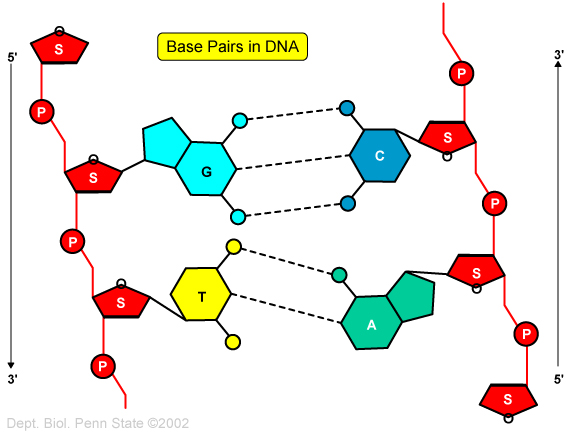
Nitrogenous bases are joined by which type of bond?
a)
polar bonds
b)
ionic bonds
c)
covalent bonds
d)
hydrogen bonds
27.

Who's work concluded that the %A=%T and %G=%C
a)
Chargaff
b)
Meischer
c)
Levene
d)
Hammerling
28.
What is the function of DNA?
a)
Contains the code to make proteins.
b)
Contains the code for making carbohydrates
c)
Contains the code for making lipids
d)
Contains the code for make Nucleic Acids
100 %

