wayground logo

Free Printable Worksheets

Font size

S
M
L
XL
Worksheets

Cumulative Vocab Quiz

Total questions: 266

Worksheet time: 4hrs 56mins

Name
Class
Date
1.

Speed

a)

Total distance divided by time

b)

Displacement divided by time

c)

Change in position with direction

d)

Change in velocity divided by time

2.

Velocity

a)

how long it takes to get somewhere

b)

distance divided by time

c)

Change in position with direction

d)

Change in velocity divided by time

3.

Displacement

a)

Total distance divided by time

b)

Displacement divided by time

c)

Change in position with direction

d)

Change in velocity divided by time

4.

What is distance?

a)

how far something travels

b)

how fast something travels

c)

how big something is

d)

seven

5.

What is speed?

a)

How fast the object is moving, usually measured in meters per second (m/s)

b)

How high an object is moving

c)

Where an object is

d)

An object changing direction

6.

Velocity

a)

speed

b)

speed with a direction

c)

Change in position with direction

d)

Change in velocity divided by time

7.
What is MOVEMENT?
a)
Inertia
b)
Force
c)
Work
d)
Motion
8.

Motion is described by an object's______________

a)

direction and mass

b)

direction and speed

c)

force and mass

d)

speed and force

9.
What is the formula to calculate velocity?
a)
v = t/d
b)
v = d/t
c)
v = d x t
d)
v = t x d
10.

A position vs. time graph shows an object's

a)

frame of reference

b)

velocity

c)

acceleration

d)

favorite food

11.
______ is a unit of speed
a)
s
b)
Kg
c)
m/s
d)
hr
12.
Which of the following is a measure of velocity
a)
30 m/s
b)
30 south
c)
30
d)
30 m/s South
13.

The ____ of a position vs time graph is velocity

a)

y-intercept

b)

slope

c)

origin

d)

none of the above

14.
Final position minus the initial position is called 
a)
displacement
b)
distance
c)
magnitude
d)
time interval
15.

What does the word "Constant" mean

a)

does not change

b)

constantly changes

c)

a group of stars in the sky

d)

velocity

16.

The symbol "d" represents what in a physics equation

a)

distance

b)

down

c)

delete

d)

deflection

17.

The symbol "v" represents what physics variable

a)

velocity

b)

vector

c)

very strong

d)

voltage

18.

Vf

a)

Final Velocity

b)

Initial Velocity

c)

Starting Velocity

d)

Velocity forward

19.

Vi

a)

Initial Velocity

b)

Final Velocity

c)

Instantaneous Velocity

d)

Increasing Velocity

20.

The units used to measure distance

a)

meters

b)

miles

c)

feet

d)

yards

21.

"m" represents which unit of measure?

a)

meters

b)

miles

c)

millimeters

d)

megatons

22.

Choose all of the below units that can be used to measure distance or length in physics

a)

Meters

b)

Centimeters

c)

Millimeters

d)

miles

e)

feet

23.

One meter equals

a)

100 centimeters

b)

100 millimeters

c)

3 feet

d)

how tall is Mr. Brooksher

24.

Time

a)

seconds

b)

miles

c)

meters

d)

midnight

25.

"s" stands for what unit of measure

a)

seconds

b)

speed

c)

velocity

d)

spring constant

26.

the letter "t" represents

a)

time

b)

torque

c)

total

d)

Tim

27.

Initial position

a)

Starting point

b)

ending point

c)

shortened point

d)

signiture

28.
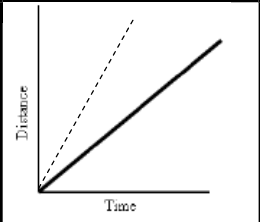
What does this graph represent?
a)
Constant Speed
b)
Acceleration
c)
Not moving
29.
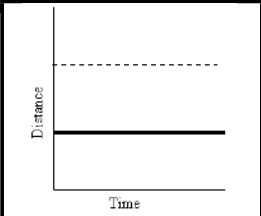
What does this graph represent?
a)
Constant speed
b)
Acceleration
c)
Not moving
30.
What does this graph represent?
a)
Constant speed
b)
Acceleration
c)
Not moving
31.
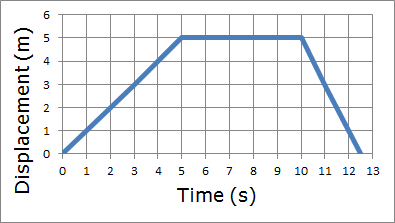
According to the graph how far does the person travel in the first 5 seconds?
a)
2 m
b)
10 m
c)
0 m
d)
5 m
32.
What is the average speed of the person during the first 5 seconds?
a)
0 m/s
b)
1 m/s 
c)
3 m/s
d)
6 m/s 
33.
Which runner won the race?
a)
A
b)
B
c)
C
34.
Which runner had a head start?
a)
A
b)
B
c)
C
35.
At what time did runner A pass runner B?
a)
0 seconds
b)
1 second
c)
2 seconds
d)
3 seconds
36.
Which runner stopped for a rest?
a)
Albert
b)
Bob
c)
Charlie
37.
Which runner won the race?
a)
Albert
b)
Bob
c)
Charlie
38.
How long did one of the runner's rest?
a)
8 seconds
b)
13 seconds
c)
5 seconds
d)
50 seconds
39.
What is magnitude?
a)
The direction that describes a quantity.
b)
A numerical value
c)
A unit of force
40.
Velocity
a)
Vector
b)
Scalar
41.
Speed
a)
Vector
b)
Scalar
42.
Mass
a)
Vector
b)
Scalar
43.
Which one of the following is not the property of a vector quantity?
a)
Unit
b)
Magnitude
c)
Location
d)
Direction
44.
Which symbol is used to show vector quantities?
a)
Circle
b)
Line
c)
Arrow
d)
Triangle
45.
30 m/sec, East. Scalar or Vector
a)
Scalar
b)
Vector
c)
Neither
46.

vertical

a)

up and down

b)

side to side

c)

x-axis

d)

y-axis

47.

horizontal

a)

up and down

b)

side to side

c)

x-axis

d)

y-axis

48.

projectile

a)

object flying through air

b)

machine that plays movies on a screen

c)

how fast something is going

49.

trajectory

a)

path followed by a moving object

b)

button to open your Playstation or Xbox

c)

speed of a free falling object

50.

relative velocity

a)

speed and direction of an object's motion in relation to another object's motion

b)

how fast your mom runs

c)

Final velocity minus initial velocity

d)

vf - vi

51.

resultant velocity

a)

combined velocity of two or more vectors

b)

distance/time

c)

vf - vi

52.
How do you combine vectors if they are at a right angle to each other, and you know two sides?
a)
Multiply
b)
Divide
c)
Pythagorean Theorem
d)
Use trigonometry
53.

component

a)

"piece" or "part"

b)

the horizontal piece of a vector

c)

the vertical piece of a vector

54.

range

a)

horizontal distance traveled by an object

b)

measured in meters (m)

c)

measured in meters per second (m/s)

d)

measured in meters per second squared (m/s2)

55.

Pythagorean Theorem

a)

a2 + b2 = c2

b)

method for finding resultant vector when adding two perpendicular vectors

c)

For every action there is an equal and opposite reaction

d)

Force = mass x acceleration

56.

The outcome when 2 or more vectors are combined

a)

Resultant vector

b)

Component vector

c)

Resultant scalar

d)

Component scalar

57.

speed of an object across flat ground

a)

horizontal velocity

b)

acceleration

c)

vertical velocity

58.

speed going upward or downward

a)

vertical velocity

b)

horizontal velocity

c)

altitude

d)

-9.8 m/s2

59.

air resistance

a)

The force of air pushing against a moving object, slowing it down

b)

A new shoe by Nike

c)

assumed to not exist when solving problems for this class

60.

What is the definition of force?

a)

A weight that pulls an object down

b)

A push or a pull that causes a change in the motion of an object

c)

How fast you're going

61.
How do you calculate force? What is the equation you use? (Hint: it was in the first picture.)
a)
f=m/a
b)
f=a/m
c)
f=m*a
d)
a=m*f
62.
Friction is a force that does what?
a)
helps an object move faster
b)
slows down or even stops the motion between two objects
c)
makes more gravity 
63.
A push or pull.
a)
force
b)
gravity
c)
interaction
d)
acceleration
64.
Gravity is 
a)
A pushing force on the earth
b)
A magnetic force 
c)
A pulling force on the earth
d)
A friction force on the earth
65.
Which would require the most force to move?
a)
a toy car
b)
a sleeping cat
c)
a science book
d)
a chair with a friend sitting in it
66.
What is force measured in?
a)
Newtons
b)
Nucleus
67.
When mass increases then gravity
a)
Decreases
b)
Increases
c)
Stays the same
68.
What does the strength of gravity between two objects depend upon?
a)
Mass & distance
b)
Mass & weight
c)
Gravity & inertia
d)
Inertia & mass
69.
All objects in the universe have a gravitational attraction to each other. 
a)
True
b)
False
70.
An _______ force must act on an object for it to CHANGE it's motion
a)
balanced
b)
unbalanced
c)
gravitational
d)
electrical
71.

If the net force is equal to zero, the forces acting on the object are

a)

balanced

b)

unbalanced

72.
Balanced forces do not change the objects speed or 
a)
direction
b)
distance 
c)
time
d)
mass
73.
The unit of force is
a)
m/s
b)
m/s^2
c)
newton
d)
kg
74.
What is the net force?
a)
65 N left
b)
65 N right
c)
35 N left
d)
35 N right
75.
What is the net force?
a)
11 N left
b)
11 N right
c)
3 N left
d)
3 N right
76.
If there are two forces going in the same direction how would you find the net force?
a)
Subtract
b)
Add
c)
Neither
d)
Multiply
77.

Explain what a net force is.

a)

It is the smallest force acting on an object

b)

It is the biggest force acting on an object

c)

It is when no forces act on an object

d)

It is the final force that acts on an object once all the other forces acting have been added together.

78.

Explain what a net force is.

a)

It is the smallest force acting on an object

b)

It is the biggest force acting on an object

c)

It is when no forces act on an object

d)

It is the final force that acts on an object once all the other forces acting have been added together.

79.

The resistance of an object to any change in its motion is called ______________________.

a)

inertia

b)

friction

c)

gravity

d)

weight

80.

According to Newton’s second law of motion, force is equal to mass times ______________________.

a)

inertia

b)

weight

c)

acceleration

d)

direction

81.
What law is best described by inertia?
a)
1st
b)
2nd
c)
3rd
82.
"For every action, there is an equal and opposite reaction."
a)
Newton's 1st Law
b)
Newton's 2nd Law
c)
Newton's 3rd Law
d)
Newton's 4th Law
83.
"An object in motion (or at rest) will to stay in motion (or at rest) until an outside force acts upon it."
a)
Newton's 1st Law
b)
Newton's 2nd Law
c)
Newton's 3rd Law
d)
Newton's 4th Law
84.

The acceleration of objects falling on Earth due to gravity is

a)

9.8 m/s

b)

9.8 m/s2

c)

9.8 g/mL

d)

9.8 g/m/m

85.

A measure of how much matter an object has

a)

weight

b)

gravity

c)

mass

d)

volume

86.

Suspended

a)

Hanging

b)

Moving horizontally

c)

Moving vertically

d)

Sitting on the ground

87.
What type of friction is not moving?
a)
static
b)
sliding
c)
kinetic
d)
rolling
88.
What type of friction is moving?
a)
static
b)
sliding
c)
kinetic
d)
rolling
89.

Static friction

a)

Force that keeps an object at rest

b)

Friction when the radio reception is bad

c)

Friction when an object is at motion

90.

Static friction

a)

Force that keeps an object at rest

b)

Friction when the radio reception is bad

c)

Friction when an object is at motion

91.

Free body diagram

a)

Used to show the relative magnitude and direction of all forces acting upon an object in a given situation.

b)

Special example of vector diagram

c)

Direction of arrow shows direction that the force is acting; size of arrow shows magnitude of force

d)

Each force arrow in the diagram is labeled to show the exact type of force

92.

Directly proportional

a)

One variable changes, and the other changes the same way

b)

One variable changes, and the other changes the opposite way

c)

One variable changes, and the other stays the same

93.

Inversely proportional

a)

One variable changes, and the other changes the same way

b)

One variable changes, and the other changes the opposite way

c)

One variable changes, and the other stays the same

94.
Acceleration of an object happens when things ________
a)
slow down
b)
go faster
c)
change direction (turn)
d)
All of the above
95.
change in velocity
a)
Speed
b)
Velocity
c)
Acceleration
96.

Constant velocity

a)

No change in speed, no change in direction

b)

No acceleration

c)

No change in speed, change in direction

d)

Change in speed, no change in direction

97.

Force of Tension

a)

The force that is transmitted through a rope, string or wire when pulled by forces acting from opposite sides.

b)

The tension force is directed over the length of wire and pulls energy equally on the bodies at the ends.

c)

Is always greater than applied force.

98.

Force of Tension

a)

The force that is transmitted through a rope, string or wire when pulled by forces acting from opposite sides.

b)

The tension force is directed over the length of wire and pulls energy equally on the bodies at the ends.

c)

Is always greater than applied force.

99.
  1. Energy is
a)

how much starbucks drink you can finish in 1 hour.

b)

the capacity to do work.

c)

the power per unit time.

d)

rate of change of work done.

100.

Kinetic energy is the energy

a)

stored in an object above ground height

b)

in a moving object

c)

stored in an objects that are stretched or compressed

d)

that attracts objects to a magnet

101.
__________ is stored energy. 
a)
Potential
b)
Kinetic
c)
None of the above 
d)
All of the above 
102.

Gravitational potential energy is the energy

a)

stored in an object above ground height

b)

in a moving object

c)

stored in an objects that are stretched or compressed

d)

that attracts objects to a magnet

103.

Elastic potential energy is the energy

a)

stored in an object above ground height

b)

in a moving object

c)

stored in an objects that are stretched or compressed

d)

that attracts objects to a magnet

104.
What are the two types of Mechanical Energy? (ME)
a)
Kinetic and Potential Energy
b)
Kinetic and Nuclear Energy
c)
Potential and Chemical Energy
d)
Thermal and Kinetic Energy
105.

Heat (thermal) energy is the energy

a)

that travels in straight lines, making objects visible.

b)

in a moving object

c)

that causes particles in a substance to move faster

d)

that attracts objects to a magnet

106.
The equation to find kinetic energy is
a)
KE=1/2mv2
b)
KE=mgh
c)
KE=1/2kx2
d)
KE=Fd
107.
The Law of Conservation of Energy states:
a)
Energy can created or destroyed but not transformed 
b)
Energy cannot be created or destroyed, it can only transformed
c)
Energy can't be created, destroyed or transformed
108.
What is the definition of power?
a)
the amount of work an object does
b)
the rate at which force is applied
c)
the amount of matter in an object
d)
the rate at which work is done
109.

What unit do we use for measuring power?

a)

Watts (W)

b)

Joules (J)

c)

Newtons (N)

d)

Foot-pounds (ft/lbs)

110.
What is the difference between calculating power and work?
a)
Power takes into account the time it takes to complete a task
b)
Work takes into account the time it takes to complete a task
c)
Power is force/area
d)
Work is force/area
111.
In order to calculate work, you must use which formula?
a)
W = f x a
b)
W = f x m
c)
W = f x d
d)
W = m x d
112.

What is the power formula?

a)

P = Work / Time

b)

P = Time / Work

c)

P = (Force x Distance) / Time

d)

I don't know

113.
The net work done by a net force acting on an object is equal to the change in the kinetic energy of the object.
a)
Force-Work Theorem
b)
Work-Kinetic Energy Theorem
c)
Force-Kinetic Energy Theorem
d)
Work-Force Theorem
114.

What is a joule?

a)

Unit of energy

b)

Unit of sound energy

c)

Unit of velocity

d)

Unit of Mass

115.
How is work defined?
a)
the amount of energy 
b)
the transfer of force over a distance
c)
rate of work in a given time
d)
the change in distance in a given time
116.

Elastic potential energy is energy stored in object that are compressed or __________.

a)

movement

b)

raised

c)

harnessed

d)

stretched

117.

Mass-spring system

a)

a mass connected by a spring to another mass or stationary object

b)

animals gaining weight after a long winter

c)

the inside of a mattress

118.

Motor

a)

something that converts electrical energy into mechanical energy

b)

can be used to pull a mass horizontally or lift a mass vertically

c)

Character in Game of Thrones

119.

Spring constant

a)

k

b)

represents how stiff the spring is

c)

March 21

120.

Potential Energy spring/elastic formula

a)

PEs=1/2kx2

b)

F=ma

c)

E=mc2

121.

Unit of mass

a)

kilogram (kg)

b)

pound (lb)

c)

meter (m)

d)

watt (w)

122.

Vertical

a)

Up and down

b)

side to side

123.

Horizontal

a)

up and down

b)

side to side

124.

1- The motion of an object around a fixed axis at a fixed distance from it is called ………………..

a)

circular motion

b)

linear motion

c)

angular motion

d)

constant motion

125.
In circular motion, the centripetal force is always directed towards...
a)
The center
b)
The tangent
c)
Away from the center
d)
Away from the tangent
126.
What is the difference between centripetal and centrifugal forces?
a)
Centripetal is towards center while centrifugal is away from the center.
b)
Centrifugal is towards center while centripetal is away from the center.
c)
Neither of the above is correct
127.
Which of the following is accelerating?
a)
A cannonball sitting on the ground
b)
A boat traveling at a constant speed in a straight line
c)
A can being crushed under a person's foot
d)
A car going around a curve at a constant speed
128.
When an object is in circular motion it is constantly changing its velocity.
a)
True
b)
False
129.

What is the speed of an object in circular motion called?

a)

circular speed

b)

centripetal speed

c)

tangential speed

d)

inertial speed

130.

What is rotational speed?

a)

speed at which an object rotates or revolves

b)

Measured in rotations per period of time

c)

distance traveled in a circle

131.
Which of the following is the unit for centripetal force?
a)
J
b)
m/s2
c)
kg⋅m/s
d)
N
132.
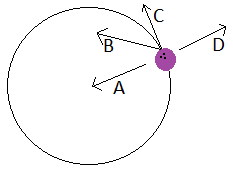
Which represents the acceleration of the ball?
a)
A
b)
B
c)
C
d)
D
133.

Which of the following depict the velocity of the blowing ball?

a)

A

b)

B

c)

C

d)

D

134.
Earth's gravity exerts a centripetal force on the Moon that keeps it moving in a nearly circular orbit.
a)
True
b)
False
135.

Formula for centripetal acceleration

a)

ac = (v2) / r

b)

2π r

c)

π r2

136.
What are the units of momentum?
a)
kg
b)
m/s
c)
kg⋅m/s
d)
N
137.

Which of the following correctly defines linear momentum?

a)

mass in motion

b)

how difficult it is to stop a body

c)

product of a body's mass and velocity

d)

all of these are correct

138.
Earth and the Moon __ on an axis
a)
rotate
b)
revolve
139.
The moon __ around Earth
a)
Rotates
b)
Revolves
140.
The moon __ around Earth
a)
Rotates
b)
Revolves
141.

A 10kg car travels at a constant speed of 20.0 m/s around a horizontal circular track. Which diagram correctly represent the direction of the car's velocity (v) and the direction of the centripetal force (Fc) acting on the car at a particular moment?

a)
b)
c)
d)
142.
Velocity is 
a)
speed
b)
direction
c)
speed with a direction
143.
What is speed?
a)
how far you go
b)
how much distance is covered over a period of time
c)
how fast you accelerate
d)
the change in the location of a object
144.
When an object spins it is said to undergo ______________. 
a)
rotational motion
b)
angular momentum
c)
axis differentiation
d)
rotational axis
145.

Which of the following is NOT a unit of rotational speed?

a)

Meters per second

b)

Revolutions per minute

c)

Revolutions per second

d)

Rotations per second

146.
The linear speed of an object directed along the tangent to the object’s circular path.
a)
centrifugal speed
b)
tangential speed
c)
linear speed
d)
angular speed
147.
What does ROTATION mean?
a)
To SPIN
b)
To ORBIT or GO AROUND
148.
Which would have a greater linear velocity?
a)
Kid near the center of the merry go round
b)
Kid near the outside of the merry go round
c)
neither
149.
The velocity is always _____ to the line of a circle. 
a)
outwards
b)
towards the center
c)
tangent
d)
faster
150.
What is the force that causes centripetal acceleration when a car goes around a curve?
a)
Friction
b)
Gravity 
c)
Normal
d)
Tension
151.
What is magnitude?
a)
The direction that describes a quantity.
b)
A numerical value
c)
A unit of force
152.

Two children, Jack and Jill, ride on a merry-go-round. Jack is at a greater distance from the axis of rotation than Jill. Which of the following are true statements?

a)

Jill and Jack have the same tangential speed.

b)

Jack has a greater tangential speed than Jill.

c)

Jill has a greater angular speed than Jack.

d)

Jill has a smaller angular speed than Jack.
153.
Which has greater angular speed, a horse near the outside rail of a merry-go-round or a horse near the inside rail?
a)
The inside horse
b)
The outside horse
c)
Neither - they both have the same angular speed
154.
Which has greater linear speed, a horse near the outside rail of a merry-go-round or a horse near the inside rail?
a)
the inside horse
b)
the outside horse
c)
Neither
155.
The highest point on a wave is:
a)
the crest
b)
the trough
c)
the top
d)
the coast 
156.
The lowest point on a wave is the:
a)
Amplitude
b)
Crest
c)
Trough
d)
Wavelength
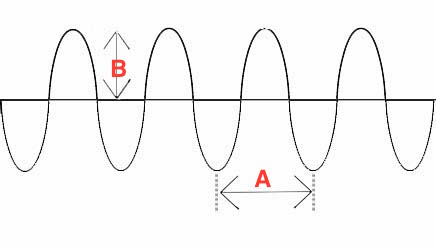
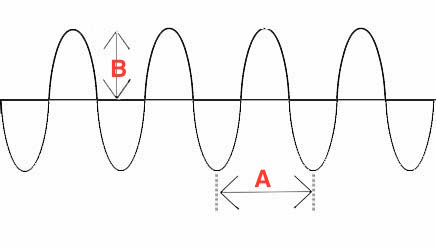
157.

What property of this wave is represented by the letter "A"

a)

amplitude

b)

crest

c)

trough

d)

wavelength

158.
What property of the wave is represented by the letter "B"?
a)
amplitude
b)
crest
c)
trough
d)
wavelength
159.

A substance that makes possible the transfer of energy from one location to another, especially through waves.

a)

medium

b)

small

c)

large

d)

extra large

160.
The type of waves that require medium to pass:
a)
Mechanical Waves
b)
Electromagnetic Waves
161.
The number of wavelengths that pass a point each per second is:
a)
frequency
b)
period
c)
longitudinal 
d)
transverse wave 
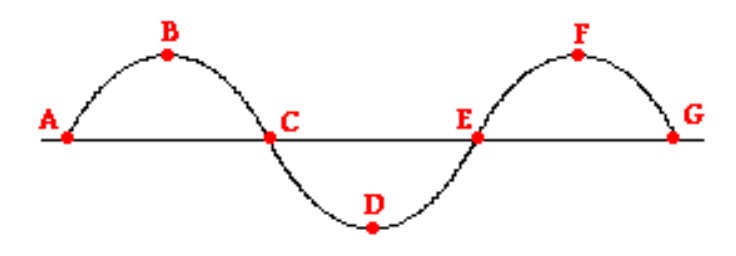
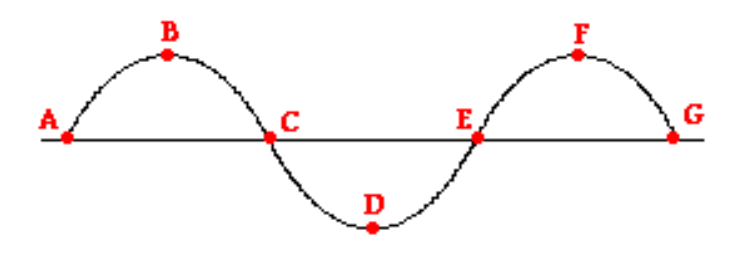
162.
Which vocabulary term is used to identify the distance between points C & G?
a)
Amplitude
b)
Crest
c)
Frequency
d)
Wavelength
163.
When the frequency of a wave increases, what happens to the wavelength?
a)
The wavelength is not directly affected by the frequency of a wave.
b)
The wavelength increases.
c)
The wavelength decreases.
d)
More specific information is needed to form a conclusion about the wavelength.
164.
A mechanical wave cannot travel through...
a)
a vacuum(empty space).
b)
water.
c)
air. 
d)
glass.
165.
Which letter(s) represent the trough of the wave?
a)
A
b)
B & D
c)
D
d)
C & G
166.
Which letter(s) represent the crest of the wave?
a)
A
b)
B & D
c)
B & F
d)
F
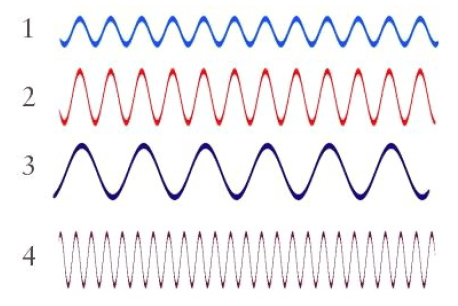
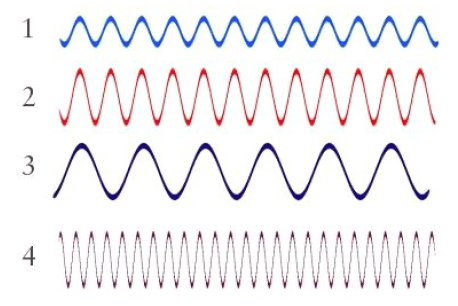
167.
Which wave in the diagram has the greatest frequency?
a)
1
b)
2
c)
3
d)
4
168.
Which wave in the diagram has the greatest wavelength?
a)
1
b)
2
c)
3
d)
4
169.
Which of the following can sound travel through?
a)
solid
b)
liquid
c)
gas
d)
all of the above
170.
Electromagnetic waves include the following except
a)
radio waves
b)
X-rays
c)
doing the wave at a football game
d)
microwaves
171.
regular disturbances that carry energy through matter or space
a)
crest
b)
energy
c)
wave
d)
trough
172.
which material does sound travel the fastest?
a)
solid 
b)
liquid 
c)
gases
173.
When a wave strikes and object and bounces off. (example echo)
a)
medium
b)
refraction
c)
reflection
d)
interference
174.
When a wave bends as it passes through at an angle from one medium to another.(example: pencil in a glass of water-)
a)
medium
b)
refraction
c)
reflection
d)
interference
175.

When waves overlap

a)

Interference

b)

Resonance

c)

Reflection

d)

Diffraction

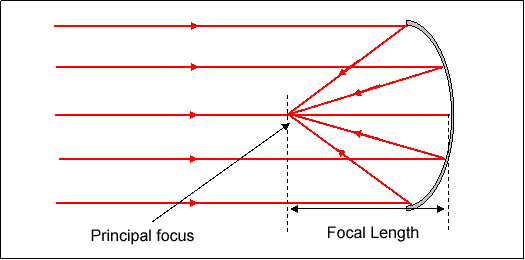
176.
This is an example of a __________ mirror.
a)
Concave
b)
Convex
c)
Plane
d)
Magnifying
177.
Concave mirrors can create virtual and real images.
a)
True
b)
False
178.
The law of reflection states that the angle of reflection is equal to the angle of incidence. 
a)
True
b)
False
179.
What is the name of the perpendicular line that we use to measure angles?
a)
Incident ray
b)
Reflected ray
c)
Normal line
d)
Source ray
180.
An incident light ray strikes a flat mirror at an angle of 30° from the normal. The reflected light ray reflects off the mirror
a)
at an angle of 30° from the mirror edge
b)
at an angle of 60° from the normal
c)
at an angle of 30° from the normal
d)
at an angle of 90° from the mirror edge
181.
Which term explains the path of the light ray in this diagram?
a)
Convection
b)
Scattering
c)
Absorption
d)
Refraction
182.
_____ is a lens that is thicker in the middle and makes an object appear bigger.
a)
prism
b)
convex lens
c)
concave lens
d)
mirror
183.
______ is a lens that is thicker on its edges and makes an object appear smaller?
a)
mirror
b)
convex lens
c)
concave lens
d)
prism
184.
The following is a picture of what type of mirror? 
a)
Convex Mirror
b)
Concave Mirror
c)
Plane Mirror
d)
Flat Mirror
185.
The following is a picture of what type of mirror? 
a)
Convex Mirror
b)
Concave Mirror
c)
Plane Mirror
d)
Flat Mirror
186.
An image that you can see , but does not really exist is called which of the following?
a)
Real Image
b)
Fake Image
c)
Virtual Image
d)
Digital Image
187.

What type of interference is represented in the diagram?

a)

Constructive

b)

Destructive

188.

What type of interference is represented in this diagram?

a)

Constructive

b)

Destructive

189.
The Law of Reflection:
The angle of incidence is _________ the angle of reflection
a)
bigger than
b)
the same as
c)
smaller than
190.

Wave speed

a)

v = f • λ

b)

frequency times wavelength

c)

a leading cause of wrist injury

191.
Frequency is a measure of...
a)
length of the wave
b)
height of the wave
c)
number of waves a second
d)
number of waves an hour
192.

If the pendulum completes exactly 12 cycles in 2.0 min, what is the period of the pendulum?

a)

0.17 s

b)

0.10 s

c)

6.0 s

d)

10 s

193.

Which factors affect the period of a pendulum?

a)

mass of bob

b)

length of string

c)

initial displacement (how far you pull the bob)

d)

size of bob

194.

Period of pendulum formula

a)

T = 2π√(L/g)

b)

P = w/t

c)

D = v*t

d)

PDQ = mr/t

195.
crest match with crest and trough match with trough is called
a)
constructive interference
b)
destructive interference 
c)
monochromotic
d)
interference 
196.
When two waves combine to form a new wave with a smaller amplitude, it is called 
a)
Refraction
b)
Constructive Interference
c)
Resonance
d)
Destructive Interference
197.
Electricity that flows in a closed path is called a
a)
path
b)
current
c)
circuit
198.

The flow of electricity in a circuit-

a)

electric current

b)

flow

c)

circuit

199.
Magnetism created by an electric current
a)
electricity
b)
electromagnetism
c)
wind energy
200.
To complete a circuit the switch must be
a)
unattached
b)
open
c)
closed
201.
If the lights are off, the circuit is
a)
closed
b)
open
202.
A material in which electrons are able to move easily
a)
Circuit
b)
Insulator 
c)
Resistance 
d)
Conductor 
203.
A material in which electrons are not able to move easily 
a)
Circuit 
b)
Insulator 
c)
Resistance 
d)
Conductor
204.
tiny particles that have a negative charge
a)
protons
b)
neutrons
c)
electrons
d)
circuits
205.
What does the switch do in a circuit?
a)
It supplies the power.
b)
It carries electricity.
c)
It opens and closes the circuit.
d)
It is an insulator.
206.
What charge does a proton have?
a)
negative (-)
b)
positive (+)
c)
neutral or no charge (0)
207.
What charge does an electron have?
a)
negative (-)
b)
positive (+)
c)
neutral or no charge (0)
208.
The buildup of charges on an object
a)
conductor
b)
static electricity
c)
electric field
d)
series circuit
209.
The measure of how much a material opposes the flow of current 
a)
insulator 
b)
conductor
c)
reisitance
d)
parallel circuit 
210.
A temporary magnet made up of a wire wrapped around a core
a)
conductor
b)
electromagnet
c)
parallel circuit
d)
series circuit 
211.
A circuit that only has one path that electricity can follow
a)
parallel circuit
b)
static electricity
c)
electromagnet
d)
series circuit
212.
A circuit that has two or more paths that electricity can follow
a)
parallel circuit
b)
series cirucit
c)
open circuit
d)
closed circuit
213.
Which of these materials is a good insulator of electricity? 
a)
saltwater
b)
plastic
c)
aluminum foil
d)
silver
214.
If one burned out bulb causes all of the lights to fail in a circuit, what might you conclude?
a)
It is a parallel circuit.
b)
A heavier wire is needed.
c)
It is a series circuit.
d)
More batteries are needed.
215.
What is a property of matter that causes objects to attract or repel each other?
a)
compass
b)
electric charge
c)
electric circuit
d)
electric field 
216.
A student added another light to an electrical circuit and all the lights became dimmer in the circuit.  What is most likely the cause of the dimmer lights?
a)
The batteries are weak.
b)
The circuit is a parallel circuit.
c)
The light bulbs are hot.
d)
The circuit is a series circuit.
217.
What material is a good conductor?
a)
copper
b)
wood
c)
rubber
d)
plastic
218.
Why are the wires covered in plastic?
a)
keeps the wire from scratching stuff
b)
makes a nice coil
c)
it is a conductor
d)
keeps you from getting shocked
219.
A type of circuit where each component is connected, one after the other, in a SINGLE loop. 
a)
series circuit
b)
parallel circuit
220.
A type of circuit where each component is connected, one after the other, in a SINGLE loop. 
a)
series circuit
b)
parallel circuit
221.
This is an example of...
a)
series circuit
b)
parallel circuit
222.
An electric current can move along more than one path in a.....
a)
Series circuit
b)
Parallel circuit
223.
The two ends of a bar magnet are its
a)
Magnetic poles
b)
Insulators
c)
Circuits
d)
Irons
224.

An object with equal amounts of positive and negative charge is electrically....

a)

neutral

b)

charged

c)

positive

d)

negative

225.

The region around any charged object where an electric force is applied matches which term?

a)

electric discharge

b)

electric current

c)

electric field

d)

electric force

226.

This is an example of what type of circuit?

a)

simple

b)

series

c)

parallel

227.
What charge does a neutron have?
a)
positive
b)
negative
c)
no charge
d)
neutral
228.

What is current electricity?

a)

constant flow of electricity

b)

how much electricity there is right now

c)

open circuit

229.

When electricity moves in only one direction (usually a current from batteries).

a)

Alternating current

b)

Direct current

c)

Ionic current

230.
What is resistance measured in?
a)
Ω (Ohms)
b)
V (Volts)
c)
A (Amps)
d)
W (Watts)
231.
AC stands for ___.
a)
Alternating Current
b)
Attraction Connections
232.
Voltage is measured in __.
a)
volts.
b)
watts.
c)
coulombs. 
233.
Current is measured in....
a)
Amps 
b)
Volts
c)
Ohms
d)
Coulombs
234.
What does a fuse do?
a)
Die
b)
Makes sure the volts don't go over a certain point.
c)
Has fun
d)
Give out energy
235.
What is voltage?
a)
The amount of electric potential energy per one coulomb of charge
b)
The amount of 1 coulomb of charge per unit of potential energy
c)
The number of volts per coulomb
d)
The amount of electric potential energy per volt
236.

What is the meaning of voltage?

a)

Voltage is the electric potential difference between two points in a circuit

b)

Voltage is the rate of electrical charges pass through a point

c)

Voltage is the physical quantities related to one another

d)

Voltage unit is ohm

237.

Voltage = Current x Resistance

a)

Faraday's Law

b)

Tesla's Law

c)

Edison's Law

d)

Ohm's Law

238.
Voltage is simply defined as...
a)
what 'pushes' electrons
b)
what 'stops' electrons
c)
moving electrons
239.
What does an ampere meter tell you?
a)
Voltage
b)
Current
c)
Watts
d)
Hertz
240.

______ is an instrument used to measure current, voltage, and resistance.

a)

Multi meter

b)

Ohm's Law

c)

Resistor

d)

Current

241.

_____is the ratio of voltage to current is resistance and is represented by the equation R=V/I.

a)

Mrs. Pulaski's Law

b)

Multi-meter

c)

Ohm's Law

d)

Potential Difference

242.

____ is the difference in electrical potential between point A and point B. In a circuit, Point A and point B represent the positive and negative terminals of a power source such as a battery.

a)

Resistor

b)

Tesla

c)

Electric Potential

d)

Potential Difference

243.

How do you measure voltage, current, and resistance in a physical circuit?

a)

Multimeter

b)

Voltmeter

c)

Ohmeter

d)

Odometer

244.

Power is measured in what units?

a)

Ohms

b)

Volts

c)

Amperes

d)

Watts

245.

What is the equation for how to calculate Power?

a)

P=IV

b)

P=VR

c)

V=IP

d)

V=IR

246.

A battery converts:

a)

Mechanical energy to electrical energy

b)

Chemical energy to electrical energy

c)

Electrical energy to chemical energy

247.
magnetic field
a)
the space around a magnet in which magnetic forces can act on objects
b)
to separate or set apart
c)
one of the two opposite ends of a magnet
d)
to provide evidence that goes against a claim
248.
This object transforms mechanical energy into electrical energy
a)
Circuit
b)
Generator
c)
Motor
d)
Battery
249.
This object transforms mechanical energy into electrical energy
a)
Circuit
b)
Generator
c)
Motor
d)
Battery
250.
What device turns electrical energy into mechanical energy?
a)
a solenoid
b)
a motor
c)
an electromagnet
d)
an electric generator
251.
A device that increases or decreases the voltage of alternating current is a
a)
generator
b)
motor
c)
transformer
d)
turbine
252.
Which of these can apply a force without actually touching an object?
a)
motor
b)
generator
c)
magnetic field
d)
turbine
253.
A(n) ______________ is a reusable safety switch that breaks the circuit when the current gets too high.
a)
Fuse
b)
Grounded wire
c)
Fuse box
d)
Circuit breaker
254.

A switch that operates electronically

a)

relay

b)

fuse

c)

motor

255.
what is this symbol for?
a)
light bulb
b)
switch
c)
battery
d)
resistor
256.
this is the symbol for a _____?
a)
switch
b)
light 
c)
battery
d)
wires
257.
This is the symbol for a ...
a)
Bulb
b)
Battery
c)
Horn
d)
Fuse
258.
This is the symbol for a ...
a)
Wire
b)
Battery
c)
Buzzer
d)
Fuse
259.
This is the circuit symbol for ...
a)
an AC current source
b)
a DC current source
c)
an ammeter
d)
a voltmeter
260.
This is the circuit symbol for ...
a)
an AC current source
b)
a DC current source
c)
an ammeter
d)
a voltmeter
261.
This is the circuit symbol for ...
a)
an AC current source
b)
a DC current source
c)
a battery
d)
a single cell
262.
This is the symbol for 
a)
An Ammeter
b)
A Voltmeter
c)
A Meter
d)
A Motor
263.
This is the symbol for a _____?
a)
Lamp
b)
Water wheel
c)
Loudspeaker
d)
Motor
264.
a)
Closed switch
b)
Push switch
c)
Trap door
d)
AC Power supply
265.

What is the following symbol represent?

a)

Wire

b)

Resistor

c)

Battery

d)

Switch

266.
a)
push switch
b)
diode
c)
circuit breaker
d)
fuse