

Wayground logo

Free Printable Worksheets

Font size

S
M
L
XL
Worksheets

Ch 1 What is Economics

Total questions: 43

Worksheet time: 32mins

Name
Class
Date
1.

Which of the following are factors of production?

a)

scarcity and shortages

b)

capital and labor

c)

technology and productivity

d)

economics and business decisions

2.

What is a service?

a)

A job

b)

an item you buy

c)

A need

d)

Something you do for another person

3.
What is a want?
a)
A person
b)
Something you would like to have but don't need to live
c)
Purple
d)
Something you need to live
4.
Which of the following is not a good?
a)
Clothes
b)
Food
c)
Dog Walker
d)
Toys
5.
Which of the following is not a service?
a)
Dry Cleaner
b)
Car Wash
c)
Clothes
d)
Babysitter
6.
Which of these is a need?
a)
car
b)
water
c)
video games
d)
candy
7.
Which of these is a want?
a)
Legos
b)
air
c)
water
d)
food
8.

You bought two new CDs with the last $30 in your checking account, and your next payday is on Monday. What is opportunity cost of these CDs?

a)

The difference between the cost to product the CDs and the price you paid.

b)

The $30 check that you wrote for the CDs.

c)

The night out with your friends that you miss because you can’t afford it now.

d)

The satisfaction of knowing you are first of your friends to have these CDs

9.
A crew of men are hired to paint a new house.  They are providing a ____
a)
service
b)
product
c)
specialization
d)
good
10.
Tools we use to make products
a)
capital resources
b)
human resources
c)
natural resources
d)
entrepreneurs
11.
The idea that resources are limited; we don't have an unlimited supply of what we want
a)
scarcity
b)
supply
c)
demand
d)
inflation
12.
When I choose one item over another because I cant afford both, this is called an ...
a)
scarcity
b)
opportunity cost
c)
choice
d)
incentive
13.
When people need to make economic choices due to a lack of available goods and money, this is called _________________________ in economic terms.
a)
trade offs
b)
scarcity
c)
opportunity cost
d)
incentive
14.
Economics is the study of how people seek to satisfy their needs and wants by making choices.
a)
True
b)
False
15.
________means that we have limited quantities of resources to meet our unlimited wants.
a)
Shortage
b)
Scarcity
c)
Recession
d)
Simplify
16.
When producers will not or cannot offer goods or services at the current prices 
a)
Shortage
b)
Scarcity
17.
Something you choose to buy is an opportunity cost.
a)
True
b)
False
18.
If you choose an apple instead of a banana, the banana is the opportunity cost.
a)
True
b)
False
19.
Scarcity is NEVER a big problem.
a)
True
b)
False
20.
The plastic needed to make iphone cases is considered _____________ ____________ because it is used to make the iphone (good).
a)
Human Resource
b)
Capital Resource
21.
The person who starts, organizes and manages a business is called
a)
an entrepreneur
b)
a consumer
c)
a logger
d)
a producer
22.
What is Scarcity? _______________________________________
a)
People must make choices.
b)
Scarcity means that there are unlimited resources, and therefore, people don't have to make decisions.
c)
Scarcity means that there are limited resources, and therefore, people must make choices.
d)
Scarcity means that there is a surplus of resources, and therefore, people have more than enough resources.
23.
The things you must have to survive...
a)
Wants
b)
Supply
c)
Needs
d)
Opportunity Cost
24.

How does the illustration below demonstrate opportunity cost?

a)

Student must decide whether to study or to watch some T.V. during free time. Studying will benefit her. Whereas, watching TV will cause her to earn a bad grade. She has decide which she will do.

b)

Opportunity cost is the process of choosing one good or service over another.

c)

The item that you don’t pick is the opportunity cost.
25.
In economics, the value of the next best alternative is called _________.
a)
Scarcity
b)
Productivity
c)
Opprotunity Cost
d)
Supply and Demand
26.
Workers
a)
Land
b)
Labor 
c)
Capital
d)
Entrepreneurship
27.
Tools
a)
Land
b)
Labor 
c)
Capital
d)
Entrepreneurship
28.
Raw materials (i.e. cotton, oil...etc.)
a)
Land
b)
Labor 
c)
Capital
d)
Entrepreneurship
29.
The people who bring all the factors together to create something are practicing
a)
Land
b)
Labor 
c)
Capital
d)
Entrepreneurship
30.
What is the fundamental problem of every society?
a)
labor costs
b)
scarcity
c)
economic interdependence
d)
market fluctuation
31.
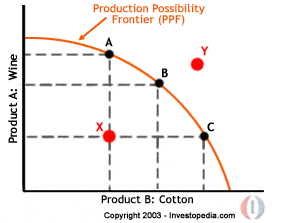
If a point lies on the curve this means the company is being efficient. If a point lies inside the curve, this tells the company what?
a)
They are being over efficient
b)
They are not efficient
c)
It is impossible
d)
None of the above
32.
What does point Y represent on the PPC?
a)
Efficiency
b)
Unattainable / impossible
c)
Inefficency
d)
Nothing
33.
What is the production possibilities curve?
a)
a graph that shows how much an economy can produce between 2 goods
b)
how much money something is
c)
the opportunity one has to give up in order to gain something else
d)
land, labor, capital, entrepreneurs
34.
What does point B represent?
a)
Production at greater than the country's minimum potential
b)
Production is less than the country's minimum potential
c)
Production is greater than the country's maximum potential
d)
Production at the country's maximum potential
35.

What is a "Tradeoff"

a)

Work performed for someone

b)

Alternative choice

c)

Cost of the next best alternative

d)

Item with worth that can be expressed in $$

36.

What does the happiness or satisfaction gained from an item represent

a)

Utility

b)

Production

c)

Market

d)

Wealth

37.

Country X has a barell of crude oil and they know that they can produce several items from this barrell.  If the following is their priority list, What is their opportunity cost of choosing heating oil 1. Heating oil 2. Gasoline  3. Plastics 4. fertilizer

a)
Heating Oil
b)
Plastics 
c)
Gasoline 
d)
Fertilizer
38.

What are the 4 Factors of Production?

a)

Land, capital, money, entrepreneurs

b)

Land, capital, labor, entrepreneurship

c)

Capital, money, supply, demand

d)

Labor, capital, supply, demand

39.
What does point X represent on the PPC?
a)
Efficiency
b)
Unattainable / impossible
c)
Inefficency
d)
Nothing
40.
What does point B represent?
a)
Production at greater than the country's minimum potential
b)
Production is less than the country's minimum potential
c)
Production is greater than the country's maximum potential
d)
Production at the country's maximum potential
41.
The branch of economics that studies national and international economies.
a)
Scarcity
b)
Marginal
c)
Microeconomics
d)
Macroeconomics
42.
Economist Adam Smith believed the central justification for the laissez-faire economic philosophy was in shown which economic concept
a)
Normative Statements
b)
Scarcity
c)
Invisible Hand
d)
Pitfalls to sound economic reasoning
43.

What are the 3 fundamental questions of economics?

a)

What to produce?

b)

Where to produce?

c)

How to produce?

d)

For whom to produce?
