wayground logo

Free Printable Worksheets

NEW

Font size

S
M
L
XL
Worksheets

Waves, Particles and Quantum Mechanics

Total questions: 33

Worksheet time: 1hrs 13mins
Name
Class
Date
1.
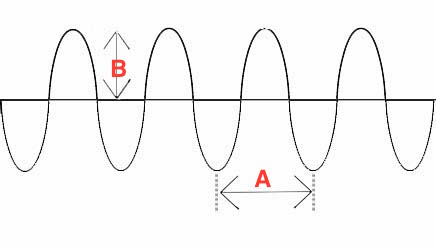
What property of the wave is represented by the letter "B"?
a)
amplitude
b)
crest
c)
trough
d)
wavelength
2.
The number of wavelengths that pass a point each per second is:
a)
frequency
b)
period
c)
longitudinal 
d)
transverse wave 
3.
When the frequency of a wave increases, what happens to the wavelength?
a)
The wavelength is not directly affected by the frequency of a wave.
b)
The wavelength increases.
c)
The wavelength decreases.
d)
More specific information is needed to form a conclusion about the wavelength.
4.
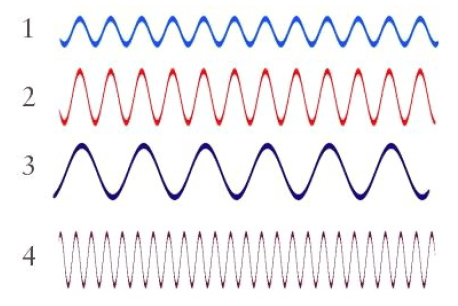
Which wave in the diagram has the greatest frequency?
a)
1
b)
2
c)
3
d)
4
5.
As the frequency of an electromagnetic wave increases, the amount of energy in that wave...
a)
increases.
b)
decreases.
c)
stays the same.
6.
Which color has the highest frequency?
a)
red
b)
orange
c)
green
d)
blue
7.
A wave with a frequency of 0.5 Hz and a speed of 10 m/s has a wavelength of
a)
0.2m
b)
0.5m
c)
20m
d)
50m
8.
A wave with a large wavelength will have a ______ frequency and _____ energy
a)
high, low
b)
high, high
c)
low, high
d)
low, low
9.
which wave has the highest frequency?
a)
radio
b)
blue light
c)
red light 
d)
UV light
10.
which wave has the highest wavelength?
a)
radio
b)
blue light
c)
red light 
d)
UV light
11.

Calculate the energy of a gamma ray photon whose frequency is 5.02 x 10²⁰ Hz?

a)

4.73 x 1072 eV

b)

2.07 x 10 6 eV

c)

3.33 x 10⁻¹³ eV

d)

1.21 x 10 35 eV

12.

A ____ is a discrete, quantized bundle of energy

a)

Photoelectric effect

b)

Photon

c)

Quantized

d)

Proton

13.
Which of the following describes electromagnetic radiation?
a)
A subatomic particle that carries a negative charge.
b)
A subatomic particle that carries a positive charge.
c)
The energy that is transferred by electromagnetic waves.
d)
A dangerous phenomena that can cause cancer.
14.
Which of the following statements about the Schrödinger wave equation is not true?
a)
the quantum mechanical model of the electron comes from this equation
b)
this equation supports the Bohr model of electron orbits
c)
solutions to this equation are called wave functions
d)
quantization of electron energies is required to solve the equation
15.
Define refraction
a)
the bouncing back of light
b)
the echo of light
c)
the bending of light waves
d)
the spectrum of light
16.
The _______________ determines the color of visible light. 
a)
wavelength
b)
speed
c)
amplitude
d)
light
17.
If an electron moves from n=2 to n=4 ...
a)
it absorbs energy
b)
it releases energy
18.
The higher the frequency the ______ the energy. 
a)
higher
b)
lower
c)
neither, stays the same
19.

Thomas Young's double slit experiment helped demonstrate that light had a _____ nature.

a)

particle

b)

wave

c)

particle-wave

d)

wave-particle

20.

Einstein's Photoelectric Effect helped demonstrate that light had a ____ nature.

a)

particle

b)

wave

c)

wave-particle

d)

particle-wave

21.
De Broglie provided a mathematical model of the electron as a ____.
a)
wave
b)
particle
c)
tsunami
d)
energy
22.
Heisenberg's uncertainty principle states that ___ and ___ cannot BOTH be known simultaneously?
a)
wavelength and distance
b)
position and momentum
c)
charge and displacement
d)
atomic radius and frequency
23.
The Quantum Mechanical Model of the Atom describes the electron's probable location around the nucleus in a 3-D cloud called a(n) ___.
a)
sphere
b)
it's just too complex to thing to answer
c)
orbit
d)
orbital
24.
This image is an illustration of
a)
photoelectric effect
b)
Dalton's atomic theory
c)
Bohr model
d)
Quantum mechanical model
25.
Einstein explained the photoelectric effect by saying that energy is quantized and absorbed in small packets of energy called photons.
a)
True
b)
False
26.
In the Bohr model, the orbit closest to the nucleus is
a)
called the ground state and is lowest in energy
b)
called the ground state and is highest in energy
c)
called the excited state and is lowest in energy
d)
called the excited state and is highest in energy
27.
Electrons are emitted when light of sufficient energy strikes the surface of metal.  This is best described as
a)
the photoelectric effect
b)
Einstein's theory of relativity
c)
Bohr model of atom
d)
Quantum mechanical model of atom
28.
Which subatomic particle is the one most responsible for chemical behavior?
a)
Electron
b)
Proton
c)
Neutron
d)
Photon
29.
Light of a single wavelength is incident on a metal.  Electrons are released. The intensity of the light is then increased.
Which of the following changes occur?
a)
Rate of electron emission: increase.
Energy of electrons: increase.
b)
Rate of electron emission: decrease.
Energy of electrons: no change.
c)
Rate of electron emission: decrease.
Energy of electrons: increase.
d)
Rate of electron emission: increase.
Energy of electrons: no change.
30.
Who was awarded the nobel prize for his work on the photoelectric effect?
a)
Hans Christian Oersted
b)
Michael Faraday
c)
Albert Einstein
d)
Max Planck
31.
The emission spectra is produced when 
a)
electrons release energy as they move to their excited state.
b)
electrons absorb energy as they move to their excited state.
c)
electrons release energy as they return to the ground state.

d)
electrons absorb energy as they return to the ground state.
32.
The photoelectric effect helps us to understand
a)
the particle nature of light.
b)
diffraction pattern produced as light passes through a single slit.
c)
the wave behavior of light.
d)
spectroscopes.
33.

The emission spectra is produced when

a)

electrons release energy as they move to their excited state.

b)

electrons absorb energy as they move to their excited state.

c)

electrons release energy as they return to the ground state.

d)

electrons absorb energy as they return to the ground state.