

wayground logo

Free Printable Worksheets

Font size

S
M
L
XL
Worksheets

Jayden Quiz

Total questions: 139

Worksheet time: 2hrs 45mins

Name
Class
Date
1.
Who were the Roman officials who ran the government?
a)
consuls
b)
tribunes
c)
assemblies
d)
plebeians
2.
What does Pax Romana mean?
a)
hardship
b)
peace
c)
trial
d)
chaos
3.
Who spread Jesus' teachings?
a)
Paul
b)
God
c)
Bob
d)
Harold
4.
What is another name for God?
a)
Buddha
b)
Hindu
c)
Yahweh
d)
Joseph
5.
____ was emperor when Mount Vesuvius erupted. 
a)
Domitian
b)
Titus
c)
Vespasian
d)
Hadrian
6.
The second emperor of Rome was ____.
a)
Augusus
b)
Tiberius
c)
Caligula
d)
Claudius
7.
The first emperor of Rome was ____.
a)
Augustus
b)
Tiberius
c)
Romulus
d)
Julius Caesar
8.
This father is known for having both of his sons succeed him as emperor. 
a)
Titus
b)
Domitian
c)
Vespasian
d)
Augustus
9.
This emperor is known for building a wall in Britain. 
a)
Augustus
b)
Hadrian
c)
Titus
d)
Claudius
10.
This emperor is known for his physical deformities. 
a)
Tiberius
b)
Nero
c)
Caligula
d)
Claudius
11.
The emperor who had his mother murdered was ____.
a)
Augustus
b)
Caligula
c)
Nero
d)
Domitian
12.
Nero suspiciously blamed the ____ for the Great Fire.
a)
Flavians
b)
Christians
c)
Druids
d)
the Republicans 
13.
The Roman Emperor reached its greatest extent geographically under the Emperor ____.
a)
Augustus
b)
Trajan
c)
Hadrian
d)
Honorius
14.
Trajan was a native of ____.
a)
Italy
b)
Spain
c)
France
d)
North Africa
15.
Gaius Octavius was adopted by ____.
a)
Julius Caesar
b)
Tiberius Claudius 
c)
Titus Flavius
d)
Ulpius Traianus
16.
Tiberius was the adopted son of ____.
a)
Nerva
b)
Trajan
c)
Augustus
d)
Claudius
17.
Vespasian created the ____ Dynasty.
a)
Julio-Claudian
b)
Claudio-Julian
c)
Nervan
d)
Flavian
18.
Which Roman Emperor named his horse as consul?
a)
Nero
b)
Augustus
c)
Caligula
d)
Trajan
19.
What does the nickname Caligula mean?
a)
Big Feet
b)
Little Boots
c)
Vicious
d)
Cruel
20.
Which Emperor made the beard fashionable?
a)
Augutus
b)
Nero
c)
Marcus Aurelius 
d)
Hadrian
21.
What are two important reasons that Julius Caesar was assassinated on March 15, 44 BCE?
a)
A) he taxed the public and outlawed slavery
b)
B) he created jealousy among the senators and the senators knew he had a fatal illness
c)
C) he declared himself Dictator for Life and took most of the power away from the Senate
d)
D) he declared himself Dictator for Life and he gave all the decision making power to the Senate
22.
The Pax Romana was a

a)
a. period of peace and prosperity. 
b)
b. leader of the senate.
c)
c. series of fortifications.
d)
d. program of public works. 
23.
Which emperor attempted to increase his popularity by building an arch for his brother, the previous emperor? 
a)
Domitian
b)
Titus
c)
Vespasian
d)
Hadrian
24.
The rule of which emperor is considered to be the start of the decline of the Roman Empire?
a)
Marcus Aurelius
b)
Lucius Verus
c)
Antoninus Pius
d)
Commodus
25.
For how many years did Augustus rule?
a)
11
b)
22
c)
44
d)
88
26.
Augustus was famous for building a giant extravagant imperial palace on the Palatine Hill
a)
Verum
b)
Falsum
27.
Where did Tiberius move the imperial palace to?
a)
city of Athens
b)
country of Gaul
c)
island of Capri
d)
province of Hispania
28.
Which emperor attempted to increase his popularity by building an arch for his brother, the previous emperor? 
a)
Domitian
b)
Titus
c)
Vespasian
d)
Hadrian
29.
Roman territories surrounded the _____________ forming one of the largest states the world had ever seen.
a)
World
b)
Mediterreanean sea
c)
empire
d)
Europe
30.
From the disorder of the disintegration of the Roman republic emerged the Roman _________________.
a)
road
b)
aqueduct
c)
engineer
d)
empire
31.
Rome's first emperor, _______________, set many of the powers that later emperors would have.
a)
Diocletian
b)
stoics
c)
Attila
d)
Augustus
32.
The Roman Empire survived for as long as it did, at least in part, because of its __________, which were written down and kept on public display.
a)
philosphy
b)
statues
c)
laws
d)
aqueducts
33.
Rome's laws protected the rights of the city's _____________ , the people who could participate in the government.
a)
citizens
b)
soldiers
c)
barbarians
d)
engineers
34.
Roman ___________ designed and built many structures to improve life in the empire.
a)
engineers
b)
soldiers
c)
buildings
d)
roads
35.
To carry water from distant mountains into the cities, the Romans constructed _____________.
a)
roads
b)
aqueducts
c)
statues
d)
laws
36.
Early in the first century AD a new religion called ________________ appeared in Rome.
a)
stoics
b)
philosophy
c)
Augustus
d)
Christianity
37.
At first the Romans saw Christianity as a branch of ________________.
a)
government
b)
stoicism
c)
Judaism
d)
citizens
38.
As church officials became major figures in Roman society, the ____________ as the bishop of Rome, emerged as the most influential.
a)
stoics
b)
barbarians
c)
pope
d)
architecture
39.
What were the three forms of government that Rome had?
a)
Oligarchy, democracy, theocracy
b)
Monarchy, republic, empire
c)
Monarchy, democracy, republic
d)
Theocracy, monarchy, empire
40.
What is a form of government called in which the leader is put into office by citizens with the right to vote?
a)
Republic
b)
Monarchy
c)
Empire
d)
Theocracy
41.
Who made himself dictator for life and was seen as a hero to the plebeians because he gave them land & food, but was power-hungry to the patricians?
a)
Julius Caesar
b)
Mark Antony
c)
Scipio
d)
Caesar Augustus
42.
What were the wars called that were fought for 20 years between Rome and Carthage? 
a)
Twenty-year Wars
b)
Mediterranean Wars
c)
Punic Wars
d)
Elephant Wars
43.
Who could rule with absolute power for a short period of time during a crisis?
a)
King
b)
Senator
c)
Dictator
d)
President
44.
During the first period of Roman expansion, the Romans...
a)
took over the Italian peninsula.
b)
conquered all of Europe.
c)
expanded into North Africa.
d)
became a dictatorship.
45.
What was a cause of the end of the Roman Republic?
a)
Caesar defeated Pompey.
b)
Rome started new colonies.
c)
Spartacus freed the slaves.
d)
Rome improved its roads.
46.
How did taking prisoners as slaves lead to unemployment in the Roman Empire?
a)
Roman citizens were not allowed to keep slaves.
b)
People who supported slave revolts lost their jobs.
c)
Owners put slaves to work instead of paying free workers.
d)
Those who captured slaves were released from the army.
47.
How did Rome's expansion affect the plebeians?
a)
The plebeians got more land.
b)
The plebeians got more slaves.
c)
More plebeians had to serve in the army.
d)
More plebeians had to set up colonies.
48.
The Punic Wars were fought against
a)
Egypt
b)
Greece
c)
Carthage
d)
Gaul
49.
Which sea did the Roman Empire surround? 
a)
Black 
b)
Atlantic 
c)
Mediterranean 
d)
Pacific 
50.
Rome’s 200 years of peace was called the...
a)
Age of Augustus.
b)
Resurrection.
c)
Pax Romana.
d)
Crucifixion.
51.
Rome is located in which country?
a)
Greece
b)
Italy
c)
Egypt
d)
France
52.
What mountain range is Hannibal famous for crossing with his soldiers?
a)
The Appenines
b)
The Alps
c)
The Atlas
d)
The Urals
53.
Where was Hannibal from?
a)
Rome 
b)
Greece
c)
Carthage
d)
Spain
54.
What was Hannibal's highest rank?
a)
President
b)
Emperor
c)
Dictator
d)
General
55.
Who said, "I found Rome a city of brick and left it a city of marble?"
a)
Julius Caesar
b)
Cleopatra
c)
Caesar Augustus
d)
Mark Antony
56.
_________ was the first emperor of Rome:
a)
Augustus
b)
Nero
c)
Caligula
d)
Caesar
57.
What culture greatly influenced Roman culture?
a)
Greek
b)
Egyptian
c)
Crete
d)
Mesopotamia
58.
Rome’s 200 years of peace was called the...
a)
Age of Augustus.
b)
Resurrection.
c)
Pax Romana.
d)
Crucifixion.
59.
What material did the Romans invent that helped their structures last?
a)
volcanic rock
b)
asphalt
c)
cement
d)
lime
60.
How did Constantine affect Christianity?
a)
He made Christianity legal in 313 AD
b)
He placed even more bans on the religion.
c)
He persecuted Christians in the Colosseum.
d)
He moved the capital of Rome to the Eastern Empire.
61.
Which apostle was most responsible for spreading the Christian faith immediately after the death of Jesus by writing letters?
a)
Peter
b)
James
c)
Paul 
d)
John
62.
Use the map to answer. Christianity began near Jerusalem, then spread as far west as ____.
a)
Britain
b)
Gaul
c)
Egypt
d)
Spain
63.
The Roman Empire fell for all of the following reasons EXCEPT...
a)
barbarian invasions
b)
strong leadership
c)
inflation
d)
political corruption
64.
What event do many historians consider the end of the Western Roman Empire?
a)
Constantine dividing the empire
b)
a barbarian general overthrowing the emperor and naming himself king
c)
a Roman general overthrowing the emperor and naming himself king
d)
Justinian moving the capital to the east
65.
Who is the leader of the Catholic Church?
a)
Patriarch
b)
Pope
c)
Roman Emperor
d)
Paul
66.
Which popular Roman attraction is pictured?
a)
Colosseum
b)
Pantheon
c)
Circus Maxiums
d)
Forum
67.
True or False: There was no system in place for choosing new emperors
a)
True
b)
False
68.
What do the first 4 books of the New Testament describe?
a)
The life and teachings of Jesus
b)
The life and teachings of Paul
c)
The life of Christians in the Roman Empire
d)
The life of Jews in the Roman Empire
69.
What is a martyr?
a)
A person who dies for Christianity
b)
A person who dies for their religion
c)
A person who dies for their political beliefs
d)
A person who dies for their beliefs
70.
Which emperor is responsible for dividing the Empire?
a)
Diocletian
b)
Theodosius
c)
Nero
d)
Augustus
71.
The Roman city destroyed by Mt. Vesuvius in 79 AD is 
a)
Herculaneum
b)
Pompeii
c)
Rome
d)
Constantinople
72.
____________ was able to build such a powerful empire for a variety of reasons. 
a)
Rome
b)
Empire
c)
Republic
d)
Europe
73.
One reason was due to the Emperor _________________.
a)
Julius Casear
b)
Augustus Casear
c)
King Tarquin
d)
Senate
74.
Augustus was a careful and brilliant leader. He used his power to create a ______________________.
a)
strong city
b)
strong republic
c)
strong government
d)
strong democracy
75.
Which describes the reason for the growth of the Roman Empire?
a)
Rome's army conquered other lands
b)
Rome's rulers were very kind
c)
Rome used christianity to force others to join
d)
Rome's roads made joining the empire easy
76.
What innovation allowed fresh water into Roman cities?
a)
rivers
b)
aqueducts
c)
catapults
d)
arches
77.
What was a problem caused by the increasing size of the Roman Empire?
a)
the empire ran out of water
b)
the empire became too large to manage and protect
c)
the empire could not make enough weapons
d)
the empire could not make enough buildings
78.
Who was the first Christian Roman emperor?
a)
Constantine
b)
Justinian
c)
Augustus
d)
Tiberius
79.
Who was the first emperor of the Roman Empire?
a)
Julius Caesar
b)
Augustus
c)
Justinian
d)
Attila
80.
What was the new capital of the Eastern Roman Empire called?
a)
Rome
b)
Antioch
c)
Alexandria
d)
Constantinople
81.

Which emperor's real name was Octavian?

a)

Julius Caesar

b)

Marc Antony

c)

Augustus

d)

Trajan

82.

What is the current name of Constantinople?

a)

Istanbul

b)

Byzantium

c)

Germania

d)

Rome

83.

Built a protective wall in Britain.

a)

Hadrian

b)

Nero

c)

Augustus

d)

Marc Antony

84.

Who was the first emperor of Rome?

a)

Nero

b)

Julius Caesar

c)

Augustus

d)

Diocletian

85.

Who started a civil war in Rome by marrying Cleopatra?

a)

Augustus

b)

Octavian

c)

Nero

d)

Marc Antony

86.

Who destroyed Byzantium in 590 BC?

a)

Xerxes

b)

Darius I

c)

Nero

d)

Julius Caesar

87.

Which emperor was responsible for the Great Fire of Rome?

a)

Caligula

b)

Nerva

c)

Nero

d)

Hadrian

88.

Mount Vesuvius erupted and destroyed which Ancient Roman city?

a)

Pompeii

b)

Rome

c)

Byzantium

d)

Alexandria

89.

When and under whom did Rome reach its peak of power?

a)

117 AD-Trajan

b)

285 AD-Diocletian

c)

312 AD-Constantine

90.

How was the Roman empire split...

a)

West and East

b)

North and South

c)

South and West

d)

North and East

91.
Emperor Diocletian divided the Roman Empire into Eastern and Western areas because the
a)
Empire was too large for a central government to rule.
b)
rulers could not agree upon a set of laws.
c)
East and West was constantly fighting each other.
d)
taxes were easier to collect in a divided empire.
92.
When the Roman Empire was split into two separate empires, what city was the capital of the Eastern Roman Empire?
a)
Rome
b)
Alexandria
c)
Constantinople
d)
Athens
93.
Who made Christianity the official state religion?
a)
Constantine
b)
Theodosius
c)
Augustus
d)
Julius Caesar
94.
Who was the Emperor that converted to Christianity and made it legal?
a)
Constantine
b)
Augutus
c)
Julius Caesar
d)
Theodosius
95.
Who proclaimed Christianity to be the official religion of the Roman Empire, and when?
a)
Emperor Theodosius; BC 380
b)
Emperor Theodosius; AD 380
c)
King Theodosius; AD 380
d)
King Theodosius; BC 380
96.
The Pantheon was built to represent who?
a)
The Gods
b)
God
c)
Barak Obama
d)
Hercules
97.
Which building in the US is based off of a Roman structure
a)
The Red House
b)
Jame's Town
c)
The Obama Memorial of Roman structure
d)
The Jefferson Memorial
98.
Which emperor converted to Christianity?
a)
Diocletian
b)
Constantine
c)
Theodosius
d)
Justinian
99.
Who was an emperor of the Byzantine Empire?
a)
Justinian
b)
Constantine
c)
Theodosius
100.
What was the name given to the Eastern Roman Empire?
a)
Byzantine Empire
b)
Rome
c)
Constantinople
d)
Byzantium
101.
What is significant about Theodora?
a)
She changed the tax code.
b)
She was a powerful Emperor.
c)
She helped expand rights for women.
102.
What is significant about Theodora?
a)
She changed the tax code.
b)
She was a powerful Emperor.
c)
She helped expand rights for women.
103.
Roman general who adopted Christianity and moved the capital of the Empire to the Greek city of Byzantium, changing its name to Constantinople.
a)
Constantine
b)
Theodosius
c)
Augustus
d)
Diocletian 
104.
Germanic general who overthrew the last emperor of the Western Roman Empire.
a)
Odoacer
b)
Theodosius
c)
Alabaster
d)
Oracle
105.
The Empire which fell to the German tribes of the North.
It's capital city was Rome.
a)
Western Roman Empire
b)
Eastern Roman Empire
106.
The Empire which lasted 1,000 years after Rome fell.
It's capital city was Constantinople.
a)
Eastern Roman Empire
b)
Western Roman Empire
107.
Northern tribes including the Vandals and the Visigoths who attacked Rome from within the empire are examples of what?
a)
Germanic Invasions
b)
Political Instability
c)
Economic Instability
d)
Strong Empire
108.
Civic Duty, The Rule of Law, Language, Philosophy, Art, Science, Architecture, and Religion are all aspects of Roman civilization that are adopted by modern civilizations like America.
a)
True
b)
False
109.
Constantinople saw natural protection due to its location on a
a)
Mountain
b)
Island
c)
Fjord
d)
Peninsula 
110.
Justinian's most famous achievement is the
a)
Wall of Constantine
b)
Holy Crusade 
c)
Crowning of Charlemagne 
d)
Justinian Code
111.
 When do historians date the fall of Rome?
a)
when Augustulus took power
b)
when Odoacer took control 
c)
when Odoacer was killed
d)
when Theodoric took control
112.
 The fall of Rome began with poor leadership, 
attacks by invaders, and
a)
a declining economy
b)
an evil emperor
c)
an overabundance of food
d)
earthquakes
113.
Rome finally fell when groups of which people invaded from 
northern Europe? 
a)
Celtic
b)
Egyptian
c)
Visigoths, Vandals (Germanic groups)
d)
Slavic
114.
What Is Inflation? 
a)
Growth in Population 
b)
Growth in Food
c)
Growth in Income
d)
Growth in Prices
115.

Which part of the Roman Empire fell to barbarians?

a)

Western Rome

b)

Eastern Rome

c)

Southern Rome

d)

Northern Rome

116.
Who moved the capital from Rome to Byzantium?
a)
Augustus 
b)
Nero
c)
Constantine 
d)
Caesar 
117.
What was the biggest impact the Romans had on the history of religion?
a)
they promoted Buddhism 
b)
they promoted many gods 
c)
they promoted Christianity 
d)
they promoted Judaism 
118.
Justinian's lasting contribution was .:
a)
His permanent retaking of the western half of the Roman Empire
b)
His uniting political and religious authority into a single leader
c)
His updating of previous legal (law) traditions
d)
His conquest of the Ottoman Turks
119.
Where was Constantinople located?
a)
on a strait linking the Mediterranean Sea with the Atlantic Ocean
b)
on a river delta at the northern edge of Africa
c)
on a peninsula at the southeastern end of Europe
d)
on an island in the southern part of the Mediterranean Sea
120.
Which of the following would most likely be found in Byzantine art? 
a)
woven tapestries of emperors 
b)
mosaics of Christian religious figures
c)
portraits of ordinary people 
d)
marble statues of Roman gods 
121.

How does the person pictured contribute to the legacy of Rome, regarding the Byzantine Empire?
a)
relocated capital of the Empire from Rome to Constantinople
b)
established Christianity as the official religion
c)
divided the Roman Empire into four equal sections
d)
reorganized & simplified existing laws of the Roman Empire
122.
Which is an important legacy of Justinian’s rule that is still significant today?
a)
Justinian's Code
b)
Justinian's Military Conquests
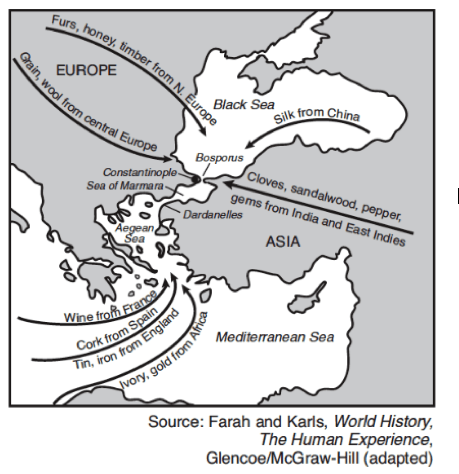
123.

What can you conclude about the city of Constantinople?
a)
Constantinople is a difficult city to travel to
b)
Constantinople is located in Asia.
c)
Constantinople located at the center of major trade routes
d)
Constantinople is on the Mediterranean Sea.
124.
A time of stability and peace in the Roman Empire, the empire grows to it's largest size, 27 BCE to 180 CE
a)
Civil War
b)
Punic Wars
c)
Et tu Brute
d)
Pax Romana
125.
What effect did Julius Caesar's seizure of power have on the Roman political system?
a)
It marked the transition from a republic to an empire
b)
It allowed for control of the state by the senate
126.
The social class made up of craftsmen, merchants, and poor farmers
a)
Ciceros
b)
Patricians
c)
Visogoths
d)
Plebeians
127.
Ancient Greek city-states remained independent from each other due to which geographic feature?
a)
flooded rivers
b)
vast deserts
c)
rocky coastlines
d)
rainforest
128.
Rome finally fell when groups of which people invaded from 
northern Europe? 
a)
Celtic
b)
Egyptian
c)
Visigoths, Vandals (Germanic groups)
d)
Slavic
129.
Why was the size of the Roman Empire a problem that contributed to the empire's fall?
a)
The size of the empire made it hard to defend.
b)
Many emperors were needed to rule the empire.
c)
Much of the empire was empty land with no population.
d)
Most of the empire was dry land that could not support farming.
130.
To control and connect the empire the Romans had what?
a)
a Great Wall
b)
a road system
c)
a pony express style mail system
d)
all three
131.

What is the best title for the list below?

· High Unemployment and Inflation

· Attacks on Rome

· Political Corruption and Instability

a)

Reasons Why the Roman Empire Fell

b)

Characteristics of the Pax Romana

c)

Causes of the Punic War

d)

Effects of the Roman Civil War

132.

Which statement is BEST supported by the map above?

a)

The Roman Empire extended over three continents

b)

Rivers kept invaders out of the Roman Empire

c)

Alexandria served as the capital city of the Eastern Roman Empire

d)

Carthage was eventually destroyed by the Romans.

133.
What problems did the later Roman Empire face?
a)
Disease
b)
High taxes
c)
Food was scarce
d)
All of the above
134.
In order to save the empire, what did emperor Diocletian do?
a)
Divide the empire into two parts
b)
Reunite the empire
c)
Sell off Eqypt
d)
Eat candy
135.
Which emperor reunited the Empire in the 300's?
a)
Diocletian
b)
Constantine
c)
Augustus
d)
Trump
136.
The Roman Empire fell for all of the following reasons EXCEPT...
a)
barbarian invasions
b)
strong leadership
c)
weak leadership
d)
political corruption
137.
Constantine moved the Roman empire's capital from Rome in the west to _________ in the east 
a)
Byzantium (later called Constantinople) 
b)
Los Angesles
c)
Africa
d)
Harrapa 
138.
The Eastern Roman Empire was called the ______ Empire, after the original name of its capital.
a)
New 
b)
Mayfair
c)
Byzantine 
d)
Romanian 
139.
What year did the Roman empire collapse?
a)
350 A.D.
b)
476 A.D. 
c)
200 A.D.
d)
632 A.D.
