
 Worksheets
Paleolithic/Neolithic Quiz
Total questions: 20
Worksheet time: 40mins
Name
Class
Date
1.
Scientists believe that the earliest humans evolved in and migrated from which continent?
a)
Europe
b)
North America
c)
Asia
d)
Africa
2.
Which best describes the nomadic lifestyle of the Paleolithic people?
a)
They lived in large villages, where they raised crops and livestock.
b)
They migrated, or moved, from place to place
c)
They stayed in one place, living in caves and beneath rock shelters.
d)
They lived in small villages and farmed the land.
3.
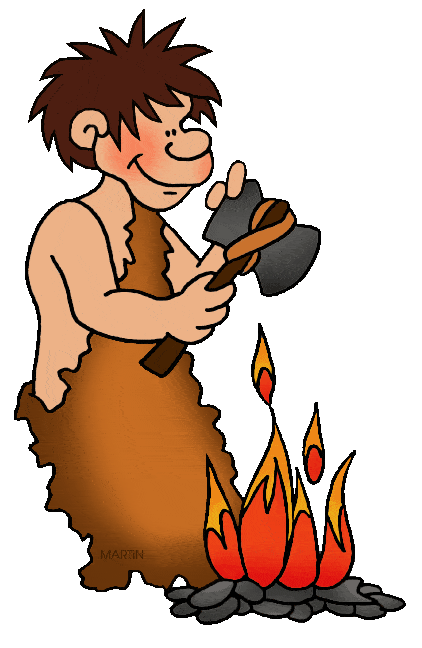
Which statement best describes hunters and gatherers?
a)
They were experts at making stone tools
b)
The tools they made from metal helped them to survive.
c)
They domesticated animals to help with daily activities.
d)
They developed ways to bring water to their crops.
4.
Which of the following would NOT apply to hunter gatherers?
a)
stone tools
b)
cave art
c)
fire
d)
domestication of animals
5.
What is the greatest, most significant change between the Paleolithic and Neolithic cultures?
a)
the jobs people had
b)
the way people got food for themselves
c)
the tools people used
d)
the clothes people wore
6.
Which statement best describes the Neolithic people?
a)
They lived in caves or built simple shelters.
b)
They migrated from place to place to hunt animals for food.
c)
They could settle in one place because they had a reliable food supply.
d)
They used simple tools made from stone.
7.

What was the main role women played in Paleolithic society?
a)
Women gathered wild plants for food.
b)
Women hunted animals for food.
c)
Women planted seeds for food.
d)
Women domesticated animals for food.
8.
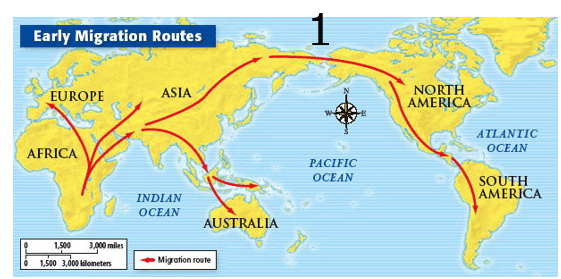
The map shows the migration routes of early humans. What made it possible for them to move from Asia to North America?
a)
They constructed large ships to sail across at #1.
b)
They crossed the land bridge at #1. This was a result of the Ice Age.
c)
They swam the short distance at #1.
d)
They built a bridge out of wood at #1.
9.

Which of the following describes how the earliest humans (paleolithic) lived?
a)
by hunting and gathering food
b)
by herding sheep and other live stock
c)
alone or in pairs
d)
in farming villages along streams and rivers
10.
Which of the following would you most likely find in the Paleolithic Era?
a)
jewelry made of smooth stones
b)
farms
c)
cave paintings
d)
domesticated animals
11.
Which statement best describes the clothing of early cultures?
a)
Paleolithic people learned to weave plants for cloth.
b)
Neolithic people used only animal skins for clothing.
c)
Paleolithic people used wool collected from domesticated sheep.
d)
Neolithic people made clothes from cloth, wool, and animal skins.
12.
What was the most common reason in which ancient people chose to migrate, or move from place to place?
a)
They needed to find employment and an income
b)
To find resources such as food and shelter
c)
To explore the world.
d)
They needed to find better transportation.
13.
How did the start of farming change early human tribes?
a)
It forced them to stay in one place and build villages and cities.
b)
It caused them to continue to hunt animals and gather plants.
c)
It ended fighting between the tribes for land.
d)
It stopped them from building temples for their gods.
14.
The movement of people from one location to another is called______________.
a)
transportation
b)
glaciation
c)
Paleolithic
d)
migration
15.
Used advanced stone tools such as sharp knives.
a)
Neolithic Man
b)
Paleolithic Man
16.
People began to learn how to weave from fibers from flax and wool.
a)
Neolithic Man
b)
Paleolithic Man
17.
People began to tame goats, sheep, pigs, and cattle.
a)
Neolithic Man
b)
Paleolithic Man
18.
Men hunted while women often looked for items to gather like roots, berries and nuts. Plants were 70% of their diet.
a)
Neolithic Man
b)
Paleolithic Man
19.
Early crops included millet (grass grown for its seeds) and wheat.
Domestication of crops became important.
Domestication of crops became important.
a)
Neolithic Man
b)
Paleolithic Man
20.
Villages and settlements were where people began to live often made of mud, bricks and timber. These settlements became permanent.
a)
Neolithic Man
b)
Paleolithic Man
100 %

