
 Worksheets
Davies Homeostasis Revision
Total questions: 23
Worksheet time: 30mins
Name
Class
Date
1.
The maintenance of an organism’s internal environment is called:
a)
compensating
b)
homeostasis
c)
balancing
d)
routine
2.
Which organic molecule has a 1:2:1 ratio of carbon, hydrogen and oxygen?
a)
carbohydrate
b)
lipid
c)
nucleic acid
d)
protein
3.
Made of monomers of amino acids
a)
Carbohydrates
b)
Lipids
c)
Proteins
d)
Nucleic Acids
4.
Carbohydrates are made of which of the following elements?
a)
C, H, O, N, S
b)
C, H, O, N
c)
C, H, O
d)
C, H, O, N, P
5.
Which of the following elements is not found in living things?
a)
carbon
b)
hydrogen
c)
oxygen
d)
helium
6.
What is diffusion?
a)
when molecules move
b)
when molecules move from a high concentration to a low.
c)
no movement
d)
molecules move everywhere
7.
Obtaining oxygen and removing carbon dioxide; releasing energy from food.
a)
Digestion
b)
Respiration
c)
Responsiveness
d)
Excretion
8.
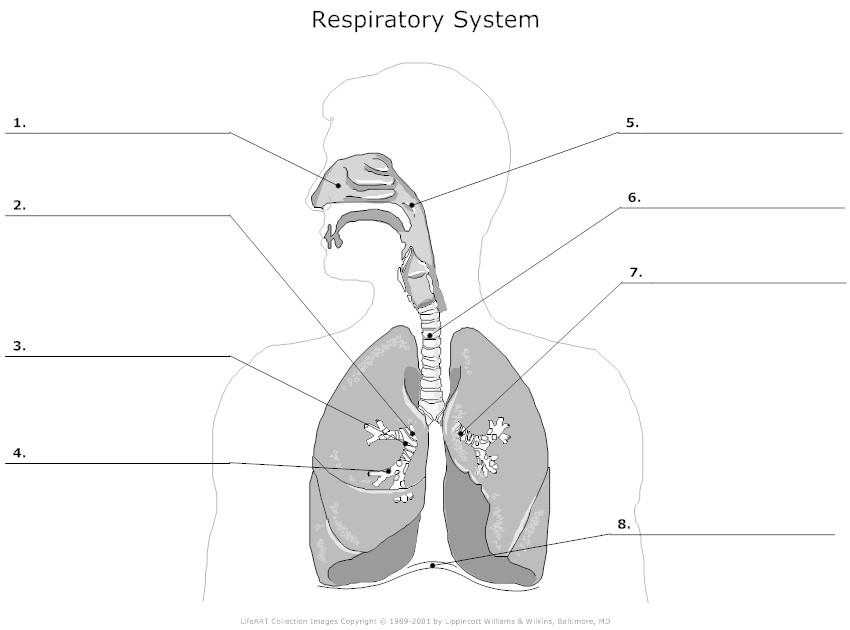
Name the structure labeled 8
a)
lungs
b)
trachea
c)
diaphragm
d)
alveoli
9.

What is the definition of Selective Permeability?
a)
The movement of materials across the cell membrane that requires NO ENERGY from the cell.
b)
The movement of materials through (or across) the cell membrane
c)
The ability of the cell membrane to allow some things to pass through while preventing other things from passing through.
d)
The movement of molecules from an area of high concentration to a area of low concentration
10.
The movement of molecules against a concentration gradient
a)
simple diffusion
b)
facilitated diffusion
c)
active transport
d)
osmosis
11.
The process of breathing is also known as
a)
inspiration
b)
expiration
c)
ventilation
d)
respiration
12.
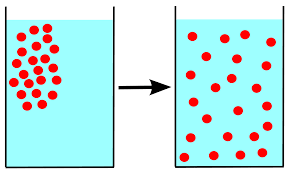
The picture below is an example of _________________.
a)
osmosis
b)
isotonic
c)
diffusion
d)
active transport
13.

Within the lungs, the exchange of oxygen and carbon dioxide occurs between the ___ and the capillaries.
a)
trachea
b)
bronchi
c)
alveoli
d)
diaphragm
14.
What is the main function of the excretory system?
a)
to collect and remove wastes from the body
b)
to strengthen skeletal muscles
c)
to protect the nervous system
d)
to bring oxygen to body cells
15.
What a cell needs to transport particles by active transport?
a)
Sun
b)
Wind
c)
Energy
d)
Channels
16.
What process occurs when WATER diffuses across a membrane?
a)
endocytosis
b)
mitosis
c)
osmosis
d)
nuclear fission
17.
Which is NOT an organ of the urinary system?
a)
kidney
b)
bladder
c)
ureter
d)
liver
18.
For cells to stay alive they require what type of SA:V?
a)
Large SA, Large V
b)
Small SA, Large V
c)
Large SA, Small V
d)
Small SA, Small V
19.
High Surface area to volume ratio allows cells to do what quickly?
a)
Move materials around inside the cell
b)
Move materials in and out of the cell
c)
Communicate to other cells
d)
Divide
20.

Hint: think SA: V
a)
Elephant because it has more volume to heat up
b)
Elephant because it has larger ears to block the sun
c)
Mouse because it has more surface area than volume
d)
mouse because it doesn't have as much heat
21.
What is the correct order of the steps of function within the nephron?
a)
Secretion, Reabsorption, Filtration
b)
Filtration, Secretion, Reabsorption
c)
Filtration, Reabsorption, Secretion
d)
Secretion, Filtration, Reabsorption
22.
What are the two muscles at the urethra that control the exit of urine out of the body?
a)
Sphinxes
b)
Renal papillary muscles
c)
Sphincters
d)
Bladder vessicle
23.
What C-shaped structure in the nephron surrounds the glomerulus?
a)
Bowman's capsule
b)
bladder
c)
renal pelvis
d)
hilum
100 %

