
 Worksheets
Test 1 Review
Total questions: 40
Worksheet time: 30mins
Name
Class
Date
1.
How would you write 4.3756 x 10⁴ in standard form?
a)
437,560,000
b)
0.00043756
c)
43,756
d)
4,3756
2.
How would you write 0.0005 in scientific notation?
a)
50 x 10-5
b)
5 x 10⁻⁴
c)
5 x 10⁻³
d)
.5 x 10-3
3.
Scientific Notation is made up of two number parts. The first part should be a number between 1 and 100.
a)
True
b)
False
4.
Scientific Notation is made up of two number parts. The second part is a power of base 10.
a)
True
b)
False
5.
When writing a number in scientific notation, the first number must be greater than 1, but less than 10.
a)
False
b)
True
6.
Which of the following is correct scientific notation?
a)
20.35 x 10⁴
b)
.2035 x 104
c)
2035 4
d)
2.035 x10⁴
7.
Express the following in scientific notation:
.000457
.000457
a)
457 x 106
b)
457 x 10-6
c)
4.57 x10⁴
d)
4.57 x 10⁻⁴
8.
How many sig figs are there?
100.00
100.00
a)
1
b)
3
c)
4
d)
5
9.
How many sig figs are there?
100000000
100000000
a)
1
b)
9
c)
10
10.
How many sig figs are there?
4004
4004
a)
1
b)
2
c)
3
d)
4
11.
How many sig figs are there?
0.00400
0.00400
a)
1
b)
3
c)
5
d)
6
12.
How many significant figures will be in the answer to the following question:
7.62 x 6.98 x 3.2645
7.62 x 6.98 x 3.2645
a)
1
b)
2
c)
3
d)
4
13.
Calculate 5.50 cm + 5.50 cm and give your answer with the appropriate number of significant figures.
a)
11 cm
b)
11.0 cm
c)
11.00 cm
d)
11.000 cm
14.
How many Significant Figures in the number below?
4.56 x 10³
4.56 x 10³
a)
5
b)
4
c)
6
d)
3
15.
Solve. Round using SigFig math rules.
98.7°C - 97.25°C
a)
1°C
b)
1.5°C
c)
1.45°C
d)
1.450°C
16.
Solve. Round using SigFig math rules.
103-cm x 11-cm
103-cm x 11-cm
a)
11-cm2
b)
1100-cm2
c)
1130-cm2
d)
1133-cm2
17.
What is mass?
a)
the distance between two points
b)
the amount of matter (stuff) in an object
c)
the amount of space an object takes up
d)
the distance between three points
18.
What is volume?
a)
the distance between two points
b)
the amount of matter (stuff) in an object
c)
the amount of space an object takes up
d)
the distance between three points
19.
The base unit for length is the
a)
second
b)
gram
c)
meter
d)
liter
20.
The base unit for volume is the
a)
second
b)
gram
c)
meter
d)
liter
21.
The base unit for mass is the
a)
meter
b)
gram
c)
kilogram
d)
liter
22.

159.7 g = ___________ kg
a)
0.1597
b)
1.597
c)
15.97
d)
1597
23.

68 cm = ___________ mm
a)
0.68
b)
6.8
c)
68
d)
680
24.

0.932 g = ___________ mg
a)
9.32
b)
93.2
c)
932
d)
9,320
25.

2,804 mg = ___________ g
a)
0.2804
b)
2.804
c)
28.04
d)
280.4
26.

1000 m = ___________ km
a)
100
b)
10
c)
1
d)
0.1
27.
Jack has a rock. The rock has a mass of 14g and a volume of 2cm3. What is the density of the rock?
a)
7 mL
b)
7 g/cm3
c)
28 g/cm3
d)
1/7 g/cm3
28.

What is the volume of Object X?
a)
10.0 cm3
b)
15.0 cm3
c)
20.0 cm3
d)
25.0 cm3
29.
What is the formula for density?
a)
density = mass x volume
b)
density = mass / volume
c)
density = mass + volume
d)
density = mass - volume
30.
Frank has a paper clip. It has a mass of 9g and a volume of 3cm3. What is its density?
a)
3 g/cm3
b)
1/3 g/cm3
c)
27 g/cm3
d)
39 g/cm3
31.
Should experiments be repeated over and over to see if the results are the same each time?
a)
yes
b)
no
32.
This variable in an experiment is the one being deliberately changed by the scientist.
a)
dependent variable
b)
independent variable
c)
data
d)
control group
33.
A possible explanation to a problem that has not yet been tested.
a)
data
b)
theory
c)
hypothesis
d)
fact
34.
The summary at the end of an experiment that explains the results.
a)
conclusion
b)
procedures
c)
materials
d)
responding variable
35.
A series of steps used by scientists to solve a problem or answer a question.
a)
scientific method
b)
recipe
c)
data collection
d)
metric system
36.
How close a measurement is to the true value is called..
a)
Accuracy
b)
Precision
c)
Significant
d)
Estimate
37.
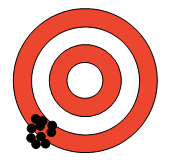
This bullseye demonstrates...
a)
High Accuracy & High Precision
b)
High Accuracy & Low Precision
c)
Low Accuracy & High Precision
d)
Low Accuracy & Low Precision
38.
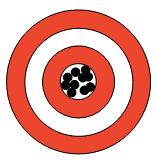
?
a)
High Accuracy & High Precision
b)
High Accuracy & Low Precision
c)
Low Accuracy & High Precision
d)
Low Accuracy & Low Precision
39.
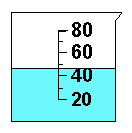
volume?
a)
48 mL
b)
48.2 mL
c)
48.25 mL
d)
4 mL
40.
In scientific notation; If the exponent is a negative number...
a)
you will get a large number
b)
you will get a small number
100 %

