
 Worksheets
Study Biochem MOCK
Total questions: 45
Worksheet time: 39mins
Name
Class
Date
1.
Nucleotides are monomers of
a)
Carbohydrates
b)
Lipids
c)
Proteins
d)
Nucleic Acids
2.
Monosaccharides are monomers of
a)
Carbohydrates
b)
Lipids
c)
Proteins
d)
Nucleic Acids
3.
Waxes, oils and fats are examples of
a)
Carbohydrates
b)
Lipids
c)
Proteins
d)
Nucleic Acids
4.
What type of macromolecule are enzymes?
a)
Protein
b)
Carbohydrate
c)
Lipid
d)
Nucleic Acid
5.
Which macromolecule stores energy, insulates us, and makes up the cell membrane?
a)
lipids
b)
proteins
c)
carbohydrates
d)
nucleic acids
6.

Used for short term (quick) energy.
a)
carbohydrates
b)
lipids
c)
proteins
d)
nucleic acids
7.
Lipids are soluble in water
a)
True
b)
False
8.
What is the purpose of an enzyme?
a)
give permission for the reaction
b)
raise activation energy
c)
speed up reactions
d)
control how many reactions occur
9.
Where do substrates bind on an enzyme?
a)
voltage-gated channels
b)
surface receptor
c)
calcium channels
d)
active site
10.
Enzymes are capable of increasing the rate of a chemical reaction within a living cell. Enzymes accomplish this through which of the following means?
a)
reducing the number of products
b)
reducing the activation energy
c)
increasing the temperature of the cell
d)
increasing the concentration of reactants
11.

What is structure A?
a)
Substrate
b)
Active site
c)
Enzyme
d)
Products
12.

What is structure D?
a)
Substrate
b)
Active site
c)
Enzyme
d)
Products
13.

What is structure C?
a)
Substrate
b)
Active site
c)
Enzyme
d)
Products
14.
What is a substance called if it speeds up a chemical reaction?
a)
reusable
b)
catalyst
c)
specific
d)
fragile
15.
Each enzyme only has 1 substrate that will fit its active site. What is this called?
a)
reusable
b)
catalyst
c)
specific
d)
fragile
16.
Once a new product leaves an enzyme, the enzyme is unchanged and ready for the next substrate. What is this called?
a)
reusable
b)
catalyst
c)
specific
d)
fragile
17.
What 3 letters do enzymes typically end in?
a)
-ose
b)
-ase
c)
-ese
d)
-tic
18.

The graph shows how enzymes affect reactions in cells. Which statement best summarizes the information shown in the graph?
a)
Enzymes increase the energy of the reactants.
b)
Enzymes decrease the energy level of the products.
c)
Enzyme decrease the activation energy of the reaction.
d)
Enzymes reverse the direction of the reaction.
19.
What happens when enzymes are heated to a high temperature?
a)
The enzymes die.
b)
The shapes of the enzyme are altered denature
c)
The enzymes' amino acid sequence changes.
d)
The enzymes remain the same
20.

Which of the following conclusions can be drawn from this graph?
a)
The optimum pH of the enzyme is 6.6.
b)
The optimum pH of the enzyme is 5.8
c)
The enzyme’s activity increases as pH increases 5.0 to 9.0
d)
The enzyme’s activity is greater around pH of 8.0 .
21.
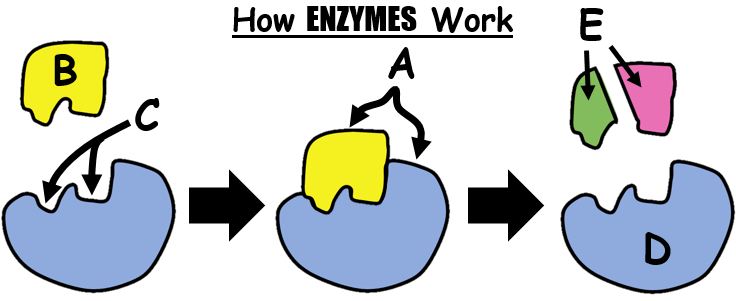
In the diagram, what is letter A?
a)
product
b)
substrate
c)
enzyme-substrate complex
d)
active site
22.
Which of these is most likely an enzyme?
a)
Sucrose
b)
Galactose
c)
Fructose
d)
Amylase
23.
The pH at which an enzyme is most efficient is called the _________ pH of an enzyme.
a)
neutral
b)
optimum
c)
minimum
d)
experimental
24.

Which statement best describes the enzyme represented in the graphs below?
a)
This enzyme works best at a temperature of 35 C and a pH of 8
b)
This enzyme works best at a temperature of 50 C and a pH of 12
c)
Temperature and pH have no influence on the activity of this enzyme
d)
This enzyme works best at a temperature above 50 C and a pH above 12
25.

If enzyme C is functioning at 25°C and a pH of 7, under which conditions would the rate of enzyme action probably increase?Use the chart below and your knowledge of enzymes to answer the question.
a)
The temperature is decreased to 22 C and the pH is kept the same
b)
The temperature is kept the same and the pH is decreased to 6
c)
The temperature is increased to 44 C and the pH is kept the same
d)
The temperature is increased to 30 C and the pH is increased to 8
26.
Which of these is NOT true?
a)
Enzymes can denature (change shape) when the temperature gets too high.
b)
Enzymes can only be used once in a chemical reaction.
c)
Extreme pH can denature enzymes.
d)
Enzymes speed up chemical reactions.
27.
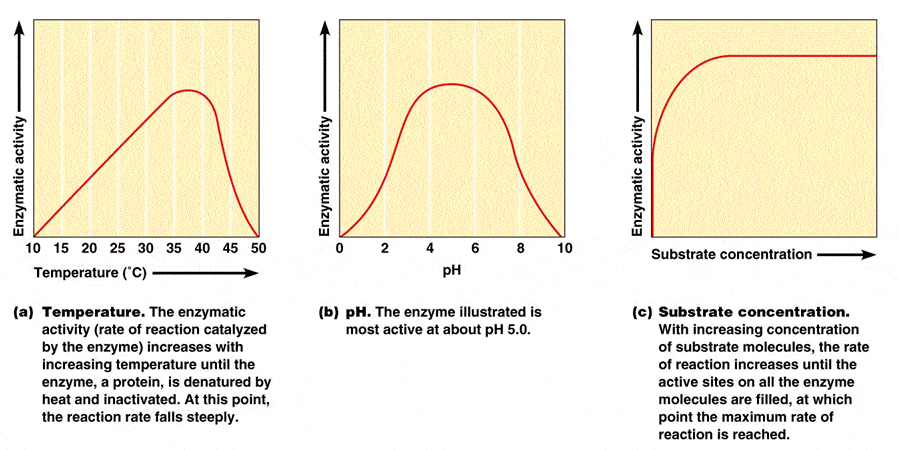
Which of the factors does NOT affect enzymatic activity?
a)
Temperature
b)
pH
c)
Concentration
d)
Color
28.
Enzyme A digests proteins in the stomach (environment with a pH of 2). Enzyme B digests proteins in the small intestine (environment with a pH of 8). Which of the following is NOT true:
a)
Enzyme A would be denatured in the small intestine.
b)
Enzyme A works best in acidic conditions.
c)
Enzyme A can also work in the small intestine.
d)
Enzyme A helps in the hydrolysis of proteins.
29.
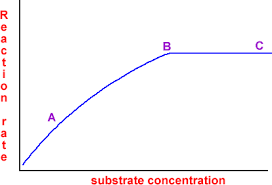
What would happen to the rate of reaction if more substrate added to the solution at point C
a)
increase reaction rate
b)
decrease reaction rate
c)
no change in reaction rate
30.
What would happen to the rate of reaction if more enzyme added to the solution at point C
a)
increase reaction rate
b)
decrease reaction rate
c)
no change in reaction rate
31.
What are the tiny structures that carry out jobs inside cells called?
a)
membranes
b)
nucleus
c)
organelles
d)
animalicules
32.
Most of the cell membrane is made of...
a)
Lipids
b)
Carbs
c)
Proteins
d)
Nucleic acids
33.

Complex cell. Can be plant or animal. Contains membrane bound organelles.
a)
Eukaryotic Cell
b)
Prokaryotic Cell
c)
Bacteria
d)
Blood cell
34.
A nucleus is found in what type of cell?
a)
Prokaryotic
b)
Eukaryotic
c)
Both prokaryotic and eukaryotic
d)
Neither prokaryotic or eukaryotic
35.
What can only be found in plant cells?
a)
Cell membrane
b)
Vacuole
c)
Chloroplast
d)
Mitochondrion
36.
This organelle breaks down and recycles cellular debris
a)
Chloroplast
b)
Lysosome
c)
Golgi
d)
Mitochondria
37.
Which cells do not have a defined nucleus or membrane bound organelles
a)
Fungi
b)
Eukaryotes
c)
Prokaryotes
d)
Protista
38.
What is the relationship between rough endoplasmic reticulum (ER) and lysosomes?
a)
Rough ER inactivates proteins that are consumed by lysosomes
b)
Rough ER connects the cell’s internal membranes to lysosomes
c)
Rough ER produces the digestive enzymes used by lysosomes
d)
Rough ER generates the membranes that surround lysosomes.
39.

a)
the independent variable is distance
b)
the independent variable is d=25 t
c)
the dependent variable is time
d)
the dependent variable is distance
40.
An experiment is performed on plants to see how different liquids affect plant growth. Each plant in the experiment is given a different liquid; water, apple juice, or milk. Each plant has the same amount of soil, sunlight, and listens to the same music. In this investigation, the independent variable is ...
a)
The type of plant
b)
The amount of sunlight
c)
The type of music
d)
The type of liquid
41.
Which organ system performs the same job for a multicellular organism as a lysosome performs for a cell?
a)
digestive system
b)
excretory system
c)
respiratory system
d)
respiratory system
42.
An experiment is performed on plants to see how different liquids affect plant growth. Each plant in the experiment is given a different liquid; water, apple juice, or milk. Each plant has the same amount of soil, sunlight, and listens to the same music. In this investigation, what is the dependent variable?
a)
Type of plant
b)
Water, apple juice, milk
c)
Plant growth
d)
Color of the plant's leaves
43.
Contains digestive enzymes to break down materials
a)
Vacuole
b)
Lysosome
c)
Centriole
d)
Flagella
44.
According to the cell theory, where do cells come from?
a)
proteins
b)
preexisting cells
c)
nucleic acids
d)
unicellular animals
45.
All of the following are examples of lipids except:
a)
oil
b)
wax
c)
fatty acid
d)
cellulose
100 %

