wayground logo

Free Printable Worksheets

NEW

Font size

S
M
L
XL
Worksheets

Honors Chemistry Classification of Matter Test Review

Total questions: 64

Worksheet time: 3hrs 21mins

Name
Class
Date
1.
Density is an...
a)
Extensive Property
b)
Intensive Property
2.
Properties that can be measured or observed without matter changing to an entirely different substance.
a)
Chemical Properties of Matter
b)
Physical Properties of Matter
c)
Physical Change
d)
Chemical Change
3.
Properties that can be measured or observed only when matter undergoes a change to become an entirely different kind of matter.
a)
Evaporation
b)
Density
c)
Physical Properties Of Matter
d)
Chemical Properties of Matter
4.
Flammability (burns): Chemical or Physical Property
a)
Chemical Property
b)
Physical Property
5.
Solubility (dissolves): Chemical or Physical Property
a)
Chemical Property
b)
Physical Property
6.
Density: Chemical or Physical Property
a)
Chemical Property
b)
Physical Property
7.
Malleability is an example of what property?
a)
Chemical property
b)
Physical property
8.
This is an example of a
a)
physical change
b)
chemical change
9.
Ability to rust is this type of property:
a)
Physical property
b)
Chemical property
10.
You mix Kool aid into water. The finished Kool aid is the
a)
solution
b)
solute
c)
solvent
d)
solubility
11.
What has mass and takes up space?
a)
space
b)
matter
c)
volume
d)
weight
12.
This matter has a fixed shape and volume w/ tightly packed particles w/ little movement.
a)
liquid
b)
gas
c)
solid
d)
plasma
13.
If you heat a substance, the atoms vibrate
a)
slower
b)
faster
c)
atoms don't vibrate
d)
it doesn't change
14.

Solids usually have _________ kinetic energy, while gases have_______.

a)

less, more

b)

more, less

15.
Frying an egg is an example of
a)
physical change
b)
chemical change
16.
The melting point of ice is 00 C. This is an example of ________.
a)
physical intensive property
b)
physical extensive property
c)
Chemical change
d)
Chemical property
17.
The rose is red. This is an example of a 
a)
physical extensive property
b)
Chemical property
c)
physical intensive property
d)
physical change
18.
Which of the following is a chemical property of milk?
a)
it is white
b)
it has fats
c)
it has turns sour if left out of the refridgerator
d)
it is soluble in water
19.
Chewing food to break it down into smaller particles represents a _________ change, but the changing of starch into sugars by enzymes in the digestive system represents a ___________change. 
a)
Chemical then Physical 
b)
Physical then Chemical
c)
Both Physical
d)
Both Chemical
20.
Which of the following is a chemical change?
a)
Painting a door red
b)
Dissolving salt in water
c)
A banana decomposing
d)
Bending a nail
21.
Which of the following is a sign that a chemical reaction has occurred?
a)
change in shape
b)
melting
c)
formation of a gas
d)
dissolving
22.
Italian Salad Dressing
a)
heterogeneous mixture
b)
homogeneous mixture
23.
Milk
a)
Heterogeneous mixture
b)
Homogeneous mixture
24.
cake batter
a)
heterogeneous mixture
b)
homogeneous mixture
25.
Chicken noodle soup
a)
heterogeneous mixture
b)
homogeneous mixture
26.
A pure substance that cannot be separated into simpler substances by physical or chemical means.
a)
metal
b)
element
c)
metalloid
d)
pure substance
27.
Water is an example of....
a)
colloid
b)
solution
c)
element
d)
compound
28.
Salt dissolved in water is an example of a.....
a)
colloid
b)
solution
c)
element
d)
compound
29.
What is a pure substance made of two or more elements that are chemically combined?
a)
element
b)
compound
c)
mixture
d)
solution
30.
The physical properties of compounds do NOT include
a)
melting point
b)
density
c)
reactivity with acid
d)
color
31.
When the temperature of matter increases the particles...
a)
speed up and move closer
b)
speed up and move farther apart
c)
slow down and move closer together
d)
slow down and move farther apart
32.
Particles closest together
a)
solid
b)
liquid
c)
gas
d)
solid, liquid and gas
33.
Particles move quickest
a)
solid
b)
liquid
c)
gas
d)
solid, liquid and gas
34.

State of matter that does not have a definite shape or volume and is compressible

a)

solid

b)

liquid

c)

gas

d)

solid, liquid and gas

35.
Definite shape and definite volume
a)
solid
b)
liquid
c)
gas
d)
solid, liquid and gas
36.
Definite volume but not definite shape
a)
solid
b)
liquid
c)
gas
d)
solid, liquid and gas
37.
What does this picture represent? 
a)
solid
b)
liquid
c)
gas
d)
plasma
38.
What does this picture represent? 
a)
solid
b)
liquid 
c)
gas
d)
plasma
39.
Which of the phases have particles that have a fixed volume but not a fixed shape? 
a)
solid
b)
liquid
c)
gas
d)
plasma
40.
Which state of matter do the particles in this picture represent?
a)
solid
b)
liquid
c)
gas
d)
plasma
41.
A block has a mass of 54g and a volume of 20cm3.  What is the density of the block?
a)
74 g/cm3
b)
1080 g/cm3
c)
34 g/cm3
d)
2.7 g/cm3
42.

How can you separate sand mixed with salty water?

a)

Distillation

b)

Decanting

c)

Filtration

d)

Chromatography

43.

Which picture is a mixture

a)

A

b)

B

c)

C

d)

D

44.

Which picture is only a compound

a)

A

b)

B

c)

C

d)

D

45.

Dyes in water soluble markers may be separated by means of..

a)

crystallization

b)

sublimation

c)

chromatography

d)

sedimentation

46.
Chocolate chip cookie
a)
Pure Substance & Element
b)
Pure Substance & Compound
c)
Mixture & Homogenous
d)
Mixture & Heterogenous
47.
How many significant figures does the following number have: 0.002040
a)
6
b)
4
c)
3
d)
2
48.
Determine the number of Significant Figures in 10.0-g
a)
5
b)
4
c)
3
d)
2
49.
How many Significant Figures in the number below?
4.56 x 10³
a)
5
b)
4
c)
6
d)
3
50.
How many significant figures does the following number have: 1740200
a)
2
b)
1
c)
3
d)
5
51.
How would you write 0.0005 in scientific notation?
a)
50 x 105
b)
5 x 10⁻⁴
c)
5 x 10⁻³
d)
.5 x 103
52.
How would you write 564,000,000 in scientific notation?
a)
5.64 x 10⁻⁷
b)
5.64 x 10⁶
c)
5.64 x 10⁸
d)
56.4 x 10⁷
53.
Find the Volume
a)
428.4 cm3
b)
412.8 cm3
c)
404.2 cm3
d)
400 cm3
54.
A student determined the density of aluminum by averaging the results of three density calculations. Each value was different, but the average was equal to the accepted value for aluminum’s density. The results of this investigation are best described as
a)
accurate, but not precise.
b)
precise, but not accurate.
c)
both precise and accurate.
d)
neither precise nor accurate.
55.
The number of significant figures in the measurement 170.040 km
a)
three. 
b)
four. 
c)
five.
d)
six.
56.
Expressed in scientific notation, 0.0930 m is
a)
9.30 × 10⁻⁴ m.
b)
9.30 × 10⁻² m. 
c)
9.3 × 10⁻³ m.
d)
93 × 10−3 m.
57.

The density of lead is 11.342 g/mL. What would be the volume of a 200.0 g sample of this metal?

a)

0.05671 mL

b)

17.63 mL

c)

2268 mL

d)

Not enough information

58.
An irregularly-shaped sample of aluminum (Al) is put on a balance and found to have a mass of 43.6 g.  The student decides to use the water-displacement method to find the volume.  The initial volume reading is  25.5 mL and, after the Al sample is added, the water level has risen to 41.7 mL.  Find the density of the Al sample.
a)
2.69 g/mL
b)
0.649 g/mL
c)
1.71 g/mL
d)
1.05 g/mL
59.

How close a measurement is to the accepted value is called..

a)

Accuracy

b)

Precision

c)

Significant

d)

Estimate

60.
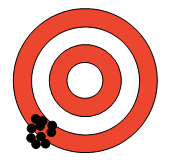
This bullseye demonstrates...
a)
High Accuracy & High Precision
b)
High Accuracy & Low Precision
c)
Low Accuracy & High Precision
d)
Low Accuracy & Low Precision
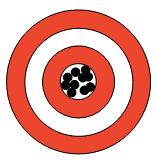
61.
?
a)
High Accuracy & High Precision
b)
High Accuracy & Low Precision
c)
Low Accuracy & High Precision
d)
Low Accuracy & Low Precision
62.
Describe the accuracy and precision of the image
a)
Accurate and Precise
b)
Accurate and not precise
c)
Not Accurate and Precise
d)
not accurate and not precise
63.

What is the mass in kilograms of a 10 Liter sample of ethanol if the density is 0.810 g/cm3 ? ( use 1000 grams = 1 kg & 1 L = 1000 mL)

a)

8.1 kg

b)

8100 kg

c)

810 kg

d)

81 kg

64.

Express 5.4 X 10³ in standard notation rounded to 4 significant figures.

a)

54000.

b)

5400

c)

5400.

d)

54000