wayground logo

Free Printable Worksheets

Font size

S
M
L
XL
Worksheets

Period 3 American Revolution to 1800

Total questions: 191

Worksheet time: 2hrs 9mins

Name
Class
Date
1.
Who fought in the French and Indian War?
a)
French vs. Indians
b)
British vs. French
c)
British vs. French and Indians
d)
Indians vs. British
2.
Where did the French and Indian War take place?
a)
England
b)
France
c)
America
d)
Africa
3.
What were the 2 main reasons for the French and Indian War?
a)
Control of land and trade with Native Americans
b)
Land and Slaves
c)
Gold
d)
Claim to land in Europe
4.
Who was the King of England during this time?
a)
King Ferdinand and Queen Isabella
b)
King Henry VIII
c)
Queen Elizabeth
d)
King George III
5.
Why do you suppose the Indians helped the French?
a)
The French forced them to fight because the Indians were enslaved by them.
b)
The British attacked the Indians first, and the French decided to help the Indians.
c)
The French and Indians cooperated with one another often; traded with one another and taught each other many techniques for survival.
d)
The French were fighting the Indians in the war.... The Indians didn't help the French at all.
6.
Who won the French and Indian War?
a)
England
b)
France
c)
Indians
d)
Spain
7.
As a result of the cost of the war, what did King George III do to the colonists?
a)
Killed them
b)
Removed them from the land in the colonies just like the Indians.
c)
Imposed taxes to pay for the war
d)
Paid for the war out of his own pocket
8.
What slogan did the colonists begin to use in order to express their frustrations with the British government?
a)
"No Taxation!"
b)
"We Need Representation!"
c)
"No Taxation without Representation!"
d)
"We Want Freedom!"
9.
The French and Indian War, unfair taxes in the colonies, along with many other events all led to what eventually?
a)
World War I
b)
American Revolution
c)
World War II
d)
Civil War
10.

Why was the French and Indian War fought?

a)

The French, Native Americans, and British did not like each other

b)

The French and British were both trying to claim the Ohio Country Land

c)

The French and the British wanted to have more power back in Europe

d)

The Native Americans wanted to fight both the British and the French

11.

Why did the British think they had a claim to own all of the Ohio Country Land?

a)

The British thought they were more powerful than the French so the land was theirs

b)

The British thought they were better friends with the Native Americans so the land was theirs

c)

The British thought they had more money than the French so the land was theirs

d)

The British thought since their king claimed all land sea to sea when they first got to North America the land was theirs

12.

What fort did George Washington attack that officially started the French and Indian War?

a)

Fort Bragg

b)

Fort Pitt

c)

Fort Duquesne

d)

Fort Delaware

13.

What Treaty ended the French and Indian War?

a)

Treaty of British

b)

Treaty of French and Indian War

c)

Treaty of Native Americans

d)

Treaty of Paris

14.

What did the British get for winning the French and Indian War?

a)

All the French governments money

b)

For the French to have to come work for the British

c)

Most of the French land in North America

d)

All of the French Armies weapons

15.

The results or effects of the French and Indian War were?

a)

Taxes, Debt, and the Proclamation of 1763

b)

Taxes, Independence, and the Proclamation of 1763

c)

Trade, Debt, and the loss of Fort Necessity

d)

Trade, Slavery, and the Proclamation of 1763

16.

The Great Awakening was a religious movement that took place...

a)

In the Middle Ages

b)

In the 1730's

c)

Under the Vikings

d)

In the 1760's

17.

The English Bill of Rights established...

a)

More power for the King

b)

Less power for the King

c)

The Right to Bear Arms

d)

The Independence of the Colonies

18.

The symbolism of the Join or Die flag is seen in the shape and pieces of the snake.

a)

True

b)

False

19.

What was the name of the Fort that George Washington built in the Ohio River Valley?

a)

Fort Detroit

b)

Fort Montreal

c)

Fort Hood

d)

Fort Necessity

20.

Why did Pontiac start a rebellion?

a)

To be famous

b)

To keep the British out of his lands

c)

To support the French

d)

To join all Natives together

21.

The Albany Plan of Union was important because...

a)

It represented all the colonies

b)

The flag was shaped like the coast line

c)

It started the French and Indian War

d)

It was the first time that the colonists tried to unite

22.

Who wrote the Albany Plan of Union?

a)

George Washington

b)

Benjamin Franklin

c)

William Pitt

d)

King George III

23.

What advantage did the Middle Colonies have?

a)

They were plantation owners

b)

They were known for their religious tolerance

c)

They had an abundance of slave labor

d)

They were self sufficient

24.

Why did the Proclamation of 1763 increase the tension between the American colonies and Great Britain?

a)

Britain started collecting taxes on the colonists

b)

Britain encouraged Natives to attack the colonies

c)

Britain reduced its military power in the colonies

d)

Britain prohibited settlement west of the Appalachian Mts

25.

What were the two key issues fought over by the French and the British? These led to the war.

a)

land and pride

b)

trading posts and farmland

c)

land and fur

d)

fur and gold

26.
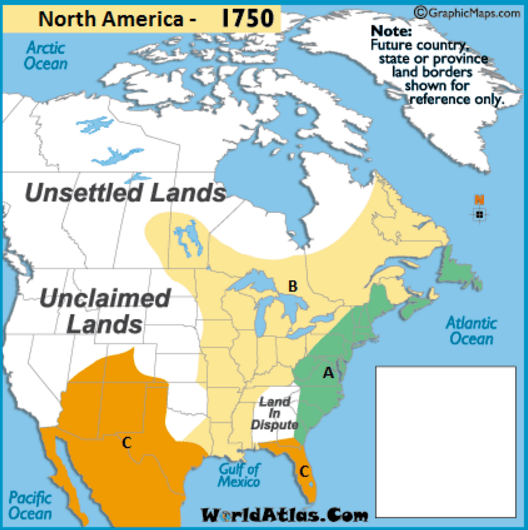
Which European power controlled territory C?
a)
England
b)
France
c)
Spain
27.
Which European power controlled territory B?
a)
England
b)
France
c)
Spain
28.
Which European power controlled territory B?
a)
England
b)
France
c)
Spain
29.
Who created this political cartoon?
a)
George Washington
b)
Benjamin Franklin
c)
Joseph Brant
d)
William Pitt
30.
Which answer best explains what the image means? (its message)
a)
The British colonies are like sneaky snakes and should be cut up and destroyed.
b)
This image warns British colonist they must unite together to defeat the French, or die from the French.
c)
The British colonies were actually divided into 10 different sections.
d)
This is how parts of a snake are labeled. 
31.
This was a tax on all printed materials in the 13 Colonies.
a)
Stamp Act
b)
Sugar Act
c)
Tea Act
d)
Townshend Act
32.
Why were the American Colonist taxed after the French and Indian War?
a)
Britain was in debt and needed money
b)
That was the agreement with the Native Americans
c)
They made too much money
d)
Townshend Acts
33.
This event broke tensions between the colonist and the British troops where shots were fired. Crispus Attucks was the first to be killed.
a)
Lexington and Concord
b)
Boston Tea Party
c)
Boston Massacre
d)
Bloody Valentine
34.
How did the colonist protest against the tea tax?
a)
Dressed up like Native Americans
b)
Boston Massacre
c)
Dumped tea into Boston harbor
d)
Didn't pay the tax on the East India Tea
35.
Which was the punishment for the Boston Tea Party?
a)
Intolerable Acts
b)
Sugar Acts
c)
Quartering Acts
d)
Stamp Acts
36.
Early revolutionary battle where 1,000 British troops died and realized the American Colonists were tougher than they though.
a)
Battle of Bunker Hill
b)
Lexington and Concord
c)
Battle of Saratoga
d)
Battle of Yorktown
37.
This type of American Colonist was in support of the British parliament.
a)
Patriot
b)
Loyalist
c)
Yes man
d)
Neutral
38.
The Second Continental Congress addressed the steps to the colonies governing themselves and the creation of what military group?
a)
Colonial militias
b)
Marines
c)
Continental Army
d)
Navy
39.
Who was the first choice to command the Continental Army?
a)
Thomas Jefferson
b)
Benjamin Franklin
c)
Thomas Paine
d)
George Washington
40.
This type of colonist was ready for rebellion and the fight for independence.
a)
Loyalist
b)
Patriot
c)
Neutral
d)
British 
41.
Colonists were forbidden to settle west of the Appalachian Mountains.
a)
Proclamation line of 1763
b)
Proclamation boundary
c)
Manifest Destiny
d)
Borderlands
42.
Which phrase became popular after passage of the Stamp Act?
a)
“The rights of Englishmen”
b)
“Give me liberty or give me death”
c)
“Life, liberty, and the pursuit of happiness”
d)
“No taxation without representation“
43.
What does Quartering mean?
a)
To allow troops to stay in your home
b)
Hitting someone with a quarter
c)
To give someone a quarter
d)
Giving a quarter of your earnings to Britain
44.
Given that only 5 people died in the Boston Massacre, why was it labeled a massacre?
a)
 British commanders ordered troops to shoot into a rioting crowd in effort to restore order
b)
the victims were innocent bystanders who were caught in the barrage of gunfire
c)
 the victims had done little to provoke the confrontational and hostile British troops
d)
Boston radicals used it as propaganda to take advantage of the heightened tensions 
45.
To refuse to buy goods from someone as a form of protest . . .
a)
occupy
b)
boycott
c)
damage
d)
repeal
46.
What group was created as a response to the Stamp Act?
a)
Sons of Liberty
b)
The Patriots
c)
The Red Coats
d)
The Loyalists
47.
Why did King George III tax the colonists so heavily?
a)
He hated the colonist
b)
He wanted more money for himself
c)
The national debt increase from the French and Indian War
d)
To make money for the colonies
48.
The Olive Branch Petition was written as a last attempt at …
a)
Freedom 
b)
Peace 
c)
Loyalty 
d)
Rebellion 
49.
Arguably the first "battle" of the Revolutionary War occurred when the Massachusetts Minutemen fired on British troops at -
a)
Boston
b)
Philidelphia
c)
Saratoga
d)
Lexington and Concord
50.
All colonies were represented at the First Continental Congress EXCEPT -
a)
Pennsylvania
b)
North Carolina
c)
Georgia
d)
South Carolina
51.
This American victory was the turning point in the war.
a)
Saratoga
b)
Yorktown
c)
Bunker Hill
d)
Lexington and Concord
52.
Surrounded by French and Continental armies, a large British army surrendered here.
a)
Saratoga
b)
Yorktown
c)
Bunker Hill
d)
Lexington and Concord
53.
This member of the Continental Congress helped gain French support for American independence.
a)
Thomas Jefferson
b)
Benjamin Franklin
c)
Patrick Henry
d)
John Adams
54.
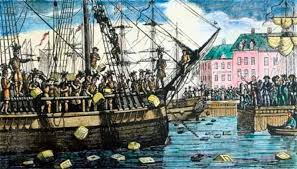
What event is depicted in this image?
a)
Boston Massacre
b)
Boston Tea Party
c)
Battle of Bunker Hill
d)
Lexington and Concord
55.
Samuel Adams and Paul Revere led members of the Sons of Liberty in this protest against taxes.
a)
First Continental Congress
b)
Boston Massacre
c)
Boston Tea Party
d)
Stamp Act Congress
56.
This enslaved person wrote poems and plays supporting American independence.
a)
Harriet Tubman
b)
Benjamin Banneker
c)
Paul Revere
d)
Phillis Wheatley
57.
Of the following people, who did not help write the Declaration of Independence?
a)
Thomas Jefferson
b)
Patrick Henry
c)
John Adams
d)
Benjamin Franklin
58.
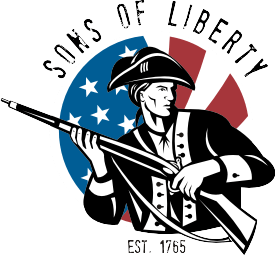
What patriot leader is represented by this image?
a)
John Adams
b)
Samuel Adams
c)
Paul Revere
d)
Patrick Henry
59.
The Sons of Liberty were:
a)
the children of our Founding Fathers.
b)
a professional dance team.
c)
Patriots who protested taxes.
d)
the writers of the Declaration of the Independence.
60.
The Daughters of Liberty were known for:
a)
their delicious apple pies.
b)
their dramatic protests.
c)
the beautiful clothes they made for the wealthy colonists.
d)
making goods that normally would be made in England and imported into the colonies.
61.
What is another name for British soldiers?
a)
Redcoats
b)
Patriots
c)
Minutemen
d)
Continental Soldiers
62.
Who were the Minutemen?
a)
Patriots who were ready to fight at a minutes notice
b)
British soldiers who were ready to fight at a minutes notice
c)
Sons of Liberty who were ready to fight at a minutes notice
d)
Hessians who were ready to fight at a minutes notice
63.
Who fired "the shot heard round the world?"
a)
the British
b)
the minutemen
c)
it is a mystery!
64.
This was sent to Britain to try to heal the dispute with the colonies.
a)
Stamp Act
b)
Olive Branch Petition
c)
Fancy Feast
d)
Boston Tea Party
65.
This man fought the British at sea.
a)
George Washington
b)
John Adams
c)
Nathaniel Greene
d)
John Paul Jones
66.
During the war African Americans
a)
stayed on plantations and kept out of the war
b)
ran away and joined both sides
c)
only fought for the Americans
d)
only fought for the British
67.
Fort Ticonderoga
a)
George Washington led his troops across the Delaware river to attack.
b)
Kept the British from splitting New England from the other colonies
c)
Was the final major battle of the Revolution
d)
The Green Mountain boys attacked and got cannons needed by the Continental Army
68.
Bunker Hill
a)
Patriots held off the British until they ran out of ammunition
b)
George Washington led his troops across the Delaware river to attack
c)
Was the final major battle of the Revolution
d)
Winter encampment where soldiers suffered from cold, hunger, and disease
69.
Trenton
a)
Kept the British from splitting New England from the other colonies
b)
Winter encampment where soldiers suffered from cold, hunger, and disease
c)
George Washington led his troops across the Delaware river to attack
d)
A.  Was the final major battle of the Revolution
70.
Valley Forge
a)
Was the final major battle of the Revolution
b)
Kept the British from splitting New England from the other colonies
c)
Winter encampment where soldiers suffered from cold, hunger, and disease
d)
Patriots held off the British until they ran out of ammunition
71.
Saratoga
a)
Kept the British from splitting New England from the other colonies
b)
Was the final major battle of the Revolution
c)
Winter encampment where soldiers suffered from cold, hunger, and disease
d)
The Green Mountain boys attacked and got cannons needed by the Continental Army
72.
Yorktown
a)
Winter encampment where soldiers suffered from cold, hunger, and disease
b)
Was the final major battle of the Revolution
c)
George Washington led his troops across the Delaware river to attack
d)
Patriots held off the British until they ran out of ammunition
73.
Common Sense
a)
Thomas Paine said kings were nonsense
b)
Stated that the American colonies were no longer part of Britain
c)
The agreement ending the Revolution
d)
Kept the British from splitting New England from the other colonies
74.
Who was the officer that turned against Americans and joined the British Army? 
a)
Benjamin Franklin
b)
Benedict Arnold
c)
Thomas Paine
d)
John Adams
75.
Who was a lawyer in Massachusetts who served on the Declaration of Independence Committee? He later became the second president of the United States. 
a)
John Adams 
b)
Patrick Henry
c)
George Washington 
d)
Benedict Arnold 
76.
The Great Compromise solved the problem of both big and small states wanting representation. 
a)
True
b)
False
77.
The Three-Fifths Compromise help settle the debate over whether to count slaves in the population or not.
a)
True
b)
False
78.
Anti-federalists SUPPORTED making a new constitution.
a)
True
b)
False
79.
Federalist SUPPORT a strong, national government and creating a new constitution.
a)
True
b)
False
80.
Which compromise is made up of ideas from the Virginia Plan and the New Jersey plan?
a)
The Great Compromise
b)
The three-fifths compromise
c)
The constitutional compromise
d)
The big compromise
81.
What is the name of the first Constitution?
a)
Articles of Confederation
b)
Articles of Incorporation
c)
The Federalist Papers
d)
The Great Constitution 
82.
Which group of people wanted the Constitution to include a Bill of Rights?
a)
Federalists
b)
Anti-federalists
c)
Democrats
d)
Northerners
83.
Shay's Rebellion helped prove what point?
a)
The federal government needed changing
b)
The states powers were too weak
c)
The Articles of Confederation were powerful
d)
George Washington was a great leader.
84.
James Madison was a federalist who wanted a federal constitution. 
a)
True
b)
False
85.
Anti-federalists wanted a Bill of Rights added to the constitution to help protect...
a)
Individual Rights
b)
State Rights
c)
Slavery
d)
The Articles of Confederation
86.
Which of the following is NOT a branch of the government?
a)
Legislative
b)
Judicial
c)
Executive
d)
Constitutional
87.
Which one of the following is not a guaranteed freedom found in the First Amendment?
a)
Right to own a gun
b)
Right to freedom of Speech
c)
Right to  petition the government
d)
Right to assemble peacefully
88.
______ is the belief that the government gets its power from the people.
a)
Rule of Law
b)
Popular Sovereignity
c)
Checks and balances
d)
Federalism
89.
The first ten Amendment to the Constitution are called the  _______.
a)
Bill of Rights
b)
Preamble
c)
Articles
d)
Naturalization
90.
What article of the Constitution created the Executive Branch of government?
a)
ArcticleI
b)
Article II
c)
Article III
d)
Article IV
91.
The Constitution replaced the ______ as the governing document of the country.
a)
Declaration of Independence
b)
Bill of Rights
c)
Emancipation Proclamation
d)
Articles of Confederation
92.
The _______ is the opening paragraph of the Constitution.
a)
Article 1
b)
Preamble
c)
Bill of Rights
d)
Prelude
93.
Which branch interprets the laws?
a)
Executive
b)
Judicial
c)
Appellate
d)
Legislative
94.
Which branch makes the laws?
a)
Executive
b)
Judicial
c)
Appellate
d)
Legislative
95.
George Mason refused to sign the Constitution because...?
a)
He felt that it did not do a good enough job protecting individual rights
b)
He felt that the executive branch did not have enough power over the military
c)
The legislative branch was weaker then the executive branch
d)
He wanted to be President
96.
Which term means 'system where the national government shares power with state governments'?
a)
propose
b)
republican
c)
federalism
d)
execute
97.
Which term means 'a representative form of government'?
a)
propose
b)
republican
c)
federalism
d)
execute
98.
Which term means 'approve or pass an amendment'?
a)
republican
b)
federalism
c)
execute
d)
ratify
99.
Which terms means 'carry out a law'?
a)
republican
b)
federalism
c)
execute
d)
ratify
100.
Which branch of government writes the bills that become laws?
a)
judicial
b)
legislative
c)
executive
101.
Which branch of government makes sure the laws are carried out and enforced?
a)
judicial
b)
legislative
c)
executive
102.
Which branch of government hears cases about the laws and decides what the laws mean?
a)
judicial
b)
legislative
c)
executive
103.
How many members are there in the U.S. Senate?
a)
50
b)
100
c)
435
104.
What are the Bill of Rights?
a)
The first Amendment
b)
The first five Amendments
c)
The first ten Amendments
d)
All of the Amendments
105.
Congress is made up of which two parts?
a)
Cabinet and Senate
b)
Senate and the House of Representatives
c)
Supreme Court and House of Representatives
d)
Senate and Supreme Court
106.
How do federal judges gain that position
a)
They are appointed
b)
They are elected
107.
How many members are in the House of Representatives?
a)
50
b)
100
c)
435
108.
Which term means 'a change or addition to the Constitution'?
a)
propose
b)
republican
c)
federalism
d)
amendment
109.
How many years is one term for a representative?
a)
1 year
b)
2 years
c)
4 years
d)
6 years
110.
How many years is one term for a Senator?
a)
2 years
b)
4 years
c)
6 years
d)
8 years
111.
Which of the following has the power to declare war on another country?
a)
President
b)
Congress
c)
Supreme Court
112.
Who is the commander-in-chief of the armed forces?
a)
Supreme Court
b)
Congress
c)
President
113.
Which group remains in power until they retire, die, or are removed for bad behavior?
a)
House of Representatives
b)
Supreme Court
c)
Senate
114.
Which branch of the government maintains a cabinet of advisors, who run the 15 executive departments?
a)
Executive
b)
Legislative
c)
Judicial
115.
What is the purpose of the Bill of Rights?
a)
they define the rights of U.S. Citizens
b)
they explain the introduction to the Constitution
c)
they gave women the right to vote
116.
The Articles of Confederation limited the authority of Congress by
a)
giving more power to the President.
b)
weakening the power of the states.
c)
creating a republic.
d)
requiring 9 of 13 states to agree before a law is passed.
117.
Shay's Rebellion showed people
a)
how to get a law passed by Congress.
b)
the weaknesses of government under the Articles of Confederation.
c)
the value of making compromises.
d)
why a bill of rights was needed.
118.
Who has the authority to veto a bill?
a)
the President
b)
the Supreme Court
c)
the Senate
d)
the Cabinet
119.
The writers of the Constitution made sure no one branch of government could become too powerful by
a)
making the President the leader of all three branches.
b)
creating a system of checks and balances.
c)
creating political parties.
d)
appointing the leader of each branch for life.
120.
People who were Federalists
a)
supported a weak national government.
b)
wanted the Preamble to the Constitution to begin with "We the States..."
c)
wanted a bill of rights added to the Constitution.
d)
wanted to ratify the Constitution.
121.
Freedom of religion, speech, and the press are protected by the
a)
First Amendment.
b)
Second Amendment.
c)
Fifth Amendment.
d)
Tenth Amendment.
122.
To help him do the work of the executive branch, the first President of the United States created
a)
a Cabinet.
b)
a federal system of government.
c)
the Supreme Court.
d)
a two-house Congress.
123.
The first two political parties in the United States were
a)
the Democratic party and the Republican party.
b)
the Loyalist party and the Patriot party.
c)
the Democratic-Republican party and the Federalist party.
d)
the Tory party and the Loyalist party.
124.
Creating a strong national government was the goal of
a)
Thomas Jefferson.
b)
Alexander Hamilton.
c)
James Madison.
d)
Patrick Henry.
125.
What year was the constitution written?
a)
2007
b)
1789
c)
1776
d)
1787
126.
Where was it written?
a)
Pittsburgh, Pennsylvania
b)
New York City
c)
Philadelphia, Pennsylvania
d)
Washington D.C.
127.
How many colonies were there when the United States became an independent country?
a)
13
b)
19
c)
50
d)
31
128.
Which branch decides if laws are followed (if people are breaking them) correctly?
a)
Legislative
b)
Judicial
c)
Executive
129.
What does tranquility mean in the preamble?
a)
Posterity
b)
Defense
c)
War
d)
Peace
130.
The legislative branch is made up up of the president and vice president?
a)
True
b)
False
131.
In Congress, there is The House of Representatives and the _____________
a)
President
b)
Judge
c)
Senate
d)
Vice President
132.
What does the 4th Amendment address?
a)
quartering soldiers
b)
trial by jury
c)
search and seizure
d)
 states rights
133.
Whose rights are explained by the 5th Amendment?
a)
unalienable rights
b)
states' rights
c)
rights of women
d)
rights of the accused
134.
Why did the Anti-federalist eventually agree to ratify the Constitution?
a)
colonial grievances were added 
b)
the Bill of Rights protecting individual rights would be added
c)
the Great Compromise set up the Legislative Branch
d)
Term limits were established by the Congress for the Executive
135.
Why did the Anti-federalism opppose the Constitution?
a)
they believe it infringed on states' rights
b)
really loved the Articles of Confederation
c)
believed that the US should rejoin Great Britain
d)
Wanted to create an American monarchy
136.
What year was the Declaration of Independence written? Where?
a)
1787; Philadelphia
b)
1776; Philadelphia
c)
1782; Virginia
d)
1803; Boston
137.
What are the Federalist Papers? 
a)
a colonial newspaper
b)
a series of essays written after the Constitution attempting to convince  colonists to support the Constitution
c)
a colonial social media page 
d)
series of essays written to encourage independence from Great Britain
138.
House of Representatives representation is based on ....
a)
equal representation
b)
how many Supreme Court justices there are
c)
population of the the state
d)
physical size of the state
139.
The Senate's representation is...
a)
equal for every state
b)
varied based on population
c)
based on the Supreme Court
d)
based on the physical size of the state
140.
Which Constitutional principle states that no one is above the law and the government only has powers listed in the Constitution?
a)
Limited Government
b)
Individual Liberties
c)
Federalism
d)
Republicanism
141.
Which president was also called the Father of the Constitution?
a)
George Washington
b)
Thomas Jefferson
c)
Alexander Hamilton
d)
James Madison
142.
What is the name for a change or addition to the Constitution?
a)
Amendment
b)
Preamble
c)
Ratification
d)
Compromise
143.
Which group wanted to keep the Articles of Confederation and give more power to the states?
a)
Federalists
b)
Anti-Federalists
c)
Judiciary
d)
Legislature
144.
Central and national are two words that mean the same thing as - 
a)
state
b)
federal
c)
local
d)
regional
145.
What was the name for the essays written in support of ratification of the Constitution?
a)
Letters from a Pennsylvania Farmer
b)
The Anti-Federalist Essays
c)
The Federalist Papers
d)
The Fundamental Orders
146.
Which compromise concerned the issue of how to count slaves for representation and taxation?
a)
The Great Compromise
b)
The Commerce Compromise
c)
The 3/5 Compromise
d)
The Connecticut Compromise
147.
Which compromise concerned how many representatives different sized states would have in Congress?
a)
The Great Compromise
b)
The 3/5 Compromise
c)
The Commerce Compromise
d)
The Intolerable Compromise
148.
Which amendment in the Bill of Rights deals with States Rights?
a)
1
b)
5
c)
6
d)
10
149.
Which amendment in the Bill of Rights prohibits cruel and unusual punishment and excessive fines?
a)
3
b)
4
c)
6
d)
8
150.
Was Alexander Hamilton a federalist or an anti-federalist?
a)
Federalist
b)
Anti-Federalist
151.
Police must get a warrant to check other people houses.
a)
1st
b)
2nd
c)
3rd
d)
4th
152.
The Articles of Conderation created a ______central government. 
a)
Weak
b)
Strong
c)
Stable
d)
Big
153.
Thomas Jefferson was inspired by a famous man of the Enlightenment.  His name was...?
a)
William Penn
b)
Roger Sherman
c)
John Locke
d)
Robert Livingston
154.
The right of the government to take private property, usually land, for public use.
a)
Due Process
b)
Bail
c)
Self-incrimination
d)
Eminent Domain
155.
Bobby's brother went to trial on charges of stealing last year; He was found not guilty.  This past week, a witness came up with concrete evidence that Bobby's brother was the one who did it, and the victim wants him tried again.  He can't be, due to right in the 5th Amendment saying you are protected from...
a)
double jeopardy
b)
eminent domain
c)
bail
d)
unreasonable search & seizure
156.
What constitutional principle divides government power between the state & local levels?
a)
limited government
b)
checks & balances
c)
federalism
d)
judicial review
157.

The Latin phrase found on American coins, E Pluribus Unum, means?

a)

Out of many, One

b)

America the beautiful

c)

Sea to shining sea

d)

Make America Great Again

158.

The government does not get in the way of business

a)

Laissez Faire

b)

Egalitarianism

c)

Populism

d)

Individualism

159.
Which of the following is NOT included in the Bill of Rights?
a)
freedom of speech
b)
 freedom of religion
c)
 right to an education
d)
right to a trial by jury
160.
Which of the following is NOT one of the principles included in the Constitution?
a)
popular sovereignty
b)
rule of law
c)
equality of the races
d)
separation of powers
161.
How many times has the Constitution been amended since it was first ratified?
a)
21
b)
10
c)
75
d)
27
162.
George Washington's foreign policy is best exemplified by the...
a)
Embargo Act 
b)
Neutrality Proclamation
c)
Aggressive Manifest Destiny
d)
XYZ Affair
163.
The first political parties were formed because of disagreements over what issue? 
a)
should more power be with state or federal government?
b)
should the US expand its borders?
c)
should Presidents be elected through electoral college or popular vote?
d)
should representation in Congress be equal or based on population? 
164.
The second President, John Adams, became very unpopular when he signed these laws in response to criticism to his handling of the XYZ Affair. 
a)
Virginia & Kentucky Resolutions
b)
Embargo Acts
c)
The XYZ Acts
d)
Alien & Sedition Acts
165.
Which of the following would NOT be associated with the Federalist political party? 
a)
Creating a national bank
b)
Thomas Jefferson
c)
Alexander Hamilton
d)
Loosely interpreting the Constitution
166.
Which President's domestic policy included putting down the Whiskey Rebellion? 
a)
George Washington
b)
John Adams
c)
Andrew Jackson
d)
James Madison
167.
An attempt by French officials to bribe American diplomats became known as the...
a)
XYZ Affair
b)
French Affair
c)
Barbary Wars
d)
Sedition Acts
168.
1755-1804 He was an American Statesman and member of the Continental Congress and the Constitutional Convention, author of the Federalist Papers, first Secretary of Treasury under George Washington, developed the Bank of the US
a)
Thomas Jefferson
b)
Alexander Hamilton
c)
Federalist Party
d)
Democratic-Republican Party
169.
A political party founded in the 1790s by Thomas Jefferson, James Madison and other leaders who wanted to preserve the power of the state governments and promote agriculture
a)
Thomas Jefferson
b)
Alexander Hamilton
c)
Federalist Party
d)
Democratic-Republican Party
170.
A political party created in the 1790s and influenced by Alexander Hamilton that wanted to strengthen the federal government and promote industry and trade
a)
Thomas Jefferson
b)
Alexander Hamilton
c)
Federalist Party
d)
Democratic-Republican Party
171.
A way of interpreting the Constitution that allows the federal government to take actions that the Constitution does not specifically forbid it from taking.
a)
Loose Constructionist
b)
Strict Constructionist
c)
National Debt
d)
Neutrality Proclamation 
172.
A way of interpreting the Constitution that allows the federal government to take only those actions the Constitution specifically says it can take
a)
Loose Constructionist
b)
Strict Constructionist
c)
National Debt
d)
Neutrality Proclamation 
173.
1793 a statement made by President George Washington that the United States would not side with any of the nations at war in Europe following the French Revolution
a)
Loose Constructionist
b)
Strict Constructionist
c)
National Debt
d)
Neutrality Proclamation 
174.
A national bank chartered by Congress in 1791 to provide security for the US economy
a)
Bank of the United States
b)
French Revolution
c)
Whiskey Rebellion
d)
Political Parties
175.
A group of people who organize to help elect government officials and influence government policies
a)
Bank of the United States
b)
French Revolution
c)
Whiskey Rebellion
d)
Political Parties
176.
French rebellion that began in 1789 in which the French people overthrew the monarchy and made their country a republic
a)
Bank of the United States
b)
French Revolution
c)
Whiskey Rebellion
d)
Political Parties
177.
1794 A protest of small farmers in Pennsylvania against new taxes on whiskey
a)
Bank of the United States
b)
French Revolution
c)
Whiskey Rebellion
d)
Political Parties
178.
1786-1787 an uprising of Massachusetts  farmers, led by Daniel Shays, to protest high taxes, heavy debt, and farm foreclosures
a)
Shay's Rebellion
b)
Marbury v. Madison
c)
Alien and Sedition Acts
d)
Kentucky and Virginia Resolutions
179.
1798 laws passed by a Federalist-dominated Congress aimed at protecting the government from treasonous ideas, actions, and people.
a)
Shay's Rebellion
b)
Marbury v. Madison
c)
Alien and Sedition Acts
d)
Kentucky and Virginia Resolutions
180.
1798-1799 Republican documents that argued that the Alien and Sedition Acts were unconstitutional
a)
Shay's Rebellion
b)
Marbury v. Madison
c)
Alien and Sedition Acts
d)
Kentucky and Virginia Resolutions
181.
President Washington set an important precedent by-
a)
not seeking reelection after 2 terms as president 
b)
recognizing Washington, DC, as the nation's capital 
c)
establishing the annual State of Union address
d)
he set up two political parties 
182.
As the Secretary of the Treasury, Alexander Hamilton was best known for his creation 
a)
the Supreme Court
b)
the Federal Reserve 
c)
the Internal Revenue Service 
d)
a national bank
183.
How did the Farewell Address influence presidents throughout history?
a)
avoiding alliances with foreign nations
b)
establishing a national military force
c)
including the Bill of Rights in the U.S. Constitution 
d)
established a national bank
184.
Hamilton believed the legal reasoning behind the national bank fit under what part of the Constitution?
a)
Bill of Rights
b)
the 15th Amendment 
c)
write of mandamus
d)
the elastic clause
185.
What is a direct result of the Whiskey Rebellion? 
a)
puts the power in the hands of the federal government to stop the rebellion 
b)
the farmers protested and the war of 1812 broke out as a result 
c)
Embargo Act was implemented to cut off all trade with Europe 
d)
the National Bank is set up to fund the rebellion 
186.
Who was the third President of the U.S.?
a)
Washington 
b)
Adams
c)
Jefferson
d)
Monroe
187.
What was a major problem faced by Washington when he became president?
a)
political parties could not agree
b)
England refused to trade with the U.S. 
c)
The Articles of Confederation needed to be replaced with a stronger constitution
d)
The US was in debt from the American Revolution 
188.
What was Washington's focus as president?
a)
foreign policy 
b)
preventing war
c)
establishing judicial review
d)
domestic policies 
189.
Who was elected as the Secretary of State under Washington?
a)
Thomas Jefferson
b)
Alexander Hamilton
c)
John Adams
d)
James Madison
190.
French agents tried to bribe US negotiators who came to talk about attacks on US ships. This is  the- 
a)
Alien and Sedition Act
b)
Whiskey Rebellion 
c)
Embargo Act
d)
XYZ Affair 
191.
What set up the court systems under Washington?
a)
Federal Judiciary Act
b)
Marbury v. Madison 
c)
Judicial Review 
d)
Proclamation of Neutrality