wayground logo

Free Printable Worksheets

NEW

Font size

S
M
L
XL
Worksheets

States of Matter

Total questions: 25

Worksheet time: 16mins
Name
Class
Date
1.
At higher temperatures
a)
particles in an object have less energy
b)
particles in an object move faster
c)
a gas contracts
2.
A gas
a)
has a definite shape but no definite volume
b)
has a definite volume but no definite shape
c)
has fast-moving particles
3.
Particles (molecules) in a ______________________ have more energy than the other states of matter.
a)
gas
b)
solid
c)
liquid
4.
What term describes a solid changing to a gas?
a)
Deposition
b)
Sublimation
c)
Evaporation
d)
Freezing
5.
The speed of the molecules determines the _____.
a)
volume
b)
density
c)
pressure
d)
temperature
6.
The slower the particles in a substance move,
a)
the colder it is.
b)
the warmer it is.
c)
the more energy it has.
d)
the less energy it has.
7.
Thermal energy is...
a)
heat energy.
b)
the energy of motion
c)
energy of nuclear processes.
d)
an indication of physical change.
8.
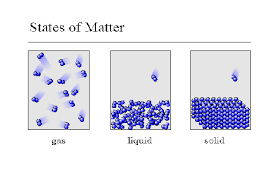
What state of matter is shown in the image?
a)
Solid
b)
Liquid
c)
Gas
d)
Thermal Energy
9.
Which of the following is NOT a part of the Kinetic Theory of Matter?
a)
All matter is made up of tiny particles.
b)
Occasionally, particles stop moving.
c)
Particles are always moving in random paths.
d)
The type of movement of particles depends on the amount of energy.
10.
At what temperature does matter change phases from a solid to a liquid?
a)
Melting Point
b)
Boiling Point
c)
100 degrees Celsius
d)
Condensation Point
11.
Which of the following is TRUE when particles GAIN Thermal Energy?
a)
Particles move more slowly
b)
Particles move further apart
c)
Particles stop moving
d)
Particles move closer together
12.
Which of the following occurs during Vaporization?
a)
Particles overcome bonds and collide with each other and the walls of the container
b)
Bonds reform between particles
c)
Particles stop moving
d)
Energy is lost
13.
What is the measure of the average kinetic energy of the particles in an object?
a)
Motion
b)
Temperature
c)
Thermal Energy
d)
Heat
14.
The average kinetic energy of water molecules is greatest in ____.
a)
steam at 100 C
b)
liquid water at 90 C
c)
liquid water at 373 K
d)
ice at 0 C
15.
Are particles of matter always in motion?
a)
yes
b)
no
16.
The characteristic temperature at which a pure solid changes to a liquid is its __________ point.
a)
melting
b)
boiling
c)
Schaffer
d)
pressure
17.
_______ occurs when a liquid changes to a gas below its surface as well as at the surface.
a)
Boiling
b)
Evaporation
c)
Freezing
d)
Melting
18.

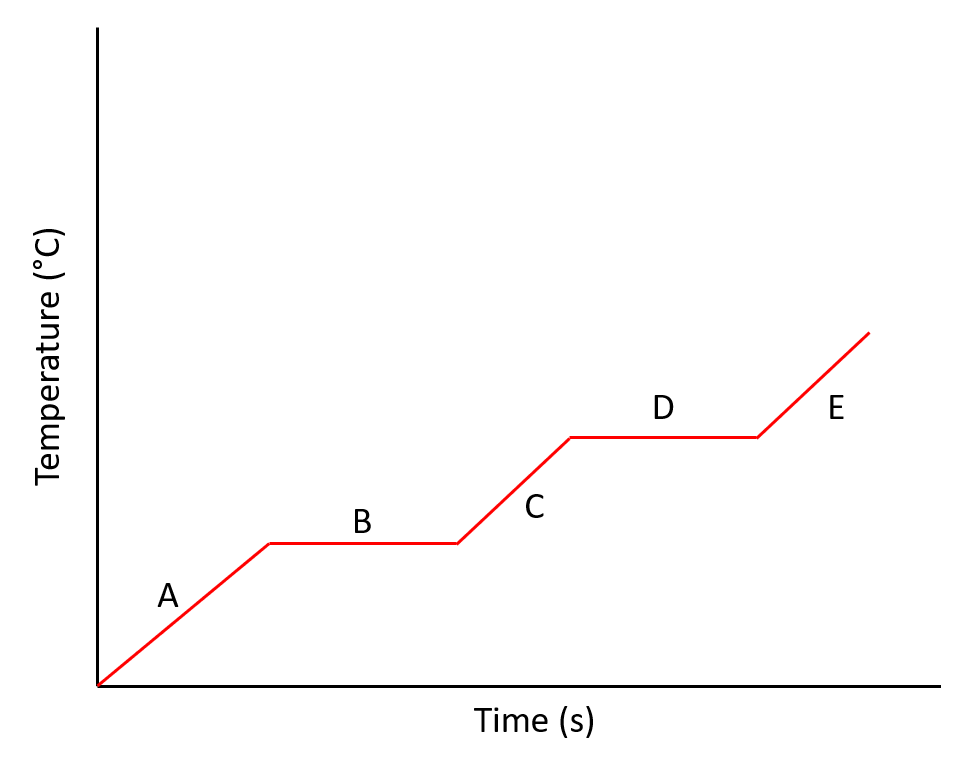
The diagram shows a heating curve for ice. Which line represents the ice melting?

a)

A

b)

B

c)

C

d)

D

e)

E

19.

Why are lines B and D flat?

a)

The ice is melting

b)

The ice is freezing

c)

All of the thermal energy is used to break the bonds

d)

They stopped the stopwatch

e)

They stopped heating the ice.

20.

The diagram shows a heating curve for ice. Which line represents the ice in a liquid state (water)?

a)

A

b)

B

c)

C

d)

D

e)

E

21.

Latent heat is

a)

the heat absorbed or released at a boiling process during a change of phase

b)

the heat absorbed or released at a constant temperature during a change of phase

c)

the heat absorbed or released at a constant temperature during a change of phase of 1 kg object

d)

the heat absorbed or released by an object to increase or decrease its temperature by 1 degree Celcius

22.

The heat absorbed by melting a solid is known as

a)

latent heat of fusion

b)

latent heat of solid

c)

latent heat of liquid

d)

latent heat of vaporisation

23.

The graph shows the cooling curve of a substance. At which stages the specific latent heat released?

a)

AB and CD

b)

BC and DE

c)

AB and EF

d)

BC and CD

24.
Evaporation is when liquid particles absorb enough energy to leave the 
a)
surface
b)
bottom
c)
center
d)
liquid throughout
25.
The Kelvin temperature scale is based on
a)
potential energy
b)
kinetic energy
c)
Kelvins
d)
water