
 Worksheets
Unit 1. Intro to Earth Science (21-22)
Total questions: 23
Worksheet time: 17mins
Which graph represents the relationship between the mass and volume of the substance?


According to the graph, what is the density of material B?
1.0 g/cm3
0.2 g/cm3
5.0 g/cm3
10.0 g/cm3
Compared to the density of liquid water, the density of an ice cube is
always greater
always the same
always less
sometime less and sometimes greater

The diagram to the right represents a cylinder which contains four different liquids, W, X, Y, and Z, each with a different density (D) as indicated. A piece of solid quartz having a density of 2.7 g/cm3 is placed on the surface of liquid W. When the quartz is released, it will pass through:
W, but not X, Y or Z
W and X, but not Y or Z
W, X and Y, but not Z
W, X, Y and Z
A student calculates the densities of five different sized samples cut from the same bar of aluminum. Which graph best represents this relationship?


The water temperature reached 65°C after the sample had been heated for approximately how many minutes?
5 min
3 min
7 min
9 min

Between which points was the temperature changing at the greatest rate?
A and B
C and D
B and C
D and E

A student measures the distance from a bridge to a rock every day for a week. What is indicated by the graph of these measurements as shown below?
no change in time or distance took place
as distance increased, time decreased
as distance decreased, time increased
as time increased, distance remained the same


What is the unit for Mass?
grams
cm
mL
ounces
Which of the following is the correct unit for Density?
grams
g/cm3
mL
mL/g
When scientists make use of their senses in the process of gathering data, they are
making an assumption
making an inference
making an observation
making a classification
Which statement best describes why a hot air balloon rises when the air inside of it is heated? The air inside...
expands and becomes more dense as it is heated
expands and become less dense as it is heated
contracts and becomes more dense as it is heated
contracts and becomes less dense as it is heated
The mass of a sample of quartz is 40.0g. If the density of the quartz is 2.0g/mL, what is the volume of the quartz sample?
80.0mL
0.05 mL
20.0 mL
40.0 mL

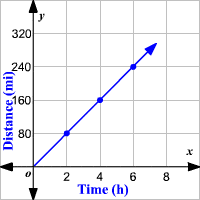
What type of relationship is seen in the graph?
Direct
Inverse
Cyclic
There is no relationship

What's an inference you can make about the picture?
The lake looks like a U shape
The grass is green
There are fields in the picture
The lake was formed from a meandering stream
Water has the greatest density at
100oC in the gaseous phase
0oC in the solid phase
4oC in the solid phase
4oC in the liquid phase

