wayground logo

Free Printable Worksheets

NEW

Font size

S
M
L
XL
Worksheets

Year 10 Physics so far

Total questions: 25

Worksheet time: 20mins
Name
Class
Date
1.
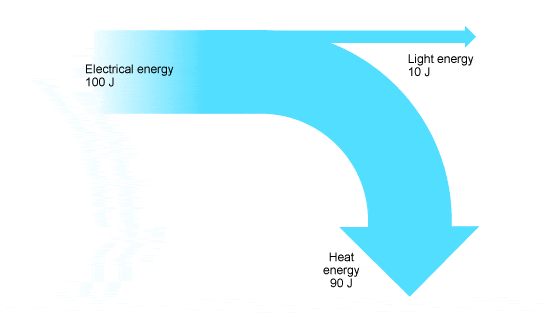
Where does most of the energy go in this transformation.
a)
Electrical energy
b)
Light
c)
Heat
d)
other
2.
What type of device might this Sankey be about?
a)
A very efficient LED light bulb
b)
A very inefficient incandescent light bulb
c)
A coal power plant
d)
A wind turbine
3.

Efficiency is...

a)

The percentage of energy that is actually used to do work

b)

The stuff in the walls that keeps energy in

c)

The amount of useful energy in a Sankey diagram

d)

how organised Dr Stocks was when she made this quiz

4.
What units are used to measure energy?
a)
Watts
b)
Newtons
c)
Joules
d)
kilowatts
5.

A hairdryer uses 300J of energy to produce 60J of sound energy and 240J of thermal energy. Calculate its efficiency.

a)

80%

b)

90%

c)

20%

d)

100%

6.

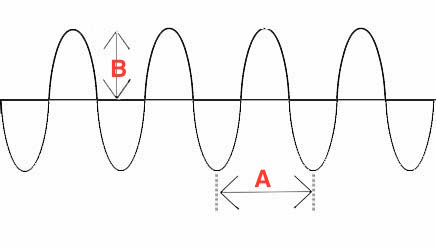
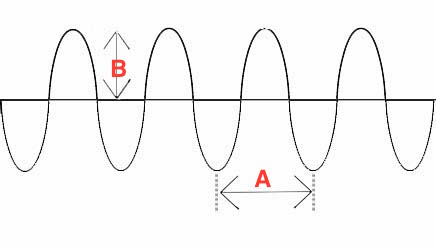
What property of this wave is represented by the letter "A"

a)

amplitude

b)

crest

c)

trough

d)

wavelength

7.
What property of the wave is represented by the letter "B"?
a)
amplitude
b)
crest
c)
trough
d)
wavelength
8.
The number of wavelengths that pass a point each per second is:
a)
frequency
b)
period
c)
longitudinal 
d)
transverse wave 
9.
The type of waves that require medium to pass:
a)
Mechanical Waves
b)
Electromagnetic Waves
10.

When the frequency of a wave increases and the speed stays the same, what happens to the wavelength?

a)

The wavelength is not directly affected by the frequency of a wave.

b)

The wavelength increases.

c)

The wavelength decreases.

d)

More specific information is needed to form a conclusion about the wavelength.
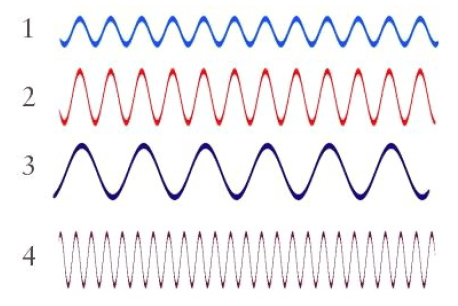
11.
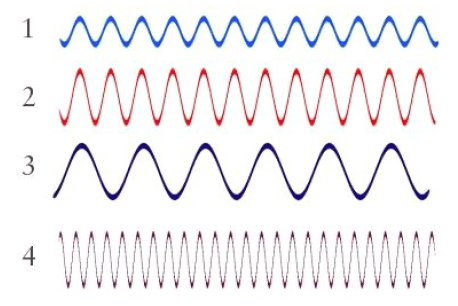
Which wave in the diagram has the greatest frequency?
a)
1
b)
2
c)
3
d)
4
12.
Which wave in the diagram has the greatest wavelength?
a)
1
b)
2
c)
3
d)
4
13.
Electromagnetic waves include the following except
a)
radio waves
b)
X-rays
c)
doing the wave at a football game
d)
microwaves
14.

In a transverse wave, particles move...?

a)

back and forth

b)

vertically

c)

up and down

d)

wherever the matter's going

15.

A wave carries...?

a)

energy only

b)

matter only

c)

neither

d)

both

16.
_______ carry the greatest amount of energy. 
a)
x-rays
b)
gamma rays
c)
infrared rays
d)
visible light
17.
How would a person measure the wavelength on this sound wave?
a)
dense to less dense
b)
trough to crest
c)
compression to compression
d)
beginning of illustration to the end
18.
Which answer best explains how a wave is created?
a)
A wave is created when energy stays still
b)
A wave is created when a force causes a vibration
c)
A wave is created when molecules become a medium
d)
A wave is created when a liquid becomes a solid
19.
Which wave is pictured?
a)
Transverse
b)
Longitudinal
c)
Both
d)
Neither
20.
What is the frequency of a wave equal to?
a)
1/Wavelength
b)
1/Period
c)
1/Velocity
d)
1/Amplitude 
21.
If a wave is traveling at 260 m/s and has a wavelength of 0.8 m/s, what is its frequency?
a)
208 Hz
b)
325 Hz
c)
430 Hz
d)
160 Hz
22.
A wave covers a distance of 68 m during one of its cycles and has a frequency of 700 Hz.  What is its speed?
a)
10.3 m/s
b)
47600 m/s
c)
3600 m/s
d)
830.5 m/s
23.
A wave has wavelength of 10 m and a speed of 340 m/s. What is the frequency of the wave?
a)
34 m/s
b)
3400 Hz
c)
3.4 Hz 
d)
34 Hz
24.
Frequency is measured in 
a)
Pounds
b)
Hertz
c)
Joules
d)
Newtons 
25.
In the wave equation (λ) represents what?
a)
amplitude
b)
wavelength
c)
frequency
d)
wave speed