
NEW
Font size
S
M
L
XL
 Worksheets
Covalent Bond-8.53
Total questions: 23
Worksheet time: 16mins
Name
Class
Date
1.
A molecule with a single covalent bond is....
a)
HCl
b)
SO
c)
CO
d)
SO2
2.
A molecule with a double covalent bond is....
a)
HCl
b)
SO
c)
I2
d)
N2
3.
Which bond would be the least polar?
a)
H-F
b)
H-O
c)
H-H
d)
H-Br
4.
Which bond would be the most polar?
a)
H-I
b)
H-Br
c)
H-Cl
d)
H-F
5.
What is a polar molecule?
a)
One that has a partial negatitive on one end and a partial positive on the other
b)
a molecule with little vibration
c)
an ionic compound
d)
the nonpolar bonds are arranged sequentially
6.

For the structural formula shown, what is the chemical formula?
a)
NO
b)
N2O2
c)
NO2
d)
N2O
7.

What two types of atoms make a covalent bond?
a)
2 Nonmetals
b)
1 Nonmetal and 1 Metal
c)
2 Metals
d)
2 Noble Gases
8.
How do covalent bonds form?
a)
Donating & receiving valence e- between atoms.
b)
Opposite slight charges attract each other between compounds.
c)
Scientists are still not sure how they form.
d)
Sharing valence e- between atoms.
9.
Which of the following is NOT formed by a covalent bond?
a)
K2S
b)
H2O
c)
I2
d)
CO2
10.
What do we call a covalent bond where electrons are shared UNEVENLY or UNEQUALLY?
a)
Ionic
b)
Polar Covalent
c)
Nonpolar Covalent
d)
Van der Waals Force
11.
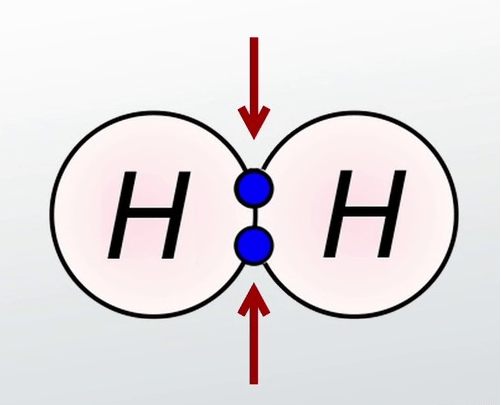
What type of bond is shown in this image?
a)
Ionic
b)
Polar Covalent
c)
Nonpolar Covalent
d)
Van der Waals Force
12.
What two types of atoms make a covalent bond?
a)
2 Nonmetals
b)
1 Nonmetal and 1 Metal
c)
2 Metals
d)
2 Noble Gases
13.
How many are shared in a single bond?
a)
2 pairs
b)
4
c)
2
d)
1
14.
How many are shared in a double bond?
a)
2
b)
4 pairs
c)
6
d)
4
15.
How many electrons are shared in a triple bond?
a)
6
b)
3
c)
6 pairs
d)
5
16.

How many valence electrons does oxygen have?
a)
2
b)
3
c)
6
d)
4
17.

How many valence electrons does nitrogen have?
a)
3
b)
2
c)
5
d)
1
18.

What is the correct formula for this molecule?
a)
NH
b)
N3H
c)
NH3
d)
NH4
19.

How many valence electrons does hydrogen have?
a)
4
b)
3
c)
2
d)
1
20.

Which element is most likely to form a covalent bond?
a)
Nitrogen
b)
Lithium
c)
Sodium
d)
Potassium
21.
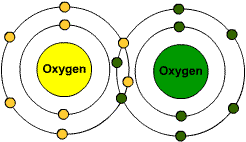
Is this image an example of covalent bonding?
a)
Yes
b)
No
22.

Outer shell electrons are called
a)
outer electrons
b)
valence electrons
c)
negatives
23.

Atoms want
a)
A full outer shell of electrons
b)
One electron short of a full shell
c)
kit kats
Reset

