wayground logo

Free Printable Worksheets

Font size

S
M
L
XL
Worksheets

Unit 2A Review

Total questions: 76

Worksheet time: 1hrs 26mins

Name
Class
Date
1.
an angle that forms a square corner
a)
right angle
b)
rectangle
c)
acute angle
2.
lines that cross or meet and form angles
a)
parallel lines
b)
intersecting lines
c)
ray
3.
an exact position or location
a)
line
b)
point
c)
ray
4.
formed by 2 rays or line segments that share the same endpoint
a)
line segment
b)
angle
c)
point
5.
lines that cross or meet to form a right angle
a)
line segments
b)
parallel lines
c)
perpendicular lines
6.
lines that never cross or meet and are the same distance apart
a)
intersecting lines
b)
parallel lines
c)
perpendicular lines
7.
a part of a line with one end point and continues in one direction
a)
point
b)
line segment
c)
ray
8.
a part of a line that has 2 endpoints
a)
line segment
b)
ray
c)
angle
9.
a straight path that continues in both directions
a)
line
b)
ray
c)
segment
10.
a)
Segment addition
b)
Congruent segments
c)
Circumcenter
d)
bisector
11.
a)
Circle
b)
Radius
c)
Diameter
d)
Circumcenter
12.
a)
line AB
b)
ray AB
c)
line segment AB
d)
points
13.
a)
perpendicular bisector
b)
angle bisector
c)
line
d)
segment
14.
a)
segment AB
b)
ray AB
c)
line AB
d)
triangle
15.
a)
ray AB
b)
line AB
c)
segment AB
d)
bisector
16.
What type of angles are <1 and <2?
a)
Linear Pair
b)
Supplementary Angles
c)
Adjacent Angles
d)
All of these
17.
Two angles that share a side and the vertex. Also called "next door neighbor" angles.
a)
Obtuse Angle
b)
Acute Angle
c)
Right Angle
d)
Adjacent Angles
18.
Two angles whose sum totals 180 degrees.
a)
Obtuse Angle
b)
Acute Angle
c)
Right Angle
d)
Supplementary Angles
19.
Collinear points are three or more points that lie on the same line.
a)
True
b)
False
20.
What type of angles are <1 and <2?
a)
Supplementary Angles
b)
Linear Pair
c)
Adjacent Angles
d)
Vertical Angles
21.
What happens to the original statement when you write the converse?
a)
It stays the same.
b)
The IF and the THEN parts switch places.
c)
Both parts are negated.
22.
What type of angles are <1 and <2?
a)
Alternate Exterior Angles
b)
Alternate Interior Angles
c)
Same-Side Interior Angles
d)
Corresponding Angles
23.
<1 is ______________ to <2.
a)
congruent
b)
supplementary
24.
What type of angles are <1 and <2?
a)
Alternate Exterior Angles
b)
Alternate Interior Angles
c)
Same-Side Interior Angles
d)
Corresponding Angles
25.
<1 is ______________ to <2.
a)
congruent
b)
supplementary
26.
Angle C and P are...
a)
Alternate Interior Angles
b)
Same Side Interior Angles
c)
Corresponding Angles
d)
Alternate Exterior Angles
27.
Angle S and A are...
a)
Alternate Interior Angles
b)
Same Side Interior Angles
c)
Corresponding Angles
d)
Alternate Exterior Angles
28.
Angle R and C are...
a)
Alternate Interior Angles
b)
Same Side Interior Angles
c)
Corresponding Angles
d)
Alternate Exterior Angles
29.
Identify the correct statement.
a)
∠1 & ∠2
are corresponding angles
b)
∠2 & ∠4
are corresponding angles
c)
∠5 & ∠8
are corresponding angles
d)
∠1 & ∠5
are corresponding angles
30.
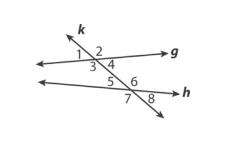
Identify the correct statement.
a)
∠1 & ∠8
are alternate interior angles
b)
∠2 & ∠3
are alternate interior angles
c)
∠4 & ∠5
are alternate interior angles
d)
∠7 & ∠4
are alternate interior angles
31.
Identify the correct statement.
a)
∠C=116°
b)
∠C=64°
c)
∠C=180°
d)
∠C=26°
32.
Identify the correct statement.
a)
∠B=82°
b)
∠B=98°
c)
∠B=180°
d)
∠B=8°
33.
If angle B measures 120 degrees, find the measure of angle Q.
a)
120 degrees
b)
-30 degrees
c)
60 degrees
34.
Name a pair of alternate interior angles.
a)
angle 3 & angle 4
b)
angle 5 & angle 6
c)
angle 3 & angle 6
d)
angle 3 & angle 5
35.
What are supplementary angles?
a)
Angles that add up to 180°
b)
Angles that add up to 90°
c)
Angles that are equal to each other
d)
Angles that are opposite of each other when lines intersect
36.
What are complementary angles?
a)
Angles that add up to 180°
b)
Angles that add up to 90°
c)
Angles that are equal to each other
d)
Angles that are opposite of each other when lines intersect.
37.
What is the complement angle to 30°?
a)
60°
b)
30°
c)
150°
d)
230˚
38.
What is the supplement angle to 42°?
a)
48°
b)
138°
c)
100°
d)
Not possible
39.
What is the measure of ∠2?
a)
38
b)
58
c)
71
d)
142
40.

Find the value of x.

a)

118

b)

108

c)

28

d)

58

41.
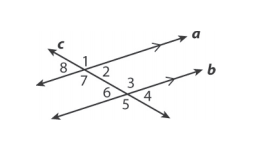
Figure 1.
Name both pairs of alternate interior angles.
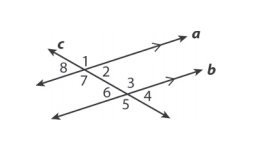
a)
3 & 7 and 2 & 6
b)
3 & 6 and 2 & 7
c)
4 & 8 and 1 & 5
d)
4 & 5 and 1 & 8
42.

Figure 1.

Name all the interior angles that are supplementary to ∠7

a)

2

b)

8

c)

6

d)

3

43.
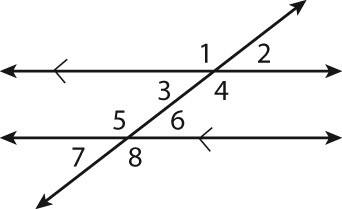
Figure 3.
Name both pairs of alternate exterior angles. 
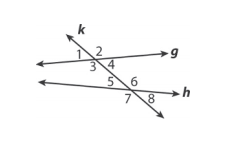
a)
∠1 and ∠7, ∠2 and ∠8 
b)
∠8 and ∠7, ∠2 and ∠8 
c)
∠2 and ∠7, ∠1 and ∠8 
d)
∠3 and ∠7, ∠4 and ∠8 
44.
Figure 3. 
Name the corresponding angle to ∠4
a)
∠8 
b)
∠2
c)
∠3
d)
∠6
45.
Solve for  y.
a)
y = 20
b)
y = 120
c)
y = 60
d)
y = 10
46.
What is the value of x?
a)
22
b)
26
c)
24
d)
23
47.
What is the measure of ∠3?
a)
55
b)
155
c)
45
d)
135
48.
What is the value of y?
a)
29
b)
119
c)
58
49.
Find y.
a)
50
b)
130
50.
What is the value of x?
a)
60
b)
26
c)
14
d)
10
51.
Which of these angles is NOT congruent to angle 5?
a)
Angle 6
b)
Angle 8
c)
Angle 1
d)
Angle 4
52.

Which could be used to prove the lines are parallel?

a)

Alternate Interior Angles Are Congruent

b)

Corresponding Angles Are Congruent

c)

Corresponding Angles are Supplementary

d)

Alternate Interior Angles Are Supplementary

53.

Which could be used to prove the lines are parallel?

a)

Alternate Interior Angles are Congruent

b)

Same Side Interior Angles are Supplementary

c)

Corresponding Angles are Congruent

d)

Cannot be proved parallel

54.

Solve for x.

a)

8

b)

10

c)

7

d)

2

55.
What is the value of x?
a)
22°
b)
10°
c)
d)
56.

1) Which statement restates the Given from the question?

a)
b)
c)
57.
When you are proving lines parallel, do you use the theorems or the converses? 
a)
theorems 
b)
converses
58.
In the figure m∠LQM=60.  Find m∠KMN.
a)
45o
b)
75o
c)
105o
d)
135o
59.
On a subway route, station C is located at the midpoint between stations A and D. Station B is located at the midpoint between stations A and C. If the distance between stations A and D is 6.4 kilometers, what is the distance between stations B and D? 
a)
1.6
b)
2.4
c)
3.2
d)
4.8
60.
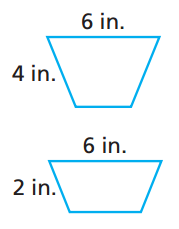
The pair of figures is similar. Find the missing side.
a)
x = 1
b)
x = 3
c)
x = 9
d)
x = 5
61.
Find missing side
a)
5
b)
7
c)
9
d)
11
62.
Find y.
a)
144
b)
18
c)
72
d)
12
63.
Two objects that are the same shape but not the same size are _______.
a)
Congruent
b)
Vertical
c)
Similar
d)
Complementary 
64.
Using a proportion, find the height of the tree.
a)
x = 0.0625 ft.
b)
16 ft
c)
x = 16 ft.
65.
All corresponding angles in similar figures are congruent.  
a)
True
b)
False
66.
Are the following similar? Why or why not?
a)
Yes
b)
No, the corresponding angles are not equal.
c)
No, the ratios of the corresponding sides are not equal.
67.
To find the height of a very tall pine tree, you place a mirror on the ground and stand where you can see the top of the pine tree.  How tall is the tree?
a)
144 feet
b)
72 feet
c)
36 feet
68.
The __________ is the ratio of a length of the image to the corresponding length on the original figure.
a)
reduction
b)
enlargement
c)
scale factor
d)
center of dilation
69.
A rectangular garden is 45 ft wide and 70 ft long. On a blueprint, the width is 9 in. Identify the length on the blueprint. 
a)
7 in
b)
9 in
c)
12 in
d)
14 in
70.
The scale drawing car length is 3 cm. If the scale is 1 cm:4 ft, what is the actual car length?
a)
12 feet
b)
16 feet 
c)
10 feet
d)
4 feet
71.
What is Dilation?
a)
Dilation means to enlarge or reduce
b)
Dilation means to reflect on something
c)
Dilation means to like something
d)
Dilation means to make something different by making it smaller
72.
A scale factor of less than one means
a)
that the prime image will be larger than the pre-image.
b)
That the prime image will be the same as the preimage.
c)
That you need to subtract that amount off  of each side.
d)
That the prime image will be a reduction of the preimage.
73.
What is the justification (reason)?
a)
Reflexive Property
b)
Symmetric Property
c)
Transitive Property
d)
Substitution
74.

What would be the reason for statement 5?

a)

Converse Corresponding Angles

b)

Definition Congruent Angles

c)

Transitive Property

d)

Substitution Property

75.
a)

Angle Addition Theorem

b)

Converse Vertical Angles Theorem

c)

Transitive Property

d)

None of the above

76.
a)

Corresponding Angle Theorem

b)

Same Side Interior Angle Theorem

c)

Alternate Interior Angle Theorem

d)

Vertical Angle Theorem