
 Worksheets
acceleration unit review
Total questions: 39
Worksheet time: 47mins
What is the velocity of a ball that has been dropped off a cliff after 1 , 2, 3, 4, and 5 seconds? ( g is -9.8 m/s2)?.
-9.8 m/s, -19.6 m/s, -29.4 m/s, -39.2 m/s, -49 m/s
-4.9 m/s, -9.8 m/s, -14.7 m/s, -19.6 m/s, -25.5 m/s
-5 m/s, -19.6 m/s, -44.1 m/s, -78.4 m/s, - 122.5 m/s
The velocity is always -9.8 m/s2.
What is the acceleration of a ball that has been dropped off a cliff after 1 , 2, 3, 4, and 5 seconds? ( g is -9.8 m/s2)?.
-9.8 m/s, -19.6 m/s, -29.4 m/s, -39.2 m/s, -49 m/s
-4.9 m/s, -9.8 m/s, -14.7 m/s, -19.6 m/s, -25.5 m/s
-5 m/s, -19.6 m/s, -44.1 m/s, -78.4 m/s, - 122.5 m/s
The acceleration is always -9.8 m/s2.
A problem that asks "how fast was the object going?" is prompting you for an answer measured in
distance in meters.
velocity in meters / second.
acceleration in meters / second^2.
time in seconds.
A problem that asks "how far did the object move?" is prompting you for an answer measured in
distance in meters.
velocity in meters / second.
acceleration in meters / second^2.
time in seconds.
A problem that asks "how long did it take" is prompting you for an answer measured in
distance in meters.
velocity in meters / second.
acceleration in meters / second^2.
time in seconds.


Derek threw a penny downward from the deck of a bridge with a velocity of -4.6 m/s. The penny impacted the river below in 1.7 seconds. Calculate the final velocity of the penny at impact with the river.
-16.7 m/s
-21.3 m/s
-12.1 m/s
-24.5 m/s
Mack was skating to the park. He went 1.5 mi north, west for 0.75 mi, south 3 mi, and east 1.25 mi. What is Mack's total displacement?
1.58 mi NW
2.5 mi NE
1.58 SE
1.75 SW

Where is the graph showing a decrease in speed?
0-20 seconds
20-30 seconds
30-40 seconds
40-50 seconds

What is the velocity between 12 and 16 seconds?
-10 m/s
-2.5 m/s
2.5 m/s
Which scenario or scenarios demonstrate acceleration? (Mark all that apply)
A bicycle skidding to a stop
A runner taking off from a stop.
A car taking a corner at a constant speed.
none of these

Which position-time graph matches the velocity-time graph?


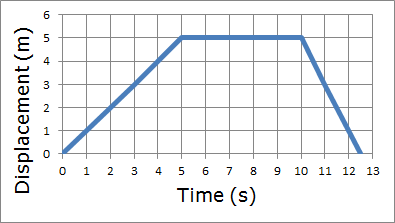
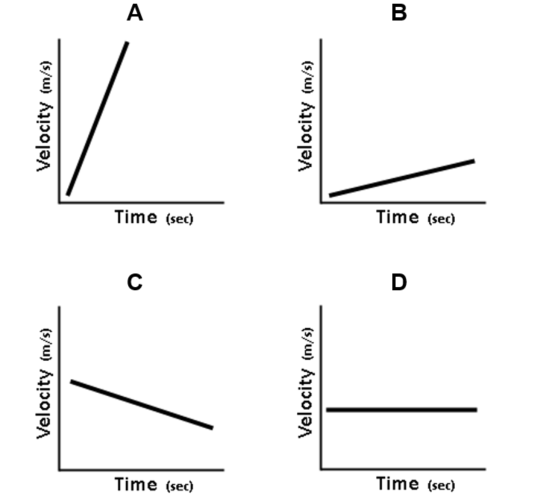
Which velocity-time graph matches the position-time graph below?


What is the acceleration between 0 and 20 seconds?
20 m/s
2.0 m/s/s
-20 m/s
-2.0 m/s/s

At what time is the object at rest in the X vs. t graph shown?
only at t=0
around 37 seconds
from 0 to 20 seconds
never, it is always moving

during what time(s) is the object speeding up while moving forward?
0-20 seconds
40-45 seconds
27-40 seconds
between 20-27 seconds




As an object falls freely in a vacuum, its
velocity increases
acceleration increases
both acceleration and velocity increase
none of the above
Starting from rest, a particle confined to move along a straight line is accelerated at a rate of 5.0 m/s2. Which one of the following statements accurately describes the motion of this particle?
(a) The particle travels 5.0 m during each second.
(b) The particle travels 5.0 m only during the first second.
(c) The speed of the particle increases by 5.0 m/s during each second.
(d) The acceleration of the particle increases by 5.0 m/s2 during each second.
(e) The final speed of the particle will be proportional to the distance that the particle covers.
An object moving along a straight line is decelerating. Which one of the following statements concerning the object’s acceleration is necessarily true?
the line.
(a) The value of the acceleration is positive.
(b) The direction of the acceleration is in the same direction as the displacement.
(c) An object that is decelerating has a negative acceleration.
(d) The direction of the acceleration is in the direction opposite to that of the velocity.
(e) The acceleration changes as the object moves along the line

