
 Worksheets
Unit:2 Geometry Quiz
Total questions: 18
Worksheet time: 16mins
Name
Class
Date
1.
Used to prove that a conjecture is false.
a)
Counterexample
b)
Inductive Reasoning
c)
Concluding statement
d)
Conjecture
2.
The type of reasoning where a person makes conclusions based on observations and patterns is called...
a)
Inductive reasoning
b)
Deductive reasoning
c)
Conjecture
d)
Experiments
3.
Identify the hypothesis and conclusion of the conditional statement:
If you give me twenty dollars, then I will be your best friend.
If you give me twenty dollars, then I will be your best friend.
a)
Hypothesis: I will be your best friend
Conclusion: you give me twenty dollars
Conclusion: you give me twenty dollars
b)
Hypothesis: you give me twenty dollars
Conclusion: I will be your best friend
Conclusion: I will be your best friend
c)
Hypothesis: if you have to pay for friends
Conclusion: then you probably should reevaluate your life
Conclusion: then you probably should reevaluate your life
d)
Hypothesis: you will not have to pay twenty dollars
Conclusion: if you have lots of friends
Conclusion: if you have lots of friends
4.
Using the statements:
If it is Friday, then I will get paid.
It is Friday.
Write the conclusion.
If it is Friday, then I will get paid.
It is Friday.
Write the conclusion.
a)
It is not Friday
b)
It is Friday
c)
I will not get paid
d)
I will get paid
5.
When taking the converse we ___________ the hypothesis and conclusion.
a)
negate
b)
switch
c)
leave the same
d)
switch and negate
6.
When taking the inverse of a statement, we_______ the hypothesis and the conclusion.
a)
negate
b)
switch
c)
switch and negate
d)
keep
7.
Conditional: If it does not rain, then we will have practice.
What is "If it rains today, then we will have not practice", called
What is "If it rains today, then we will have not practice", called
a)
Inverse
b)
Converse
c)
Contrapositive
d)
Counterexample
8.
A type of logical statement that has 2 parts, a hypothesis and conclusion is called a __________________________________.
a)
Conditional Statement
b)
Conjecture
c)
Counterexample
d)
Proof
9.
Draw a conclusion from the statement.
If a whole number is even, then its square is divisible by 4.
The number I am thinking of is an even number.
If a whole number is even, then its square is divisible by 4.
The number I am thinking of is an even number.
a)
Then it's not odd.
b)
Then it's a whole number.
c)
Then its square is divisible by 4
d)
Then it's even.
10.
What are vertical angles?
a)
Angles that are adjacent to each other
b)
Angles that add up to 180°
c)
Angles that are opposite of each other when lines intersect
d)
Angles that add up to 90°
11.
the statement formed by both exchanging and negating the hypothesis and conclusion
a)
conditional statement
b)
converse statement
c)
inverse statement
d)
contrapositive statement
e)
biconditional statement
12.
Which property says that if k = 3, then 3 = k?
a)
Substitution Property
b)
Reflexive Property
c)
Symmetric Property
d)
Transitive Property
13.
Which property states that if 10a = 2b and 2b = c, then 10a = c?
a)
Substitution Property
b)
Reflexive Property
c)
Symmetric Property
d)
Transitive Property
14.

What is the Angle Relationship?
a)
Alternate Interior
b)
Alternate Exterior
c)
Corresponding
d)
Same Side Interior
15.
If 2x - 5 = 10, then 2x = 15.
a)
Subtraction Property of Equality
b)
Addition Property of Equality
c)
Division Property of Equality
d)
Substitution
16.
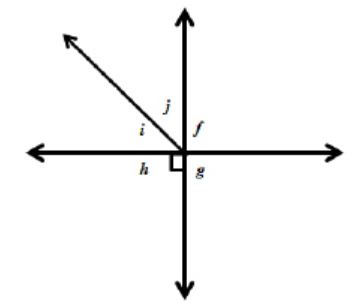
Name the vertical angle to
∠h.
∠h.
a)
∠f
b)
∠i
c)
∠g
d)
∠j
17.
What phrase does a biconditional statement use?
a)
if, then
b)
if, when
c)
if and only if
d)
then, if
18.
coming to conclusion using facts and evidence, not guessing or inferring.
a)
Deductive reasoning
b)
inductive reasoning
c)
Conditional
d)
Converse
100 %

