wayground logo

Free Printable Worksheets

NEW

Font size

S
M
L
XL
Worksheets

Quarter 1 Review

Total questions: 41

Worksheet time: 36mins

Name
Class
Date
1.
a)

1

b)

2

c)

3

d)

4

2.

Which have the same texture?

a)

a tennis ball and a wool blanket

b)

a football and a baseball

c)

an apple and an orange

d)

an eraser and a candle

3.
a)

It compares the volume of two objects.

b)

It compares the mass of two objects.

c)

It measures only the mass of solids.

d)

it measures the height, depth, and width of an object.

4.
a)

when the height information was taken

b)

where the tree grows

c)

whether the data is for an oak, elm, or pine tree

d)

who took the measurements

5.
a)

There was no change in temperature for either object.

b)

The wood's temperature increased more than the metal's temperature.

c)

The metal's temperature is 90 degrees F, and the wood's temperature is 20 degrees C.

d)

The metal's temperature increased about 15 degrees C, and the wood's temperature increased by about 3 degrees C.

6.
a)

The students did not take the readings at the same time.

b)

Emily does not know how to read a thermometer.

c)

Two students measured the temperature in degrees Celsius.

d)

The students read the thermometer to the nearest degree line.

7.

Which would most likely cause a scientist to draw an incorrect conclusion from an experiment?

a)

inaccurate data

b)

displaying data using a graph

c)

recording data in a table

d)

observations made using the eyes only

8.
a)

boiling

b)

evaportaing

c)

freezing

d)

melting

9.

Which describes a change from gas to liquid?

a)

evaporation

b)

freezing

c)

melting

d)

condensation

10.
a)

The fish's mass is 410 grams.

b)

The fish swims in a circle around its pond.

c)

The fish will freeze in the winter.

d)

Fish like worms, so that is good bait.

11.

What do scientist use to support their claims?

a)

conclusions

b)

evidence

c)

hypothesis

d)

variables

12.
What is the water cycle?
a)
the 3 forms of water
b)
the movement of water on, above, or below the surface of the Earth
c)
when water melts
d)
when clouds form
13.
What is the energy source for the water cycle?
a)
the sun
b)
the earth
c)
water
d)
the moon
14.
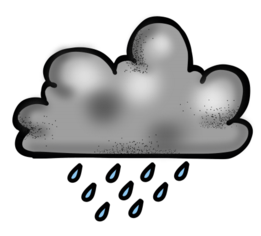
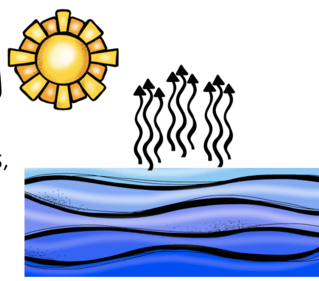
What part of the water cycle does this picture show?
a)
condensation
b)
precipitation
c)
evaporation
15.
What part of the water cycle does this picture show?
a)
condensation
b)
precipitation
c)
evaporation
16.
What is evaporation?
a)
The part of the water cycle when the sun heats up water, turning it from a liquid into water vapor or steam. It rises from the ground into the air.
b)
The part of the water cycle when the water vapor in the air gets cold. The water turns back into a liquid and forms clouds.
c)
The part of the water cycle when clouds get heavy and can no longer hold the liquid water. This causes the water to fall from the sky to the earth as rain, snow, sleet, or hail.
17.
What is condensation?
a)
The part of the water cycle when the sun heats up water, turning it from a liquid into water vapor or steam. It rises from the ground into the air.
b)
The part of the water cycle when the water vapor in the air gets cold. The water turns back into a liquid and forms clouds.
c)
The part of the water cycle when clouds get heavy and can no longer hold the liquid water. This causes the water to fall from the sky to the earth as rain, snow, sleet, or hail.
18.
What is precipitation?
a)
The part of the water cycle when the sun heats up water, turning it from a liquid into water vapor or steam. It rises from the ground into the air.
b)
The part of the water cycle when the water vapor in the air gets cold. The water turns back into a liquid and forms clouds.
c)
The part of the water cycle when clouds get heavy and can no longer hold the liquid water. This causes the water to fall from the sky to the earth as rain, snow, sleet, or hail.
19.
When water condenses, the water vapor in the air gets ___________ and changes back into liquid.
a)
cold
b)
hot
c)
warm
d)
solid
20.
When water condenses, the liquid water forms ______________.
a)
water vapor
b)
steam
c)
air
d)
clouds
21.
Precipitation happens when clouds of water droplets are too ______________.
a)
cold
b)
light
c)
heavy
d)
hot
22.
Evaporation happens when the sun ___________ water and turns it into vapor.
a)
cools
b)
heats up
c)
freezes
d)
lights up
23.
Which of these is not an example of precipitation?
a)
rain
b)
clouds
c)
sleet
d)
snow
24.
Which of these is an example of precipitation?
a)
snow
b)
air
c)
clouds
d)
vapor
25.
Does evaporation happen before or after condensation?
a)
before
b)
after
c)
during
26.
Does precipitation happen before or after condensation?
a)
before
b)
after
c)
during
27.
Which best explains why runoff is important?
a)
It returns water to other locations on Earth
b)
It increases the chance of flooding
c)
It makes evaporation occur faster
d)
It increases condensation
28.

When you hang wet clothes on a clothes line and you go outside to check on them and they are dry what part of the water Cycle can explain this?

a)

Condensation

b)

Evaporation

c)

Runoff

d)

transpira

29.

Based on the diagram, which statement best describes how fresh water sources on land are created from ocean water?

a)

Ocean water runs across the surface of the land and forms streams.

b)

Wind carries evaporated ocean water over the land and it precipitates into lakes.

c)

People collect ocean water and filter it to remove the salt and create reservoirs.

d)

Land soaks up ocean water and when it is saturated it forms ponds

30.

Water changes between states naturally throughout the water cycle. What is the next step the water in this image could take in the cycle?

a)

Freezing into ice or evaporating into vapor.

b)

Condensing into clouds or filtering into streams.

c)

Flowing into runoff or melting into ground water.

d)

Precipitating into rain or running into the ocean.

31.
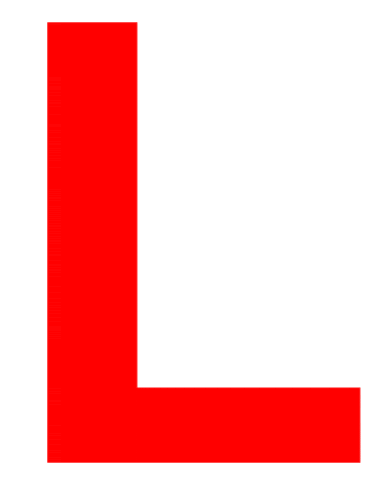
What does this symbol on a weather map indicate? 
a)
High pressure system
b)
Low pressure system
c)
Cold front
d)
Warm front
32.
What does this symbol indicate on a weather map? 
a)
High pressure system
b)
Low pressure system
c)
Cold front
d)
Warm front
33.
What kind of weather is usually associated with a high pressure system?
a)
Sunny weather
b)
Precipitation (rain, snow, etc.)
34.
Which weather tool measures air pressure?
a)
thermometer
b)
barometer
c)
anemometer
d)
psychrometer
35.
This weather tool measures wind speed and direction
a)
thermometer
b)
barometer
c)
anemometer
d)
psychrometer
36.
Mark looks at the clouds in the sky and decides that he does not need to
take his umbrella with him today. Which clouds did Mark most likely see
in the sky?
a)
cirrus
b)
nimbostratus
c)
cumulonimbus
37.
Hot air (RISES / FALLS) __________.
a)
RISES
b)
FALLS
38.
Cold air (RISES/ FALLS)  _________.
a)
RISES
b)
FALLS
39.
What does this symbol on a weather map indicate? 
a)
High pressure system
b)
Low pressure system
c)
Cold front
d)
Warm front
40.
Rain, snow, sleet, and hail are all forms of _____.
a)
precipitation
b)
condensation
c)
evaporation
d)
climate
41.
The amount of water vapor present in the air is called ________________.
a)
weather
b)
humidity
c)
air mass
d)
dew point