
 Worksheets
Circular motion basics- level 2
Total questions: 10
Worksheet time: 22mins
A 10kg car travels at a constant speed of 20.0 m/s around a horizontal circular track. Which diagram correctly represent the direction of the car's velocity (v) and the direction of the centripetal force (Fc) acting on the car at a particular moment?


At the instant shown in the diagram, the car's centripetal acceleration is directed-
toward E
toward N
toward W
clockwise
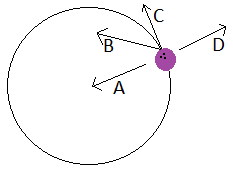
Which of the following depicts the velocity of the bowling ball?
A
B
C
D


The diagram shows an object moving counterclockwise around a horizontal, circular track. Which diagram below represents the direction of both the object's velocity and the centripetal force acting on the object when it is in the position shown?


At the position shown in the diagram, which arrow indicates the direction of the centripetal acceleration of the cart?
A
B
C
D

What is Newton's First Law
F = ma
For every action there is an equal and opposite reaction.
An object remains moving at a constant velocity (in a straight line at a constant speed) unless a net force acts upon it.
Accelerated motion is cause by a lack of a net force acting in any direction.

The string breaks. Describe the motion of the ball correctly.
It moves in a straight line.
It continues to move in a circular motion
It moves in a straight line at a tangent to the circle
It continues to accelerate.
If an object is moving in a circular motion it is moving at a constant speed. . so why is it not following Newton's 1st Law
There is no net force acting on the object.
It's direction is constantly changing and so a net force has to be acting. Therefore by definition, F = ma, the object has to be accelerating.
It's direction is constantly changing and so a net force has to be acting. Therefore by definition, F = ma, the object has to be moving at a constant velocity.
It's direction is constantly changing and so a net force is not acting. Therefore by definition, F = ma, the object is not accelerating.

