
Font size
S
M
L
XL
 Worksheets
Properties of Matter, Density, & Solubility
Total questions: 30
Worksheet time: 19mins
Name
Class
Date
1.
I am anything that has mass and takes up space!
a)
energy
b)
matter
c)
molecules
d)
atoms
2.
The amount of space that matter takes up is its _______.
a)
atom
b)
volume
c)
matter
d)
weight
3.
The amount of matter something contains is its ______________.
a)
gas
b)
solid
c)
weight
d)
mass
4.
The measurement system used by scientist around the world.
a)
metric system
b)
customary systerm
c)
calorie system
d)
science system
5.
What is the measure of gravity on an object?
a)
matter
b)
mass
c)
weight
d)
volume
6.
Dimensions of a shape are:
length- 5cm
height- 6cm
width- 2cm
What is the volume?
length- 5cm
height- 6cm
width- 2cm
What is the volume?
a)
13cm cubed
b)
12cm cubed
c)
60cm cubed
d)
30cm cubed
7.
2 meters = ____________ centimeters
a)
100
b)
20
c)
200
d)
2000
8.
4,000 milliliters = ______________ liters
a)
4
b)
40
c)
400
d)
0.4
9.

This picture represents which of the following?
a)
element
b)
compound
c)
mixture
10.
The ability of a substance to be pounded or rolled into thin sheets
a)
State
b)
Ductility
c)
Malleability
d)
Thermal Conductivity
11.
The ability of a substance to be pulled into wires
a)
Malleability
b)
Flexibility
c)
State
d)
Ductility
12.
Physical or Chemical Property? The temperature of boiling water is 100 degrees Celsius.
a)
Physical
b)
Chemical
c)
Neither
13.
An object with which of the following densities will float on water?
a)
0.7 g/cm3
b)
1.2 g/cm3
c)
3.5 g/cm3
d)
11.4 g/cm3
14.
A can of Coke will sink in a bowl of water. A can of Diet Coke will float in a bowl of water. What does this tell you about the density of the Diet Coke?
a)
it is bigger than 1
b)
it is smaller than 1
c)
it is equal to 1
d)
it is equal to -1
15.
Why do ice cubes float in a glass of water?
a)
the ice cubes are more dense than the water
b)
the water is more dense than the ice cubes
c)
the water is more dense than the glass
d)
the ice is more dense than the glass
16.
The following liquids are poured together in a beaker: alcohol (density=0.79), corn syrup (density=1.38), water (density=1.0), and cooking oil (density=0.93). Which of these liquids will sink to the bottom of the beaker?
a)
alcohol
b)
corn syrup
c)
water
d)
cooking oil
17.
Mercury is a metal that is liquid at room temperature and has a density of 13.5 g/cm3. Which of these metals would sink below the mercury if dropped into a container of mercury?
a)
gold (density=19.3 g/cm3)
b)
lead (density=11.4 g/cm3)
c)
iron (density=7.9g/cm3)
d)
aluminum (density=2.7g/cm3)
18.
A brick sinks in water while a wooden block of the same size floats. This is because the brick has a
a)
lower volume than the wooden block
b)
lower density than the wooden block
c)
higher volume than the wooden block
d)
higher density than the wooden block
19.
A scientist has four different liquids and pours them all into a bottle. The silver liquid sinks to the bottom, the red liquid settles on top of the silver one, and the pink liquid stays at the surface. Which liquid has the smallest density?
a)
the pink liquid
b)
the silver liquid
c)
the red liquid
d)
the water
20.
What is the density of water?
a)
0 g/ml
b)
1 g/ml
c)
10 g/ml
d)
100 g/ml
21.
Which of these would be correct to put at the end of a density answer?
a)
g/cm
b)
cm3
c)
g/ml
d)
g/lb
22.
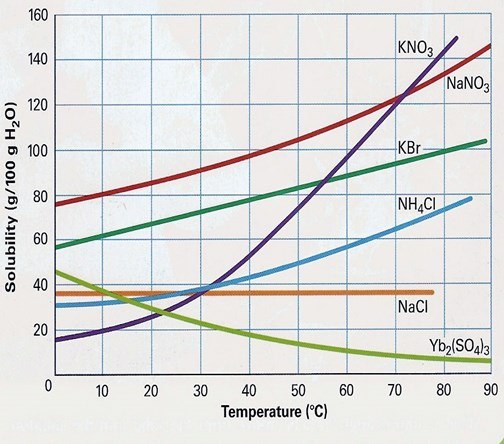
At 30'C, which substance has the lowest solubility?
a)
KNO3
b)
KBr
c)
NaCl
d)
Yb2(SO4)3
23.
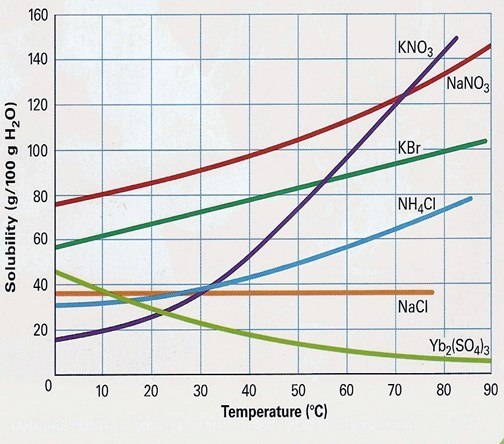
The solubility of Yb2(SO4)3 ________________ with added temperature.
a)
increases
b)
decreases
c)
remains the same
24.
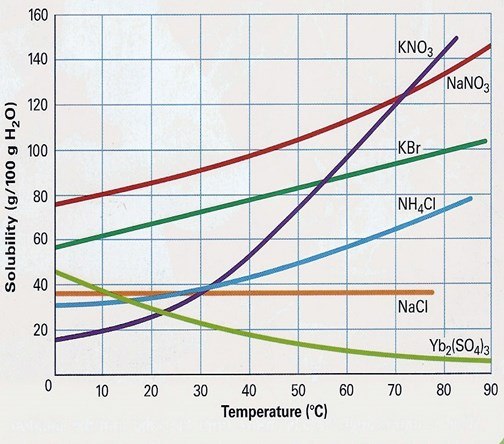
At 80'C, KBr's solubility is:
a)
100
b)
90
c)
80
d)
0
25.
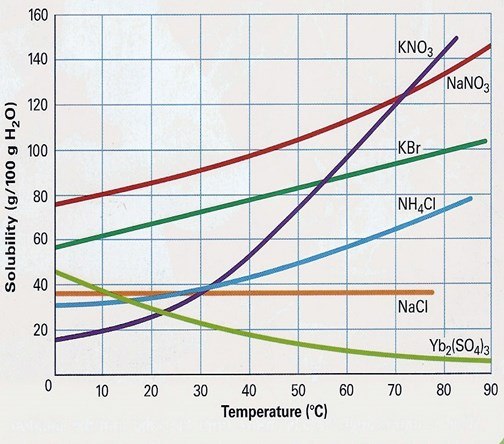
Identify if the following solution would be saturated, unsaturated, or supersaturated: 103 g KBr at 70'C.
a)
Unsaturated
b)
Saturated
c)
Supersaturated
26.
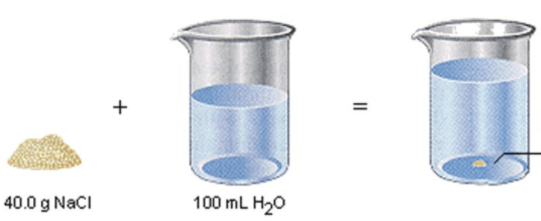
Identify the saturation associated with the product of this experiment.
a)
Unsaturated
b)
Saturated
c)
Supersaturated
27.

How does a solution become supersaturated?
a)
dissolve lots of solute in it.
b)
dissolve a little solute in it.
c)
dissolve more solute than you should be able to.
d)
dissolve a solvent in it.
28.
__________ are made up of solutes and solvents.
a)
Solutions
b)
Suspensions
c)
Heterogeneous Mixtures
d)
Pure Substances
29.
Which is an example of a solvent?
a)
Salt
b)
Egg whites
c)
Water
d)
Sugar
30.
Ways to increase solubility are:
a)
grind the solute into smaller particles
b)
heat up the solvent
c)
stir the solution
d)
decrease the temperature
e)
water is the universal solvent
Reset

