
 Worksheets
Population Ecology
Total questions: 21
Worksheet time: 13mins
Name
Class
Date
1.
If you have a lot of offspring but do not provide parental care you are described as...
a)
K- selected
b)
r- selected
c)
Q- selected
d)
w- Selected
2.
As a population grows, it will most likely stop growing at what size?
a)
Growth limit
b)
Exponential limit
c)
Carrying Capacity
d)
It won't stop growing
3.
Which kind of growth does the human population follow? It is described as a J-shaped curve.
a)
Exponential Growth
b)
Logistic Growth
c)
Outstanding Growth
d)
Minimal Growth
4.
A population is...
a)
A group of one species in one area
b)
Multiple species that live in one area
c)
All of the living and nonliving things in an area
d)
None of these
5.
Which dispersion pattern is described by organisms being spaced out equally?
a)
Uniform
b)
Random
c)
Clumped
d)
None of these
6.
What will happen to the population when the death rate is larger than the birth rate?
a)
grow
b)
shrink
c)
stay the same
d)
None of these
7.
What will happen to the population when the birth rate is larger than the death rate?
a)
grow
b)
shrink
c)
stay the same
8.

What is the carrying capacity of the following graph?
a)
1000
b)
8000
c)
800
d)
600
9.

Refer to the diagram of the survivorship curve.
Which curve best describes an organism that invests a lot of energy in parenting?
Which curve best describes an organism that invests a lot of energy in parenting?
a)
A
b)
B
c)
C
d)
this is not a survivorship curve
10.

Which survivorship curve represents a species where most of the individuals live through their lives and die of old age?
a)
Type 1
b)
Type 2
c)
Type 3
11.

What point on the graph represents the carrying capacity?
a)
A
b)
B
c)
C
d)
D
12.
What factor describes when populations decrease because animals are moving out of a population?
a)
Emigration
b)
Limiting Factors
c)
Immigration
d)
Exponential Growth
13.

What does the graph represent?
a)
Emigration
b)
Exponential growth
c)
Immigration
d)
Logistic Growth
14.
Which limiting factor is independent of the number of individuals in a population?
a)
competition
b)
parasitism/disease
c)
stress
d)
natural disasters
15.
Logistic growth has 3 phases. In Phase 1, the population grows rapidly. In Phase 2, population grows slowly. In Phase 3, growth stops. What causes growth to stop in the 3rd phase of logistic growth?
a)
Emigration
b)
Immigration
c)
Exponential Growth
d)
Carrying Capacity
16.
Which factor is a density-dependent limiting factor on the population of a species?
a)
seasonal variation
b)
natural disasters
c)
unusual weather
d)
predation
17.
An environmental factor such as storms and extreme heat or cold that affects population regardless of their density
a)
density- dependent factor
b)
population density
c)
dispersion
d)
density- independent factor
18.
No two species can occupy the same niche
a)
Competitive Exclusion Principle
b)
Limiting Exclusion Theory
c)
Competitive Limiting Principle
d)
Limiting Competitive Theory
19.
Number of Individuals per unit area
a)
density-dependent factors
b)
carrying capacity
c)
renewable resource
d)
population density
20.
A population is __________________.
a)
a group of organisms of the same species, in the same place, at the same time.
b)
a group of organisms of the different species, in the same place, at the same time.
c)
an individual organism of the one species, in the same place, at the same time.
d)
a group of organisms of the same species, in the different place, at the same time.
21.
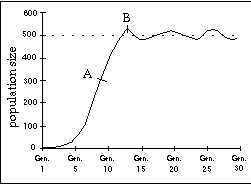
What is the carrying capacity of the graph?
a)
around 500
b)
more than 500
c)
less than 500
d)
around 600
100 %

