wayground logo

Free Printable Worksheets

NEW

Font size

S
M
L
XL
Worksheets

Osmosis and Tonicity Extra Practice

Total questions: 55

Worksheet time: 47mins

Name
Class
Date
1.
Why do your fingers Prune when in the water for a long time?
a)
Carbon goes out
b)
Diffusion
c)
Osmosis
d)
Magic
2.
This egg has shrunk, what type of solution was it placed in?
a)
hypotonic solution
b)
hypertonic solution
c)
isotonic solution
d)
active transport
3.
An ISOTONIC solution has a(n) ______________ concentration of solute (dissolved stuff) than inside the cell.
a)
lower
b)
equal
c)
higher
4.
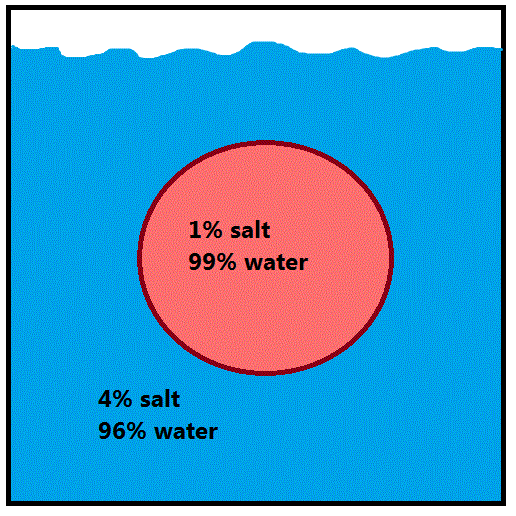
What type of solution is this cell in?
a)
Isotonic
b)
Hypertonic
c)
Hypotonic
d)
diffused
5.
The salt in the glass of saltwater is considered the
a)
solvent
b)
solution 
c)
pepper
d)
solute
6.

In an isotonic solution which way will the water flow

a)

it will not flow at all

b)

it will flow into the cell

c)

it will flow both ways at equal rates

d)

out of the cell

7.

A solution outside of a cell that contains a higher water concentration than the cytoplasm of a cell is called:

a)

solution

b)

hypertonic

c)

hypotonic

d)

isotonic

8.

The solution surrounding the cell in Diagram B, would be defined as:

a)

hypertonic

b)

hypotonic

c)

isotonic

9.

The solution surrounding the cell in Diagram C, would be defined as

a)

hypertonic

b)

isotonic

c)

hypotonic

10.

The solution surrounding the cell in Diagram A, would be defined as

a)

hypertoinc

b)

hypotonic

c)

isotonic

d)

solutonic

11.
A cell in an isotonic solution will
a)
swell (get bigger)
b)
shrink (get smaller)
c)
stay the same size
d)
impossible to tell
12.
A cell started out with 60 g of mass. Then, when put in a solution, it decreased in mass to 40 g. What type of solution was it in?
a)
Hypertonic
b)
Hypotonic
c)
Isotonic
d)
Gin and Tonic
13.
A cell started out with 60 g of mass. Then, when put in a solution, it decreased in mass to 40 g. What happened in this experiment?
a)
Water moved out of the cell
b)
Water moved into the cell
c)
Water moved in and out of the cell at the same rate
d)
The water did not move
14.
In this picture, which way will the water move?
a)
Water will move into the cell
b)
Water will move out of the cell
c)
Water will move in and out of the cell
d)
Water will not move
15.
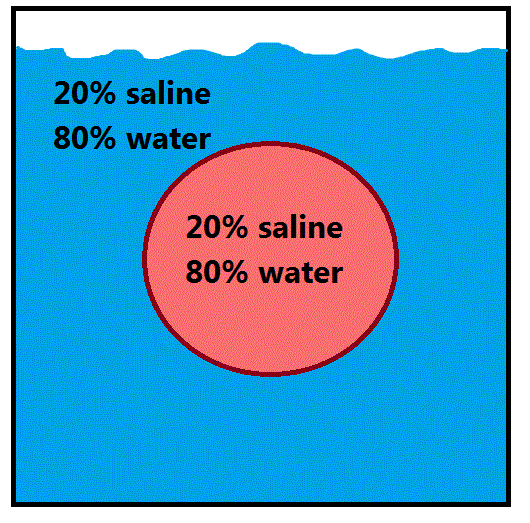
In this picture, how do you classify the solution?
a)
The solution is hypotonic
b)
The solution is hypertonic
c)
The solution is isotonic
d)
The solution is my tonic
16.

Which of the following molecules crosses through a semipermeable membrane during the process of osmosis?

a)

water

b)

salt

c)

sugar

d)

protein

17.

If the semipermeable membrane allows the green chemical to pass through it freely, where will the green chemical move?

a)

right to left

b)

left to right

c)

up and down

18.

The concentration of red molecules outside the cell is higher than the concentration inside the cell. The red molecules cannot penetrate the cell. What will happen to the cell?

a)

Water will leave the cell, and the cell will shrink.

b)

Water will enter the cell, and the cell will expand.

19.

The concentration of red molecules outside the cell is higher than the concentration inside the cell. The red molecules cannot penetrate the cell. The cell is inside a ______.

a)

hypotonic solution

b)

hypertonic solution

20.

The membrane does not allow the green molecules to pass through it. What will happen next?

a)

Water will flow into side A.

b)

Water will flow into side B.

c)

Water will stay still.

21.

Which Type of solution is the middle cell placed in?

a)

Hypertonic

b)

Hypotonic

c)

Isotonic

d)

Robotonic

22.

What would happen to a cell if it were placed in a hypotonic solution?

a)

The cell would shrink

b)

The cell would expand and could eventually burst

c)

The cell would remain unchanged

d)

The cell would shrink and then expand

23.

Which of the following pictires shows an Isotonic cell?

a)

Left Picture

b)

Middle Picture

c)

Right Picture

24.

Which picture shows a cell suspended in a hypertonic solution?

a)

Left Picture

b)

Middle Picture

c)

Right Picture

25.

Which of the following correctly describes the make up of the cell membrane?

a)

2 Phospholipid layers and some proteins, carbohydrates, and cholesterol

b)

2 layers of proteins, some lipids carbohydrates, and cholesterol

c)

2 carbohydrates, and cholesterol

d)

2 lasagna layers with marshmellows and pasta

26.

Which environment has reached equilibrium in regards to homeostasis?

a)

Left Picture

b)

Middle Picture

c)

Right Picture

27.
What type of solution allows water to enter the plant cell?
a)
hypotonic solution
b)
hypertonic solution
c)
isotonic solution
d)
active transport
28.
These red blood cells were most likely in a 
a)
hypertonic solution
b)
hypotonic solution
c)
isotonic solution
29.
If you are stranded at sea (oh no!) why is it safer to drink urine than sea water?
a)
One cup of sea water has enough sodium to poison you.
b)
Sea water is hypertonic to your cells and will only further dehydrate you.
c)
Sea water is too isotonic to your cells and you will absorb too much water.
d)
The salt will cause high blood pressure and you will die from a stroke.
30.
A HYPERTONIC solution has a _____ concentration of solute than the interior of the cell and a cell will ______ when placed into this solution.
a)
lower; shrink
b)
lower; swell
c)
higher; shrink
d)
higher; swell
31.
0.9% NaCl is isotonic to red blood cells.  Which of these describes what will happen if a technician misplaces a decimal point and makes 9.0% NaCl solution instead and administers it to a patient?
a)
The cells exposed to the solution will burst.
b)
The cells exposed to the solution will shrink.
c)
The cells will remain the same size.
d)
The cells exposed to the solution will expand but not burst.
32.
Which cell is in a hypotonic environment?
a)
A
b)
B
c)
C
33.
Which cell is in a hypertonic environment?
a)
A
b)
B
c)
C
34.
Which cell is in an isotonic environment?
a)
A
b)
B
c)
C
35.
Which beaker has a cell in a hypertonic environment?
a)
A
b)
B
c)
C
36.
Which beaker has a cell in a hypotonic environment?
a)
A
b)
B
c)
C
37.
If salt cannot permeate the membrane, which cell will lose the most water?
a)
A
b)
B
c)
C
38.
If salt cannot permeate the membrane, which cell will gain the most water?
a)
A
b)
B
c)
C
39.
The cell membrane is selectively permeable, which means...
a)
All materials can enter and leave the cell
b)
Certain things can enter while others cannot
c)
The cell manually sorts through all materials
d)
Only certain cells can interact with the cell.
40.
Which cell is placed into a hypotonic environment? 
a)
A
b)
B
c)
C
d)
D
41.
Mr. Slug was salted. Where was there more solute immediately after salting?
a)
Outside of the slug
b)
Inside of the slug
c)
There was no solute anywhere
42.
Where will the water go?
a)
Into the cell
b)
Out of the cell
c)
Equally in & out - it's isotonic
d)
There is no water
43.
A blood cell is placed into the jar, as seen. Where will the water go?
a)
Into the cell
b)
Out of the cell
c)
Equally in & out - it's isotonic
d)
The water is a lie
44.
 If a cell containing 5% salt is placed into a glass of water with 20% salt, the water is _______ compared to the cell.
a)
hypertonic
b)
hypotonic
c)
isotonic
45.
During osmosis
a)
water moves from high to low concentration
b)
large or oddly shaped molecules move across a cell membrane
c)
water moves when energy is used
d)
proteins are built
46.
HYPO means...
a)
Low
b)
High
c)
Equal
d)
Fat
47.
ISO means...
a)
Low
b)
A lot
c)
Equal
d)
Mammal
48.
What happens if someone gives you a 90% salt saline drip?
a)
Your cells will shrivel and you'll die
b)
Your cells will swell and you'll die
c)
Nah you'll be fine.
49.
Why can't you drink salt water?
a)
It's hypertonic to your cells
b)
It's hypotonic to your cells
c)
It's isotonic to your cells
d)
It's paratonic to your cells
50.
Which of the following could be used to refer to plant cells during the process of osmosis?
a)
plasmolysis
b)
crenation
c)
lysis
d)
active transport
51.
Vegetables are often sprayed with water in grocery stores.
What is the term for the water in the vegetable cells during this process?
a)
hypertonic
b)
isotonic
c)
hypotonic
d)
decreasing turgor pressure
52.
What protects carrot cells from swelling too much when it rains?
a)
They don't swell because rain is absorbed by the roots.
b)
They have pores in their cell membranes that keep them from swelling.
c)
The rain water is hypertonic to the cells so the cells lose water.
d)
They have cell walls that keep them from swelling too much.
53.
What is plasmolysis?
a)
Pulling away of the plant cell membrane as it loses water in a hypertonic solution.
b)
Pulling away of the animal cell membrane as it undergoes osmosis.
c)
An increase in turgor pressure as the cell undergoes osmosis.
d)
Contraction of the protoplast of a plant cell as a result of gaining water.
54.
What is the definition of  Selective Permeability?
a)
The movement of materials across the cell membrane that requires NO ENERGY from the cell.
b)
The movement of materials through (or across) the cell membrane
c)
The ability of the cell membrane to allow some things to pass through while preventing other things from passing through.
d)
The movement of molecules from an area of high concentration to a area of low concentration 
55.
An animal cell that is surrounded by fresh water will burst because the osmotic pressure causes
a)
water to move into the cell.
b)
water to move out of the cell.
c)
solutes to move into the cell.
d)
solutes to move out of the cell.