
NEW
Font size
 Worksheets
2.7 IB DNA Replication
Total questions: 25
Worksheet time: 2hrs 47mins

Which is true about the relationship between enzymes and DNA?
Both enzymes and DNA are made from proteins
The base sequence of DNA is determined by which nucleotide DNA polymerase III attaches to the template strand
The shape of a protein is due to the base sequence in the DNA that coded for it
Both proteins and DNA are subject to denaturation

Which of the following units (monomers) are repeatedly joined together to form a strand of DNA?
amino acids
nucleotides
fatty acids
polysaccharides


AAT CAT GGA


The enzyme that attaches the complimentary base pairs to the original strand of DNA is called...
helicase
DNA polymerase III
replicase
synthase

The enzyme that breaks the hydrogen bonds between the bases to prepare for replication....
helicase
replicase
DNA polymerase III
ligase


the % of A = the % of T
the % of G = the % of C
(Handsome brute isn't he?!)

This is the direction in which the new DNA strand is synthesized.
3' - 5' direction
5' - 3' direction
2' - 4' direction
4' - 2' direction


What are Okazaki fragments and why do we get them?
They are short DNA sequences on the lagging strand due to the multiple sites where RNA Primase has to bond to the DNA.
They are the name given to the new DNA strands formed due to semi-conservative replication.
They are the short strands on the leading strand that are joined together by ligase
They are the short pieces of DNA that are exposed when helicase breaks the hydrogen bonds between the nitrogenous bases.

What is the name of the enzyme that synthesizes a short fragment of RNA that binds to the DNA (because DNA polymerase can only build off an existing backbone)?
ligase
DNA polymerase I
primase
helicase
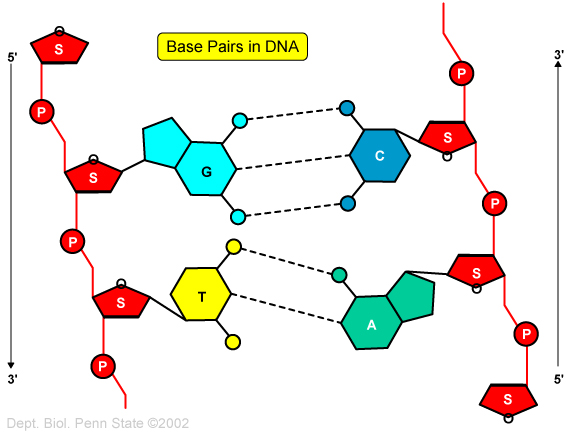

DNA replication results in two DNA molecules,
each one with two original strands
each one with two new strands
each one with one new strand and one original strand
one with two new strands and the other with two original strands

Which is larger guanine or cytosine?
guanine because it's a purine
guanine because it's a pyrimidine
cytosine because it's a purine
cytosine because its a pyrimidine

What enzyme helps seal the Okazaki fragments together?
DNA Polymerase III
ligase
DNA Polymerase I
primase

Why do we get a lagging strand when DNA is being synthesized?
DNA polymerase III can only build DNA in a 5' - 3' direction
DNA polymerase III can only build DNA in a 3' - 5' direction
It takes time for a new strand of DNA to be built
The RNA polymerase takes time to attach to the template strand of DNA.

What about DNA is unique to each individual organism?
Order of nitrogenous bases
Order of sugars
Order of phosphates
Order of amino acids

What does this diagram of Meselson & Stahls work show?
E. coli preferes N14 nitrogen to regular N15 nitrogen.
DNA replication results in the new DNA being half the original and half the new.
DNA replication results in the new DNA being either all original or all new.
E. coli replicates its DNA in a different way to humans

What did Meselson & Stahl prove?
That DNA replication happens in E. coli just like it does in humans
That DNA replication is semi-conservative
That DNA polymerase III can only build in the 5'-3' direction
That DNA replication relies on complimentary base pairing

What is meant by the 'origin' in respect to DNA replication?
The very end of the DNA double helix.
The place on the DNA where replication begins.
The part of the DNA that is the original strand.
A sequence on the DNA that indicates where ligase should join the bases.

Eukaryotic DNA is found on numerous straight chromosomes, whereas prokaryotic DNA only has one chromosome which is circular. What can you deduce from this information?
During DNA replication both eukaryotes and prokaryotes have several origins.
During DNA replication eukaryotes have one origin whereas prokaryotes have several origins.
During DNA replication both eukaryotes and prokaryotes have only one origin.
During DNA replication eukaryotes have several origins whereas prokaryotes only have one origin.

