
 Worksheets
2.7 IB Transcription, Translation and Protein Synthesis
Total questions: 20
Worksheet time: 2hrs 40mins
Name
Class
Date
1.
What process is going on in this photo?
a)
Transcription
b)
Translation
c)
Replication
d)
All the above
2.
Translation is the process where.....
a)
mRNA is created in the Nucleus
b)
mRNA is decoded to form a protein
c)
glucose molecules are made
d)
is where lipids are synthesised
3.
How many amino acids are coded for by this sequence of nucleotides:
ATG GGA ACT CCA
ATG GGA ACT CCA
a)
4
b)
2
c)
6
d)
12
4.

The amino acid sequence of a polypeptide chain creates the _________ structure of the protein.
a)
Primary
b)
Secondary
c)
Tertiary
d)
Quaternary
5.

The enzyme that produces mRNA in transcription is called....
a)
RNA Polymerase
b)
DNA Polymerase
c)
Transcriptase
d)
RNA Intrase
6.
RNA is read in sections called......
a)
Triplets
b)
Genes
c)
Codons
d)
Genes
7.

Transcription is a process that in eukaryotic cells takes place in the.......
a)
Nucleus
b)
Cytoplasm
c)
Golgi Apparatus
d)
Rough E.R.
8.

RNA polymerase builds RNA in the _________ direction
a)
5' to 3'
b)
3' to 5'
c)
both directions
d)
any direction
9.

Translation is a process in eukaryotic cells that takes place in the.......
a)
Cytoplasm
b)
Nucleus
c)
Nucleolus
d)
Golgi Bodies
10.

The codon 5'-UAC-3' would have an anti-codon match of
a)
3'-AUG-5'
b)
3'-TAC-5'
c)
5'-AUG-3'
d)
5'-CAU-3'
11.

Translation is a process that produces.....
a)
mRNA
b)
Proteins
c)
Polypeptide Chains
d)
tRNA
12.
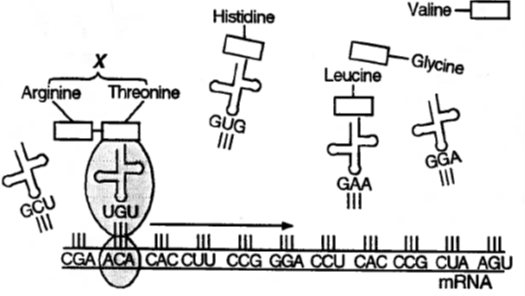
What process is going on in this diagram?
a)
Transcription
b)
Translation
c)
Replication
d)
All the above
13.
The main function of tRNA is to.......
a)
carry a message that, when translated, forms proteins
b)
form a portion of ribosomes
c)
string together complementary RNA and DNA strands
d)
bring amino acids from the cytoplasm to the ribosomes
14.
Translation is performed by........
a)
Ribosomes
b)
Mitochondria
c)
Golgi Bodies
d)
Endoplasmic Reticulum
15.

DNA codes for........
a)
cholesterol
b)
proteins
c)
fatty acids
d)
carbohydrates
16.
In proteins, the amino acid order is determined by........
a)
nitrogenous bases in RNA
b)
random placement
c)
nitrogenous bases in DNA
d)
there is no order
17.

What amino acid is represented by the codon CAG?
a)
Aspartic Acid
b)
Histidine
c)
Glutamine
d)
Methionine
18.
Ribosomes......
a)
have an anticodon and amino acid end
b)
serve as the site of transcription and are composed of rRNA and protein
c)
serve as the site of translation and are composed of rRNA and protein
d)
are located in the nucleus of the cell where translation takes place
19.

The process represented in the diagram produces a molecule that is complementary to the template strand of DNA. What type of molecule is produced?
a)
New DNA
b)
Polypeptide
c)
Messenger RNA
d)
protein
20.
There is a different tRNA molecule for each of the 20 amino acids involved in protein synthesis.
a)
b)
100 %

