
 Worksheets
Ecology Final Review
Total questions: 29
Worksheet time: 22mins
Name
Class
Date
1.
The passing of traits from parent to offspring
a)
Heredity
b)
Genetics
c)
Hybrid
d)
Probability
2.
which is heterozygous ?
a)
Tt
b)
TT
3.
Which is homozygous ?
a)
Zz
b)
SS
4.
the genetic makeup of an organism
a)
heterozygous
b)
punnet square
c)
genotype
5.
B=brown eyes
b= blue eyes
What is true about two brothers that have brown eyes?
One has genotype BB the other Bb.
b= blue eyes
What is true about two brothers that have brown eyes?
One has genotype BB the other Bb.
a)
they have same phenotype and genotype
b)
they have different genotypes and phenotypes
c)
they have same phenotype but different genotypes
d)
they have same genotype but different phenotypes
6.
What is a phenotype?
a)
The expression of a trait; what you see.
b)
refers to the genetic makeup of an individual
c)
An organism that has the same genes for a trait (ex. TT or tt)
d)
the passing of traits from parent to offspring
7.
What is a change in an organism that allows for it to survive in its environment?
a)
homologous
b)
vestigial
c)
variation
d)
adaptation
8.
What is an organism that has similar characteristics and can reproduce?
a)
species
b)
organism
c)
embryology
d)
vestigial
9.
Which of the following is NOT an example of natural selection?
a)
People selectively breeding hamsters.
b)
Insect populations developing resistance to certain pesticides.
c)
Bacteria becoming resistant to antibiotics.
d)
Male birds of certain species developing colorful feathers to attract female mates.
10.
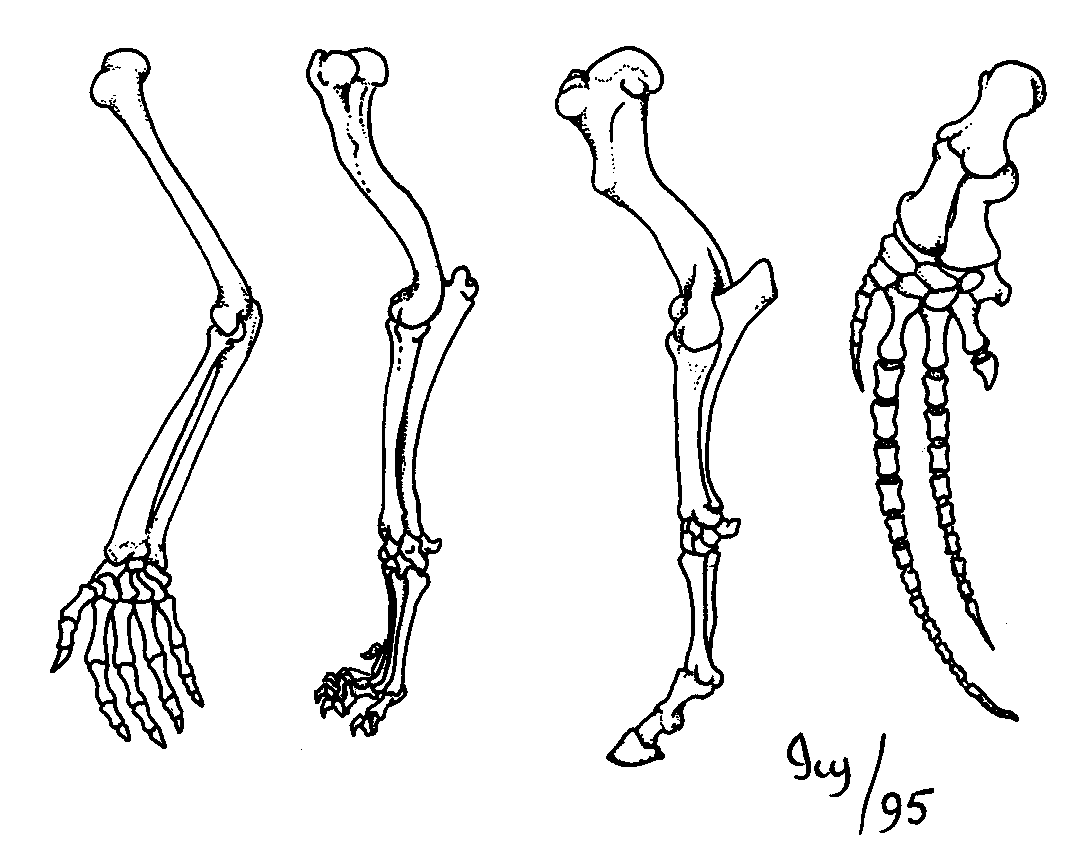
Structures with the same parts have different functions; suggests that organisms share a common ancestry
a)
vestigial structures
b)
homologous structures
c)
adaptive radiation
d)
fossil
11.
Why are advantageous traits more likely to be passed onto offspring?
a)
Because they are more likely to survive and reproduce.
b)
Because they come from dominant alleles.
c)
Because they come from recessive alleles.
d)
Because the trait is an acquired phenotype.
12.
The ability of an organism to survive and reproduce in its specific environment
a)
diversity.
b)
evolution
c)
adaptation
d)
fitness
13.
What is the term for each step in the transfer of energy and matter within a biological community?
a)
energy path
b)
food web
c)
trophic level
d)
food pyramid
14.

which symbiosis is this
a)
parasitism
b)
mutualism
c)
commensalism
d)
nonalism
15.

What does a food web represent?
a)
All connections of energy flow throughout all organisms in a habitat.
b)
The specific ways that mutualism is carried out.
c)
A single pathway or energy flow between organisms.
d)
How carnivores get their food.
16.
The amount of energy that usually transfers from one trophic level to the next...
a)
10%
b)
20%
c)
80%
d)
50%
17.
What are the correct types of Trophic levels?
a)
Producers
Primary
Secondary
Primary
Secondary
b)
Primary
Secondary
Secondary
c)
Producers
Consumers
Decomposers
Consumers
Decomposers
d)
Producers
Primary
Secondary
Tertiary
Primary
Secondary
Tertiary
18.

In this food web, what is the grasshopper?
a)
producer
b)
tertiary consumer
c)
secondary consumer
d)
primary consumer
19.

In the energy pyramid here, which organisms have the most energy available?
a)
Producers
b)
Carnivores
c)
Herbivores
d)
Top Predator
20.

Identify the process shown in this diagram.
a)
Extinction
b)
Toxin Accumulation
c)
Pollution
d)
Biomagnification
21.

What is a keystone species?
a)
A species that helps to hold an ecosystem together
b)
A species that lives in or around rocks
c)
Keys and stones have nothing to do with ecology
d)
A keystone isn't a living thing, it's just a stone
22.
a deer population has significantly increased, the best hypothesis is
a)
the deer's main predator has been eliminated
b)
competition increased
c)
decreased water levels of local ponds
d)
organisms that rely on similar food sources migrated to the area
23.
The term for the role an organism has in the community.
a)
niche
b)
habitat
c)
tolerances
d)
competition
24.

Approximately how many inches of rain did Anqing receive in June?
a)
5 inches
b)
7 inches
c)
10 inches
d)
12 inches
25.

Which city has the lowest rainfall in July?
a)
Iquitos ( Graph on Left)
b)
Monrovia ( Middle Graph)
c)
Normanton (Graph on Right)
d)
None of the above
26.
Which of the following is an EXAMPLE of a limiting factor?
a)
Water
b)
the color of the sky
c)
Migration
d)
Thick fur
27.
As population grows, what happens to our resources (food, water, shelter)?
a)
Nothing changes
b)
We use less of each resource to balance out for having more people
c)
We always create more resources to meet our needs
d)
There's more of a demand for them and we start running out
28.

How can a population grow?
a)
Emigration and death
b)
Immigration and death
c)
Immigration and birth
d)
Emigration and birth
29.
What will happen to the population when the birth rate is larger than the death rate?
a)
grow
b)
shrink
c)
stay the same
100 %

